Amazon COP30: The $1.3 Trillion Stress Test
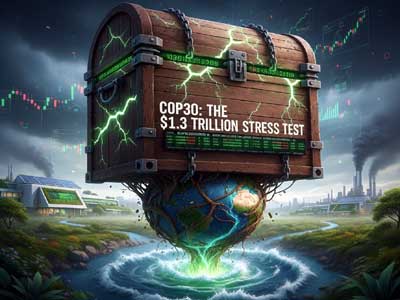
As the world’s climate clock ticks ever louder, all eyes turn to Belém, Brazil — gateway to the Amazon and host to the much-anticipated COP30 summit. In his commentary, Krishan Gopal Sharma steers us through the drama unfolding at COP30: from Brazil’s ambitious Tropical Forest Forever Facility making headlines, to the ongoing tug-of-war between development funding, political divides, and the growing assertiveness of the Global South. Sharma’s analysis brings us face-to-face with the summit’s real stakes—will fiery speeches finally give way to funding that matters? Is climate justice still a rallying cry, or are we inching closer to making it a reality?
Amazon COP30: The $1.3 Trillion Stress Test
KRISHAN GOPAL SHARMA
The COP30 summit in Belém, Brazil, marks a decisive shift from pledges to implementation. At its heart are two transformative initiatives: the Baku-to-Belém Roadmap, which aims to mobilise $1.3 trillion annually in climate finance by 2035, and Brazil’s launch of the Tropical Forest Forever Facility (TFFF), a permanent mechanism to fund nature conservation. The summit is shaped by a widening finance divide, with developing nations demanding grants over loans, and growing frustration over the United States’ federal disengagement. Success hinges on finalising adaptation metrics and forging a credible framework to close the emissions gap and fund the global transition.
The Reckoning in Belem
Running from 10 to 21 November 2025, COP30 is hosted in Belém—the humid, vibrant gateway to the Amazon rainforest. With the planet nearing the 1.5°C warming threshold, UN Secretary-General António Guterres has called for a “decade of acceleration and delivery.” Brazil’s decision to host the summit on the rainforest’s doorstep is a strategic move, placing forests, biodiversity, and Indigenous rights at the centre of global climate negotiations.
Brazil’s Flagship: The Tropical Forest Forever Facility
Brazil’s most significant contribution is the launch of the Tropical Forest Forever Facility (TFFF), a permanent, results-based investment model for forest conservation. The TFFF aims to build a $125 billion endowment fund—$10 billion from public sponsors and $115 billion from private capital. Initial pledges total $5.5 billion, with support from 53 countries. Annual investment returns will reward tropical nations for keeping forests intact, reversing the economic logic that often favours deforestation. Notably, at least 20% of payments are earmarked for Indigenous Peoples and Local Communities (IPLCs), the proven stewards of forest ecosystems.
The Political Divide: A Tale of Two Americas
The United States’ presence at COP30 reveals a stark contradiction:
Federal Hostility: The US Federal Government has sent no high-level delegation and has withdrawn from the Paris Agreement once again. This undermines global trust and multilateral cooperation.
Subnational Leadership: In contrast, a robust coalition of US governors, mayors, and business leaders under the banner “America Is All In” is present in Belém, affirming that market forces and local action are driving irreversible climate progress.
Global South vs Developed World
The Global South, including major economies like India, is united in its call for climate justice. Their demands include a shift from loans to grants and accelerated technology transfer. They argue that the true cost of climate action and resilience requires finance at a trillion-dollar scale. Meanwhile, developed nations are focused on finalising rules for global carbon markets (Article 6.4) and delivering on long-promised adaptation finance and the Loss and Damage Fund.
The Finance Faultline
Climate finance remains the summit’s most contentious issue. The Loss and Damage Fund is critically underfunded, despite escalating climate disasters. Current national climate plans (NDCs) are insufficient, placing the world on a trajectory far from the 1.5°C goal. A robust Ambition Framework is essential to compel countries to enhance their 2035 targets.
The Baku-to-Belém Roadmap: Mobilising $1.3 Trillion
Jointly developed by COP29 (Azerbaijan) and COP30 (Brazil), the Baku-to-Belém Roadmap sets an aspirational target of $1.3 trillion annually by 2035 for developing countries. It introduces five integrated action fronts—the 5Rs:
1. Replenishing: Increase public finance quality and volume, especially grants and concessional funding.
2. Rebalancing: Embed climate-resilient debt clauses (CRDCs) to offer fiscal relief during disasters.
3. Rechanneling: Reform multilateral development banks to de-risk private finance and lower capital costs.
4. Revamping: Build institutional capacity in developing nations to manage large-scale climate portfolios.
5. Reshaping: Advocate systemic reforms, including taxes on fossil fuel profits and financial transactions.
The roadmap’s strength lies in its short-term action steps for 2026–2028, shifting the debate from intention to execution.
What Belém Must Deliver
COP30’s credibility depends on tangible outcomes:
• Adaptation Metrics: Finalise indicators for the Global Goal on Adaptation and secure high-value finance.
• Nature Finance: Capitalise the TFFF and validate performance-based forest protection.
• Finance Framework: Embed the Baku-to-Belém Roadmap into COP30’s final decision.
• Fossil Fuel Transition: Advance COP28’s phase-out language through a Belém Action Mechanism for a Just Transition.
Conclusion
The imperative from Belém is clear: the technology and targets are in place. What remains is political courage and financial justice. COP30 must prove that implementation is not just possible—but inevitable.
********
The writer is a retired officer of the Indian Information Service and a former Editor-in-Charge of DD News and AIR News (Akashvani), India’s national broadcasters. He has also served as an international media consultant with UNICEF Nigeria and contributes regularly to various publications.
(Views are personal.)


