
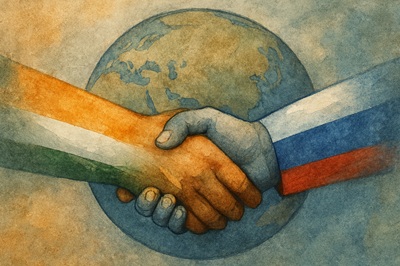
President Vladimir Putin’s recent visit to India has naturally stirred debate on the balance of gains between Moscow and New Delhi. In this article, K.G. Sharma examines various aspects of the visit and concludes that India got a boost in defence and energy sectors whereas Russia earned legitimacy and showcased defiance of Western sanctions.
Beyond Optics: Indo-Russia Ties
Krishan Gopal Sharma
Introduction: A Summit Under Scrutiny
President Vladimir Putin’s December 2025 visit to India was billed as a reaffirmation of the “special and privileged strategic partnership” between Moscow and New Delhi. Yet the balance sheet of gains and optics suggests Russia walked away with more tangible advantages than India. For New Delhi, the summit delivered incremental advances in defence and logistics, while for Moscow it was a showcase of resilience, legitimacy, and defiance of Western sanctions. The visit reverberated across Asia‑Pacific security, BRICS dynamics, and global diplomacy, raising questions about alignments and India’s tightrope walk between Russia and the West.
India’s Calculated Gains: Incremental, Not Transformative
India’s most concrete achievement was the signing of the Reciprocal Exchange of Logistics Agreement (RELOS), granting reciprocal access to military bases for supplies and repairs. This enhances India’s operational reach, particularly in the Indian Ocean, where logistical depth is critical to counterbalance China’s expanding naval presence. Progress was also noted on leasing another nuclear‑powered submarine, sustaining deliveries of the S‑400 air defence system, and discussions on advanced technologies such as the S‑500. Energy assurances, including discounted Russian crude and expanded civil nuclear cooperation, reinforced India’s energy security at a time when global markets remain volatile.
Yet these gains were evolutionary rather than revolutionary. Defence deals remain in negotiation stages, energy imports continue existing arrangements, and diversification of trade beyond oil and defence was limited. Domestically, criticism arose over the government’s decision not to invite Opposition leaders to the state dinner with Putin, which was seen as undermining democratic inclusivity and projecting centralised control. For India, the optics of exclusion mattered almost as much as the substance of agreements, raising questions about how its diplomacy is perceived abroad.
Russia’s Strategic Windfall: Legitimacy and Lifelines
For Moscow, the visit was a diplomatic and economic triumph. Being hosted in New Delhi despite an ICC warrant gave Putin legitimacy at a time of Western isolation. Agreements on rupee–ruble settlements offered alternative financial channels to bypass sanctions, while expanded oil and nuclear cooperation reinforced Russia’s economic resilience. Just as importantly, Russia diversified beyond China, signalling that it retains influential partners in Asia and is not wholly dependent on Beijing.
The optics of being welcomed in India were as important as the deals themselves. For Russia, the summit demonstrated that Western sanctions cannot fully dictate global diplomacy. It showcased Moscow’s ability to maintain strategic partnerships in Asia, strengthening its bargaining power globally and reminding the West that isolation is never absolute.
Global Optics: Unease in Western Capitals
Western capitals reacted sharply. Washington and Brussels argued that India was undermining sanctions by deepening ties with Moscow, particularly through oil imports and defence deals. Concerns were raised about India’s ability to maintain interoperability with Western partners in the Indo‑Pacific. The absence of Opposition voices at the state dinner was noted internationally as symbolic of India’s increasingly centralised diplomacy, raising questions about pluralism in its foreign policy.
For the West, the visit was a reminder of the limits of its influence. India’s insistence on strategic autonomy complicates Western efforts to build a cohesive Indo‑Pacific alignment. While Washington continues to court New Delhi as a partner in the Quad, the summit underscored that India will not be drawn into binary choices between Russia and the West.
Asia‑Pacific Security: A More Complex Chessboard
The visit reshaped the regional security environment. Russia’s support strengthened India’s deterrence posture against China and Pakistan, complicating Beijing’s calculations along contested borders and in the Indian Ocean. For Washington and its allies, India’s refusal to align fully with the West added complexity to Indo‑Pacific strategies, positioning New Delhi as a swing power capable of tilting balances.
China’s reaction was muted but uneasy. Analysts in Beijing worried that Russian defence support could embolden India’s military posture along contested borders. Social media commentary questioned Moscow’s motives in offering India advanced systems. Closer Russia–India ties may prevent Moscow from becoming overly dependent on Beijing, preserving multipolarity. Officially muted, China’s response nonetheless betrayed unease.
BRICS Fault Lines: Diversity Over Unity
Within BRICS, the visit highlighted diversity rather than unity. Russia and China often align against the West, but India’s independent trajectory underscored fault lines. The summit may strengthen BRICS as a platform for alternative financial mechanisms, yet it also exposed the limits of cohesion. India’s balancing act contrasts with China’s confrontational stance, suggesting BRICS will remain a diverse coalition rather than a unified bloc.
Trade Relations and Realignment with the US
On trade, the summit reinforced India’s reliance on discounted Russian oil and nuclear cooperation, but did little to diversify commerce beyond energy and defence. For Russia, however, it cemented alternative channels to bypass sanctions and showcased resilience.
India’s balancing act with the United States becomes more delicate. Washington is likely to intensify pressure on New Delhi to reduce Russian imports and defence ties, even as it continues to court India as a strategic partner in the Indo‑Pacific. The visit therefore complicates India’s realignment with the US, forcing it to manage competing expectations while asserting autonomy.
Challenges Ahead: Risks of Autonomy
India faces several challenges in the aftermath of the visit. Secondary sanctions remain a risk, supply chain vulnerabilities could disrupt defence deliveries, and reputational costs may strain relations with Western allies. Overreliance on Russian systems could limit India’s ability to integrate with Western technology, undermining interoperability in the Indo‑Pacific. At the same time, India must accelerate indigenous defence production to reduce external dependence.
For Russia, the challenge lies in sustaining its commitments under sanctions. Delivery delays and financial constraints could undermine its reliability as a supplier. Yet the diplomatic legitimacy gained in New Delhi strengthens Moscow’s hand in global negotiations, giving it leverage in both Eurasia and Asia‑Pacific theatres.
Conclusion: Autonomy with Consequences
Putin’s visit to New Delhi was both symbolic and strategic. It reaffirms a long‑standing partnership, tests India’s diplomatic balancing skills, and reflects the emergence of a multi‑polar world where countries like India assert greater independence in shaping global outcomes. The Asia‑Pacific grows more complex, BRICS remains diverse, and China watches warily.
India gained operational depth and energy assurances, but Russia walked away with legitimacy, economic lifelines, and proof that sanctions cannot isolate it. The summit is a reminder that autonomy carries risks, but also the promise of shaping the future global order on one’s own terms.
***********


We are trying to create a platform where our readers will find a place to have their say on the subjects ranging from socio-political to culture and society. We do have our own views on politics and society but we expect friends from all shades-from moderate left to moderate right-to join the conversation. However, our only expectation would be that our contributors should have an abiding faith in the Constitution and in its basic tenets like freedom of speech, secularism and equality. We hope that this platform will continue to evolve and will help us understand the challenges of our fast changing times better and our role in these times.
About us | Privacy Policy | Legal Disclaimer | Contact us | Advertise with us