
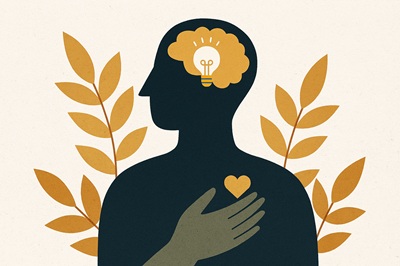
What does it mean to be an 'evolved' human being? In everyday life, we often measure progress by material success, social status, or adherence to tradition. Yet thinkers across centuries—from Buddha and Socrates to Gandhi and Einstein—have reminded us that true growth lies elsewhere: in clarity of thoughts, courage of conviction, and compassion in action. In his philosophical essay, K.G. Sharma invites us to look at human evolution not as a distant biological process but as something lived daily. For the common reader, the message is simple but profound: evolution is not about rituals or labels, but about the quality of our consciousness.
Evolving Consciousness: The Measure of a Human Being.
Krishan Gopal Sharma
In an age overflowing with information and crowded with competing authorities, the question of what defines an evolved human being carries renewed urgency. Across centuries, thinkers and reformers have challenged inherited dogmas and social hierarchies, insisting that growth lies not in ritual or obedience but in the clarity, courage, and compassion with which individuals conduct their lives. This essay brings those strands together—philosophical, psychological, historical, and contemporary—to explore human evolution as a practical, lived endeavour rather than an abstract concept.
Consciousness as Practical Evolution
Biological evolution unfolds over millennia, but the evolution of consciousness occurs in the choices individuals make daily. It does not hinge on belief versus unbelief, or religious versus secular identity. Rather, it is reflected in autonomy of thought, moral courage, empathy, and the willingness to examine one’s assumptions.
Einstein’s invitation to become “a person of value” captures this shift. Human worth is not determined by inherited ideology or status but by how responsibly and reflectively one engages with the world. Despite cultural differences, moral traditions converge on shared principles—compassion, justice, integrity, and respect for human dignity. Figures such as Buddha, Jesus, Nanak, Muhammad, and Ambedkar all appealed to the ethical self, urging societies to look beyond ritualism and hierarchy.
Yet institutional structures often restrain these ideals. Ritual, while meaningful, has frequently been used to enforce conformity. Voltaire’s caution that believing absurdities can lead to committing atrocities explains how authority, when left unexamined, can override conscience and halt moral development.
Authority, Autonomy, and the Human Mind
Human beings naturally seek belonging and certainty, and authority offers both. Psychological studies reinforce this point: Milgram’s obedience experiment revealed how far people can go when instructed by authority, while Asch’s conformity research exposed the pressure to align with majority opinion even against personal judgment.
Critical inquiry, scepticism, and ethical reflection counterbalance these tendencies. They cultivate autonomy rather than rebellion for its own sake. Bertrand Russell’s idea of a life “inspired by love and guided by knowledge” emphasises that evolution depends on conscious engagement, not on whether a person is religious or sceptical. Belief can deepen ethical commitment, and unbelief does not guarantee moral clarity. What matters is the degree of reflection with which choices are made.
Contemporary examples show this duality. Many faith-based activists champion gender equality, environmental protection, and social justice, working from within their traditions. Conversely, secular ideologies can also harden into dogma when dissent is discouraged. The issue, therefore, is never belief itself but the relationship between conscience and authority.
A Long History of Challenging the Unexamined
Societies evolve when individuals are willing to question entrenched structures. Buddha resisted ritualised Brahminism, Jesus confronted rigid legalism, Nanak opposed caste, Muhammad challenged Meccan elites, and Ambedkar dismantled social discrimination. Their struggles were expressions of intellectual and moral autonomy rather than theological rivalry.
Socrates’ insistence that “the unexamined life is not worth living” remains a touchstone for conscious progress. Today’s equivalents can be found in activists addressing inequality, scientists countering misinformation, whistle-blowers resisting corruption, and ordinary citizens insisting on accountability. Each embodies the principle that evolution is less about belief and more about responsible awareness.
Signs of an Evolving Human Being
An evolved human being demonstrates independence of mind without arrogance, empathy without condescension, and the courage to act ethically even when such action is costly. They are alert to bias—their own and others’—and are aware of how institutions, norms, and peer pressure shape behaviour.
Moral evolution lies in embracing values that transcend tribe or identity: truth, justice, compassion, and fairness. Gandhi’s reminder to “be the change” expresses this ethos: evolution is practice, not proclamation. It appears in how people treat strangers, how they respond to injustice, and how they reconcile their convictions with evidence and empathy.
Faith can nurture this growth; scepticism can too. Neither guarantees virtue. What distinguishes an evolved human is reflective ethical consciousness: choosing what is right not out of fear, habit, or inherited command, but out of understanding.
Conclusion
An evolved human being is not defined by the rituals they observe, the doctrines they inherit, or the metaphysical labels they claim. Evolution reveals itself in the quality of one’s consciousness—clarity of thought, courage of conviction, empathy in action, and the capacity to question without hostility.
Aristotle’s conviction that the essence of life lies in doing good and serving others remains a fitting guide. Conscious evolution unfolds moment by moment, in choices that affirm dignity, justice, and truth. By engaging life with awareness and integrity, each person contributes to the slow, deliberate shaping of a humane and reflective society.
**********


We are trying to create a platform where our readers will find a place to have their say on the subjects ranging from socio-political to culture and society. We do have our own views on politics and society but we expect friends from all shades-from moderate left to moderate right-to join the conversation. However, our only expectation would be that our contributors should have an abiding faith in the Constitution and in its basic tenets like freedom of speech, secularism and equality. We hope that this platform will continue to evolve and will help us understand the challenges of our fast changing times better and our role in these times.
About us | Privacy Policy | Legal Disclaimer | Contact us | Advertise with us