
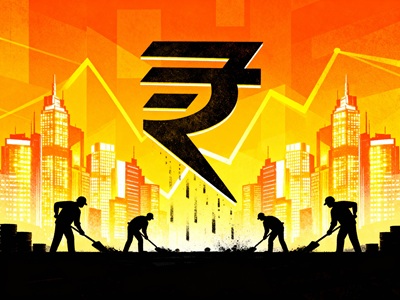
K.G. Sharma in this article on the current state of the Indian economy highlights serious loopholes in the government's rosy portrayal. Income inequalities and a dismal job situation challenge claims of a robust economy.
The Paradox of Prosperity: Why India’s Growth Story Doesn't Add Up for Everyone
KRISHAN GOPAL SHARMA
India today presents a confusing picture of its economic standing: a confident government celebrating its status as the world's fastest-growing major economy, promising third-largest status by 2030. These headlines look great, with national growth rates soaring past 7%. Yet, for the average citizen, this 'prosperity' feels distant. Experts at home and abroad point to serious cracks—a lack of transparency in official figures, a flawed growth model, and a job market that isn't delivering. This article explores the unsettling gap between the government's grand claims and the tough reality facing most Indians.
The Job Myth: Growth Without Real Jobs
The government loves to talk about the total size of the economy (the Gross Domestic Product, or GDP), aiming for the $5 trillion mark. But the experts argue that the size of economy isn't everything. A country's wealth matters less if it isn't shared. India remains one of the poorest countries in the G20 when you look at GDP per person—the real measure of average wealth.
Worse, the growth we are seeing is often "jobless growth." The official numbers say unemployment is low. However, this is misleading. Why? Because the increase in work isn't in stable, well-paid formal jobs; it’s mostly in the self-employed category. Official surveys show that almost 6 out of every 10 Indian workers now fall into this category. This doesn't mean they are running successful startups; for many, it means selling small goods on the roadside or doing odd jobs—a fragile livelihood of last resort, not a ladder to prosperity. The economic engine is running fast, but it’s not creating enough good seats for its massive, young population.
The Skill Trap: Training Schemes That Fail
Compounding the lack of quality jobs is a fundamental problem with how we train our youth. India has a massive "skill gap": the skills workers have don't match what modern businesses actually need. Even successful government training programmes struggle to make a real difference.
Take the apprenticeship schemes meant to give young people on-the-job training. These programmes often fail to scale up or provide quality instruction. Instead of offering structured career paths, many small businesses use them simply as a way to get cheap, temporary labour. The hard facts are alarming: the International Labour Organization (ILO) reported that 83% of the unemployed workforce in India are young people. When those with university degrees can't find appropriate work, it confirms that the system is failing to convert diplomas into genuine, productive employment.
The Credibility Gap: Why We Can’t Trust the Numbers
A major international concern, which hurts India’s global standing, is the lack of trust in its official economic data. The numbers that track our growth are being questioned.
The International Monetary Fund (IMF), the world’s financial watchdog, gave India’s primary statistics system a low 'C' grade. They pointed out problems like using outdated methods (like a decade-old "base year" for calculating GDP) and having "sizeable discrepancies"—meaning the way India measures total national production doesn't quite match the way it measures total national spending. It’s like using a broken speedometer and two different scales to weigh the economy, and the two readings don't agree.
This distrust is amplified when the government makes controversial decisions, such as refusing to release a key national survey on consumer spending from 2017-18, reportedly because its findings showed people were spending less. When officials seem to hide bad news, it raises a "credibility gap" that harms long-term confidence.
The Way Forward: Trading Narrative for Reform
India’s true potential is undeniable, but its future success is not guaranteed. It hinges on leaders' willingness to move beyond grand political narratives and commit to difficult structural reforms.
We need to stop focusing solely on building bigger roads and start focusing on building a better labour market. This means genuinely simplifying rules for small and medium businesses to encourage formal hiring, massively improving vocational training quality, and—most importantly—ensuring total transparency in economic progress measurement. True success won't be a specific GDP ranking but sustained, strong growth translating directly into higher incomes and stable, quality jobs for all 1.4 billion Indians.
*************


We are trying to create a platform where our readers will find a place to have their say on the subjects ranging from socio-political to culture and society. We do have our own views on politics and society but we expect friends from all shades-from moderate left to moderate right-to join the conversation. However, our only expectation would be that our contributors should have an abiding faith in the Constitution and in its basic tenets like freedom of speech, secularism and equality. We hope that this platform will continue to evolve and will help us understand the challenges of our fast changing times better and our role in these times.
About us | Privacy Policy | Legal Disclaimer | Contact us | Advertise with us