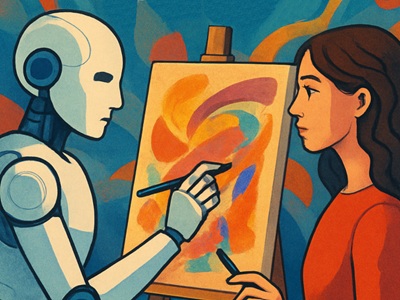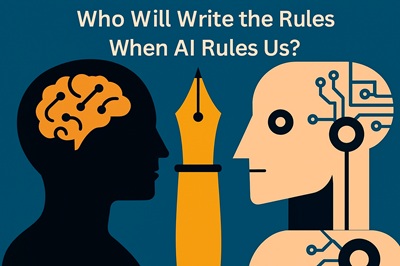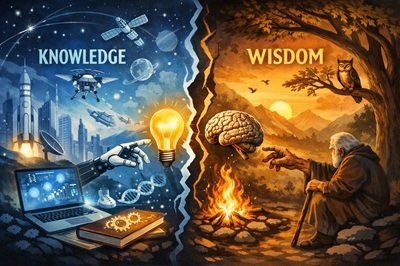
K.G. Sharma is a versatile writer. Not very long ago, he wrote two pieces for us—The Rogue AI Myth: Why Artificial Intelligence Cannot Simply Go Rogue (Link) and Digital Hypnosis: Weaponisation of Conformity by Social Media (Link). In today’s article, he takes up another big question: whether advances in knowledge really bring advances in wisdom, as he notes at the end of his essay. If you haven’t read his earlier two articles, it’s worth taking a quick look at all three in sequence. You’ll also find some other notable writings on this subject in the “May Also Read” section below.
The Polished Savage: Why Modern Progress is Prehistory with Wi-Fi
Krishan Gopal Sharma
"The civilized man has built a coach, but has lost the use of his feet."
— Ralph Waldo Emerson
"We have Paleolithic emotions, medieval institutions, and god-like technology."
— Edward O. Wilson
The Persistent Myth of the Upgraded Human
Open a newspaper, browse a news website, or scroll through your morning feed. The headlines speak of artificial intelligence, climate negotiations, quantum computing, space exploration and global financial markets. Humanity appears to be advancing at breathtaking speed. We have mapped the human genome, built machines capable of learning, and placed probes at the edge of the solar system. The story we tell ourselves is straightforward: we have left our primitive past behind.
It is an appealing story. It is also incomplete. The assumption underlying much of modern discourse is that technological progress and human progress are essentially the same thing. Because our tools have become more sophisticated, we assume that we have become more sophisticated as well. Yet a closer look at politics, economics, culture and technology suggests something rather different. Our inventions have evolved dramatically, but the instincts guiding their use remain surprisingly familiar.
The emotions that animated our distant ancestors—fear, ambition, tribal loyalty, status-seeking, competition and the desire for security—continue to shape the modern world. They now operate through institutions, markets and digital networks rather than through clans and campfires, but their influence remains unmistakable.
This is not an argument against progress. Human achievements in science, medicine and technology are extraordinary. Average life expectancy has increased. Child mortality has fallen. Knowledge has expanded beyond anything previous generations could have imagined. Yet progress in capability should not be confused with progress in character. The central question of our age may not be how advanced our technology has become, but whether our emotional and moral development has kept pace with it. The modern human often resembles a prehistoric mind operating extraordinarily sophisticated machinery.
I. Diplomacy: Tribal Instincts in Tailored Suits
International affairs are frequently presented as the triumph of rational statecraft. Summits, treaties and strategic dialogues appear to represent humanity's escape from the raw contests of earlier eras. Yet beneath the language of diplomacy, familiar patterns emerge.
Throughout history, groups have sought security, influence and resources. Ancient tribes defended territory, formed alliances and viewed outsiders with suspicion. Modern nation-states pursue remarkably similar objectives, albeit through far more elaborate mechanisms.
What is often called a "sphere of influence" differs in form from tribal territory but not entirely in function. Powerful nations still seek buffers, strategic advantages and regional dominance. Alliances remain essential because the fear of vulnerability remains deeply embedded in human behaviour.
The language has changed. The instincts have not disappeared.
Military deployments, economic sanctions and geopolitical rivalries are frequently framed as matters of principle or security. Sometimes they are. Yet they are also expressions of a timeless concern: ensuring that one's group remains protected and influential in an uncertain world. International law has undoubtedly reduced conflict and established important norms. Nevertheless, its effectiveness often depends upon political will and the balance of power. The uncomfortable reality is that principles and power continue to coexist, just as they always have.
The ancient fear of the outsider has not vanished either. It now appears in debates about national identity, migration, ideology and cultural influence. We have developed more sophisticated language to discuss these anxieties, but the underlying emotions remain recognisably human. The cave walls have been replaced by national borders. The psychology is often much the same.
II. Markets: The Mammoth Hunt Goes Digital
Few institutions are portrayed as more rational than modern financial markets. They are presented as systems governed by data, models and analytical precision.
Yet markets are also theatres of human emotion. Behavioural economists have spent decades demonstrating that investors are not purely rational actors. Fear, greed, optimism, panic and herd behaviour influence decisions as much as spreadsheets and forecasts.
The prehistoric hunter worried about survival during the next harsh season. The modern investor worries about economic downturns, inflation, market crashes and financial insecurity. The context has changed, but the underlying concern remains familiar: uncertainty about the future. This perspective helps explain one of the most puzzling features of modern capitalism—the relentless pursuit of accumulation.
From a strictly practical standpoint, there is little reason for individuals who possess immense wealth to continue pursuing ever greater fortunes. Yet accumulation frequently becomes an end in itself. Evolutionary psychology offers one explanation. For most of human history, resources were scarce and unpredictable. Those who secured more resources generally enjoyed greater security and status. Our brains evolved in conditions where abundance was temporary and uncertainty was permanent.
Today, digital wealth can accumulate on a scale unimaginable to our ancestors. Yet the emotional machinery responding to that wealth remains rooted in a world where survival was never guaranteed.
The result is a paradox of modern prosperity. Societies become wealthier, but anxieties about status and scarcity often persist. Material conditions improve, while the psychological race continues unabated. The mammoth hunt never truly ended. It simply migrated to trading floors, boardrooms and investment portfolios.
III. Technology: The New Priesthood of the Information Age
Nothing symbolises modern confidence more than technology. Artificial intelligence, machine learning, biotechnology and quantum computing are frequently presented as evidence that humanity has finally transcended the limitations of its past. Science has unquestionably transformed civilisation. Yet the social dynamics surrounding technology reveal some striking continuities with earlier forms of belief.
Every society develops trusted interpreters of complexity. In ancient communities, shamans, priests and mystics explained forces that ordinary people could not fully understand. Today, technologists, engineers and data scientists often occupy a comparable social position. They interpret systems whose inner workings remain opaque to most citizens.
The comparison should not be taken literally. Scientific knowledge is fundamentally different from superstition because it relies upon evidence, testing and revision. The distinction is crucial. Yet the public relationship with technology often resembles a form of faith.
Most users cannot explain how a search engine ranks information, how a neural network generates responses or how an algorithm shapes the content they see online. They simply trust the outputs. Technology becomes a source of reassurance, guidance and authority. The modern screen can sometimes function psychologically as the ancient oracle once did.
When uncertainty increases, people look for systems that promise clarity. When complexity becomes overwhelming, they seek trusted interpreters. Human beings have always searched for certainty in a confusing world. The tools have changed dramatically. The emotional need they serve remains remarkably consistent.
IV. Soft Power: The Globalisation of the Campfire
Power is not exercised solely through armies or markets. It is also exercised through stories, symbols and aspirations.
Throughout history, successful groups attracted others through culture as much as through force. Songs, rituals, myths and traditions reinforced identity and projected influence beyond immediate borders.
Modern societies do the same on a vastly larger scale. Films, music, fashion, sports, consumer brands and digital platforms travel across continents with extraordinary speed. They shape perceptions, preferences and aspirations. What scholars call "soft power" often operates through attraction rather than coercion. This is one of the defining features of contemporary globalisation. When people around the world consume the same entertainment, wear the same brands or participate in the same digital culture, they are not merely making individual choices. They are engaging with systems of influence that shape how they understand success, identity and belonging.
The dominant cultures of any era enjoy a powerful advantage: they help define what others aspire to become. This process is not inherently sinister. Cultural exchange has enriched human civilisation for centuries. Yet it does reveal another enduring aspect of human behaviour. People seek belonging. They imitate admired groups. They gravitate towards symbols associated with prestige and success. The campfire has become global, but the desire to gather around it remains ancient.
Conclusion: Progress and the Primitive Mind
The story of humanity is neither one of uninterrupted progress nor one of permanent stagnation. It is more complicated than either extreme. We have achieved remarkable advances in science, medicine, communication and knowledge. These achievements deserve recognition and celebration. To deny them would be both inaccurate and ungrateful. Yet it would be equally mistaken to assume that technological sophistication has transformed human nature. The same species that developed vaccines, satellites and artificial intelligence continues to struggle with fear, tribalism, status competition and short-term thinking. Our capacity for innovation has expanded faster than our capacity for wisdom.
This tension may be the defining challenge of the twenty-first century. For the first time in history, a species shaped by prehistoric evolutionary pressures possesses tools capable of altering planetary systems, editing genomes and potentially creating forms of intelligence beyond itself.
The question is no longer whether we can build increasingly powerful technologies. We clearly can. The more important question is whether the minds directing those technologies are evolving quickly enough to use them wisely. Perhaps the central drama of modern civilisation is not the conflict between humanity and technology. It is the conflict between our astonishing inventions and the ancient instincts that continue to govern their use. The future may ultimately depend on which of the two develops faster.
Author's Note
This essay is not an argument against science, technology or human achievement. On the contrary, it recognises their extraordinary value. Its purpose is to challenge a common assumption: that advances in knowledge automatically produce advances in wisdom. History suggests otherwise. Human beings are capable of breathtaking creativity and remarkable destruction, often at the same time. Our tools evolve rapidly; our instincts evolve slowly. Understanding that tension may be one of the first steps towards managing it.
For all our satellites, algorithms and global networks, we remain recognisably human—still seeking security, status, belonging and meaning, much as our ancestors did around distant campfires.
The polished surface of civilisation is real. So is the ancient creature beneath it. The challenge of our age is not to deny either reality, but to learn how to reconcile them.
*************

The writer is a retired officer of the Indian Information Service and a former Editor-in-Charge of India’s national broadcasters. Also worked as an international media consultant with UNICEF Nigeria and contributes regularly to various publications. kgsharma1@gmail.com; Mobile: 9811340809:
(Views are personal)

We are trying to create a platform where our readers will find a place to have their say on the subjects ranging from socio-political to culture and society. We do have our own views on politics and society but we expect friends from all shades-from moderate left to moderate right-to join the conversation. However, our only expectation would be that our contributors should have an abiding faith in the Constitution and in its basic tenets like freedom of speech, secularism and equality. We hope that this platform will continue to evolve and will help us understand the challenges of our fast changing times better and our role in these times.
About us | Privacy Policy | Legal Disclaimer | Contact us | Advertise with us