
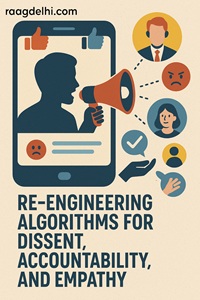
K. G. Sharma’s article on social media’s impact on core democratic values argues that these platforms exploit psychological mechanisms—proven by Stanley Milgram, Solomon Asch, and Philip Zimbardo—to manipulate users systematically. They manufacture consensus and fuel mass digital hostility, painting a dismal picture in this post-truth era. One wonders how truth might prevail and how values like dissent, accountability, and empathy can endure. Yet Sharma, perhaps simplistically, offers a fresh framework for ethical AI intervention: re-engineering algorithms to actively foster user dissent, accountability, and empathy.
Digital Hypnosis: Weaponisation of Conformity by Social Media
Krishan Gopal Sharma
The Unsettling Legacy of the Lab
The modern digital landscape, governed by powerful and often opaque algorithms, has unwittingly created the largest, most pervasive psychological laboratory in human history. While social media promises connection, its very architecture is engineered to exploit the fundamental human need for acceptance and obedience—vulnerabilities that were first uncovered in the controlled, often controversial, experiments of the mid-20th century. This convergence of ancient human psychology and cutting-edge technology presents a profound ethical challenge: how do we prevent platforms from becoming a lethal psychological weapon in the hands of those seeking to manipulate minds and manufacture chaos?
The Three Pillars of Digital Compliance
The mechanisms of digital manipulation are rooted in three foundational insights into social influence: conformity, obedience, and role-play.
1. Weaponised Conformity: The Asch Effect
In the 1950s, Polish-American psychologist Solomon Asch conducted his seminal conformity research, demonstrating that individuals would readily deny the evidence of their own senses to align with a unanimous majority of peers. Asch found that 75% of participants conformed at least once when faced with a group giving a clearly wrong answer to a simple visual test.
Social media weaponises this finding by creating an artificial state of unanimity far more compelling than Asch’s small group of confederates. The algorithm crafts the ultimate Echo Chamber, systematically filtering out any dissenting views from a user's feed. This lack of visible opposition instantly validates extreme beliefs, transforming them into perceived universal truths and intensifying Informational Social Influence—the belief that the group must be correct. Furthermore, the relentless pursuit of engagement metrics (likes, shares) acts as an intense form of Normative Social Influence, conditioning users to adjust their behaviour and beliefs to secure constant social acceptance, thereby normalising misinformation and suppressing critical inquiry.
2. Remote Obedience: The Milgram Principle
In the early 1960s, American psychologist Stanley Milgram conducted his notorious obedience experiments at Yale, demonstrating that ordinary people would inflict severe, seemingly harmful electric shocks when instructed to do so by an authoritative figure in a lab coat. Milgram's core finding was that 65% of participants administered the maximum shock, having entered an "agentic state" where they relinquished moral responsibility to the authority.
In the digital realm, influencers, high-profile accounts, and political leaders assume the role of the "Experimenter." Their verification checks and massive follower counts function as a digital uniform, signalling unquestionable authority. When these figures issue direct commands—to "go after" a target or "spread" a narrative—followers enter a digital agentic state, acting as agents of the authority. The distance afforded by the screen and the anonymity of the crowd provide a powerful psychological buffer, reducing accountability and enabling mass harassment and abuse that individuals would never commit face-to-face.
3. The Power of Role and Dehumanisation: The Zimbardo Effect
The final piece of the puzzle is the power of social roles, as exposed by American psychologist Philip Zimbardo in the 1971 Stanford Prison Experiment (SPE). The SPE revealed how quickly and drastically normal individuals assigned powerful roles (Guard or Prisoner) internalise them, with Guards descending into abuse and Prisoners into learned helplessness.
Social media facilitates this effect through de-individuation. The use of avatars, handles, and partial anonymity obscures personal identity, reducing accountability and enabling users to adopt extreme, antagonistic roles—the "troll," the "militant defender." This mirrors the Zimbardo effect at scale. Furthermore, the ease with which platforms allow users to refer to opponents using generalised, derogatory labels (a form of digital dehumanisation) lowers the moral barrier to attack, ensuring that toxic tribalism and aggressive behaviours are sustained.
The Antidote: Reclaiming the Digital Commons
While this analysis of the situation is grim, providing the unsettling picture of "lambs to the wolves," the same psychological science offers a robust pathway for resistance. Humanity is not destined for total compliance; we are capable of dissent, as shown by French social psychologist Serge Moscovici's Minority Influence studies, which proved that an unwavering minority can shift majority opinion.
To reclaim the digital commons, we must deploy Ethical Artificial Intelligence as a tool for systematic psychological intervention, moving platform architecture away from profit-driven engagement towards Trust and Well-being Optimisation.
Engineering Resistance Through AI
1. Countering Unanimity with the AI Ally: To defeat the Asch Effect’s manufactured consensus, algorithms must be programmed to act as the Algorithmically Introduced Ally. Instead of filtering for alignment, the AI should be designed to strategically introduce credible, fact-checked counter-perspectives into a user’s feed. This intervention breaks the illusion of consensus and legitimises the individual’s private doubt, fostering critical thinking.
2. Challenging Digital Authority: To defeat the Milgram Effect’s remote obedience, systems must implement measures to challenge source legitimacy. AI should audit content origins and apply transparent labels detailing the source’s funding, political affiliations, or previous misinformation history. This provides the necessary contextual friction to prevent the immediate, unquestioning deference to digital authority.
3. Restoring Empathy and Accountability: To counter the Zimbardo Effect’s role adoption, platforms must introduce content friction and empathy prompts. Before a user can post hostile or dehumanising content, the system should mandate a brief delay paired with an ethical prompt. This intervention forces the user out of the state of de-individuation and back into conscious, moral contemplation, restoring individual accountability for their actions.
Conclusion
The principles revealed by Milgram, Asch, and Zimbardo are not just chapters in a psychology textbook; they are the governing rules of our most powerful modern communication tool. The danger lies in their current exploitation. However, the future is not pre-written. By choosing to embed the principles of dissent, accountability, and empathy into the very code that governs our digital lives, we possess the ability to disarm the lethal psychological weapon of social media and transform it into a force that promotes ethical autonomy and a more resilient, well-informed society. The fight for the mind of the digital citizen is not just a regulatory battle—it is a struggle for the preservation of independent thought.
*****************


We are trying to create a platform where our readers will find a place to have their say on the subjects ranging from socio-political to culture and society. We do have our own views on politics and society but we expect friends from all shades-from moderate left to moderate right-to join the conversation. However, our only expectation would be that our contributors should have an abiding faith in the Constitution and in its basic tenets like freedom of speech, secularism and equality. We hope that this platform will continue to evolve and will help us understand the challenges of our fast changing times better and our role in these times.
About us | Privacy Policy | Legal Disclaimer | Contact us | Advertise with us