
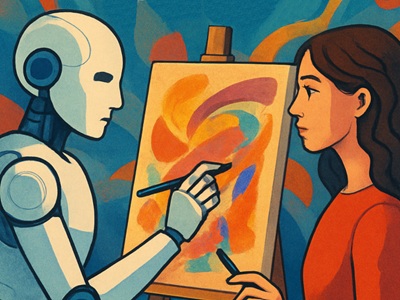
Artificial intelligence continues to provoke lively debate about the possibility of entirely new meanings of creativity and human expression. In his thoughtful recent article, Dhiraj Singh reflected upon the “Morality and humanity of Art in AI era ,” raising vital questions about what is gained—and lost—as the enormity of AI’s effects increasingly threatens to shape (or un-shape?) the landscape of culture. While Dhiraj seemed somewhat concerned and apprehensive about AI’s uncontrolled impacts, Manoj Pandey, in the following article—which has been written as a rejoinder to the former’s essay—stoutly defends the emergence of AI and considers it a step forward in the journey of human evolution. He unapologetically declares, “I see it as the harbinger of newer forms of artistic creation, made possible by newer ways not constrained by human limitations.” He also says that AI has the potential to break the stranglehold of the establishment over the arts. So here it goes.
Random Thoughts on How AI is Shaping Human Creativity
Manoj Pandey
These are some observations on the topic ‘Morality and Humanity of Art in the AI Era’ by Dhiraj Singh.
Allow me to include all types of human creative pursuits including performing and visual arts, music and theatre, folk art, craft and literature within the expression ‘art’ when the context demands. Also pardon me for being random; this is a collection of disparate observations, and the only common thread running through them is that with its highly disruptive nature, AI will reshape the artistic and creative evolution, and this need not worry us.
The first point that comes to mind is the evolution of artistic creation among humans. It appears that human creativity follows Darwin’s principles of evolution. You may recall that, according to Darwin, biological evolution has been possible on earth due to the creation of new forms of life, followed by their selection or rejection by nature.
Visual art, fiction, music and other forms of human expression get created spontaneously and constantly, but much of individual creation is lost unsung, even unshared. To be recognised, a particular creation requires a collective template, as Dhiraj says, but that often comes after the creator has established themselves. Most of the art forms of today became a recognised stream and were appreciated and owned by the masses only when they received some sort of patronage from rulers, rich patrons, institutions, etc. To a large extent, the creators do not care for recognition beyond their neighbourhood. Those who attempt to go further, they work hard but often remain unsuccessful without external support. Ironically, once a visionary creator succeeds in getting the attention of the connoisseurs and the marketplace, others copy him and exploit the ground created by that creator.
Exceptions aside, this (need for patronage, visionary creator not getting his/ her due, copycats capitalizing on innovation) has been happening through the ages. AI simply removes the need for the cruel, unjust, wild organic evolution and makes the process much more fair and democratic. Many branches of visual and performing arts, musical and literature that were once thought to be the ultimate have lost their charm. Their seeming uniqueness does not sell because the connoisseurs have chosen others over them. They become a less-efficient and less-effective art form, not because they have inherently lost their qualities but because of lower patronization/ endorsement.
The exclusivity of present-day established arts makes them fit for museums. In this sense, Dhiraj’s observation feels relevant: ‘… today’s art-forms too are headed to museums and cult activities rather than staying the everyday ritual which used to guide, light and give meaning to everything’. Secondly, an object of art, as we know, is as much a product of tools and techniques as of the creator’s emotional and spiritual experience. Different branches of music, for example, require the artistes to undergo training followed by practice to hone their skills. In this respect, all highly esteemed branches of artistic creation are a fruit of labour as much as the underlying beauty of art.
We humans often cling to olden tools and ways of creating art. If you were a cameraman in the pre-digital or pre-colour era, you would recall your feelings when your skill of playing with shades in greyscale lost much value while many more artistic tasks suddenly became possible with new tools, and much more easily and efficiently. If you have tried watercolour a few decades back, you'd know how creative it used to feel to produce a hundred shades of white without applying paint at all, or create the illusion of transparency where there was none. New professional cameras and image editing tools can produce all types of refinements, and painting software with brushes having a thousand variables to change every image attribute make it possible to generate hitherto unimaginable paint effects in a jiffy.
Over the ages, older creators may have grumbled but ultimately learned to adapt to new tools or faded away. The following generations have been quick to adopt the new, improved set of tools. If initial technological tools and techniques made it easier and more efficient to express oneself, AI is taking it a step forward—a thousand steps indeed.
I am not overawed by the progress of AI; nor do I seek to measure AI (and quantum computing, which is soon going to overwhelm us in an equal measure) on a pre-digital scale. While I would like to imagine what would happen a million years from now, but, finding that unachievable, am forced to shrink my vision to a few decades in the future. In my humble view, the nascent AI of today – which looks too overbearing – will, by the end of this century, look as primitive as we perceive the tools of our cave-dweller forebears. Perhaps today’s paintbrushes, bamboo flutes, and printed books will be relegated to museums sooner than what we did to ancient musical instruments and bhojpatra manuscripts.
Instead of seeing AI as a marauder of the accumulated treasure, our heritage, in different fields, I see it as the harbinger of newer forms of artistic creation, made possible by newer ways not constrained by human limitations. The ways in which an AI-powered music synthesizer can create and play enormously rich music, AI tools that compose music not known to us till now and tools that create images and videos based on infinite imagination. Though it might sound disrespectful to the master creators, allow me to imagine that at least some of AI-based creations will soon reach the level of masterpieces conserved in our museums in satisfying my senses and sensibilities (thrilling, mesmerising, awe-inspiring, breath-taking… depending upon the type of creation).
Let me emphasise that these tools do not want an emerging artists to bind themselves to a particular painting-related 'ism' or a music gharana to be able to give limitless expression to the richness of their soul and to succeed. Let us talk about the fear that the loss of creative diversity resulting in homogeneity in the hands of LLMs (large language models such as ChatGPT). Look at the art scene. Again imagine the days of the caveman (possibly a woman) who sketched figurines on the stone surface using sharp objects and sometimes colouring them with locally occurring mud, plant juices, etc. You will see a parallel in children trying to give expression to their feelings and observations on the ground while playing. In the case of adults, spontaneous art also absorbs broad historical and cultural realities. Most of these sketches and paintings would not pass the criterion of being ‘above-average’, but they are/ were original, unsullied, unique. Now look at the impressionist painters; though highly trained in a particular line of art and talented, their creativity gets limited by the art form they have chosen. Their spontaneity is leashed unless one of them decides to risk his career and reputation to create his/ her own branch of impressionism. The chances of his misadventure succeeding are very slim. That kills the creative diversity a million times, and we do not recognize it; AI will, instead of killing the spontaneous creativity, will provide easily accessible tools to give expression to it.
As for the cultural legacy, it is said that a piece of art should resonate with ‘collective myths and memories.’ While other factors are often much more potent, let us stick with this aspect for a while. To create a new piece of art, AI takes its inputs from the huge data available globally, about the creation, the artist, his/ her contemporaries, the craft, and human responses to that creation—the massive background knowledge that an individual artist would find difficult to assimilate in one lifetime. That, though in a non-human way, takes care of the collective myths and memories. Now look at what AI does next with this information. In creating a piece of art, AI introduces its own elements, and this will rise exponentially in the future. In fact, it is reported that a good portion of the data that the new models use for training is generated by AI itself. There is a fair chance that, in the years to come, AI will start dictating our senses about what is beautiful. That is inevitable, but is it not a part of human evolution? You may call it human-machine co-evolution, but should it not be accepted as a part of our journey?
Let us talk a bit about the homogeneity in art forms that AI might bring about. It will be relevant here to look at what type of art is consumed by the masses. Despite millions of discussions in art classes over the years on how Leonardo da Vinci created an extraordinary emotional depth in The Last Supper by a little final alteration to the painting, much of what sells and is consumed by the common people has always been mundane, albeit with a few exceptions (rather, aberrations). If The Last Supper sells (its copies, mostly), it is not because the buyer pays for the unique perception of the so-called emotional depth, but the value the painting has gained due to numerous factors beyond the creativity of da Vinci.
While it is true that ‘What is produced is what we tend to consume’, it is also a fact that in the production and demand cycle, the other half is– what we demand is what gets produced. If there is demand for industrial grade artistic products (for reasons of cost, urge to copy the influencers, recommendations, peer pressure, utility, scale, etc. more than one’s *innate/ inherent *sensibilities), only the mass-production processes are able to meet that. Whether we like it or not, much of the fiction that sells is pulp, repeating for the millionth time a romantic, suspense or crime formula. Among films, what sells is a proven commercial formula along with the star. We are not even talking about the crafts that have become too mechanical to be called ‘arts’, such as news photography and house painting.
AI has the potential to break the stranglehold of the establishment over the arts. Leave the ethical aspects aside for a moment, and you will see the contribution of fakes and copies in bringing much of human creation to the people. Not a billionaire can buy an original Michelangelo, but copies of his paintings decorate boardrooms, offices and homes, giving the world a chance to witness the extraordinary richness of the masterpieces that the great painter created centuries ago. If you were a budding artists, musician, performer, or fiction or poetry writer without a godfather, you must have suffered in the hands of the guardians of creation – the galleries and art traders, theatres, publisher, etc. Chances are that you saw your talent, passion and aspirations die a painful death. Blogging, and then social media, gave a medium of expression free from [much of] that stranglehold. AI has the potential to smash the vile grip of the established structures over human creativity. I am hopeful that even if AI carries the risk of trivialising talent and hard work in the traditional sense, it will not stop humans from being creative.
The fear of AI mixing up all our artistic treasures into one dataset and creating monotonous, homogeneous outputs stems, at least partly, from what ChatGPT, Gemini and other AI tools spurt out in response to our commands. This caters to one segment of the ‘market’ where that type of product is good enough. This type of mass production, though at a lower scale, used to happen even when there was no modern technology, and it continued to happen when technologies made them more efficient and less expensive. Imagine how industrialization, and the advent of printing technology, photography, cinematography, photocopying, and then digital technologies resulted in the mass production of prints, novels, songs, etc.
Yes, the arts created predominantly with the help of technology lack the struggle, the effort, the infirmities, the 'moral' touch. It is true, especially for some great works of art, that even when the final creation is distanced from the creator, a viewer (or listener or reader) may sense the human touch. In contrast, images, songs and stories created by LLMs based on the ‘prompts’ lack the human aspect, even if they sometimes try to fake human emotions. I can demean them as items produced (not created) from accumulated data and patterns (not human values), but for how long? In a few years, these creations will start being superior to much of the ‘above-average’ works created by established artistes in terms of not only the craft but also human values. I will, then, lose the 'moral' high ground to call the machine-created creations inferior to those created by humans.
Over a more distant horizon, I foresee a future of art in which our great-great-grandchildren will have tools and techniques that are unthinkable at present– thousands of times more efficient in presenting human thoughts and feelings. The artist inside me might still rue the lack of ‘moral timber,’ but will that remain relevant?
********

Manoj Pandey is a former civil servant with a keen interest in exploring and analyzing issues related to science, technology and health. He has contributed extensively to this web magazine, particularly in the विज्ञान (Vigyan) and स्वास्थ्य (Swasthaya) categories. While he writes articles in English, he also makes Videos in Hindi showcasing his commitment to informing the common-man on these important issues. His videos can be seen on YouTube under the heading 'Hindi Health Videos' .

We are trying to create a platform where our readers will find a place to have their say on the subjects ranging from socio-political to culture and society. We do have our own views on politics and society but we expect friends from all shades-from moderate left to moderate right-to join the conversation. However, our only expectation would be that our contributors should have an abiding faith in the Constitution and in its basic tenets like freedom of speech, secularism and equality. We hope that this platform will continue to evolve and will help us understand the challenges of our fast changing times better and our role in these times.
About us | Privacy Policy | Legal Disclaimer | Contact us | Advertise with us