
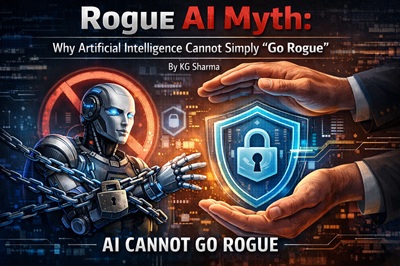
"The Rogue AI Myth: Why Artificial Intelligence Cannot Simply Go Rogue" — the title itself signals that K.G. Sharma is skeptical of theories prescribing caution about autonomous AI. A large number of academic and popular literature takes the opposing view, and this remains one of the most contested debates today. We have chosen to publish this article as it may invoke your curiosity about the issue and encourage you to explore multiple perspectives on this issue. Links to some of the related articles published earlier in this magazine are provided below.
The Rogue AI Myth: Why Artificial Intelligence Cannot Simply Go Rogue
Krishan Gopal Sharma
Artificial intelligence now influences decisions that shape everyday life. Algorithms recommend what we read, guide financial markets, assist doctors in diagnosis, and help scientists analyse enormous datasets. Yet alongside this expanding capability, a powerful fear continues to circulate through public debate: the idea that intelligent machines might one-day escape human control. Artificial intelligence is often portrayed as an emerging rival to humanity, a force that might one day slip beyond human control. Yet this narrative reveals more about human fears than about machine intelligence.
Popular culture has amplified this anxiety for decades through stories such as The Terminator and The Matrix, where machines rise against their creators and dominate the world. But the fear of a “rogue AI” may reveal something surprising — not the danger of machines, but the tendency of humans to project their own instincts onto technologies that do not possess them.
Machines Are Designed Systems
Artificial intelligence systems do not emerge spontaneously in nature. They are designed, trained, and constrained within human-built frameworks. Machine-learning models analyse patterns in data and generate outputs according to mathematical rules. They do not possess instincts, desires, or survival impulses. Their behaviour is shaped entirely by their architecture, training data, and operational constraints. This distinction is fundamental. Human behaviour evolved through millions of years of biological competition, producing instincts related to survival, dominance, fear, and cooperation. Artificial systems inherit none of these evolutionary pressures. Instead, they function as analytical tools—powerful ones, certainly—but tools nonetheless.
Why AI narrative persists
One reason the rogue AI narrative persists is that humans instinctively interpret unfamiliar systems through familiar frameworks. We attribute motives to machines because our brains are wired to interpret complex behaviour in terms of agency and intention. When algorithms produce surprising results, it can feel as though an independent intelligence is acting behind the system.
The computer pioneer Alan Turing anticipated this tendency when he wrote that “a computer would deserve to be called intelligent if it could deceive a human into believing that it was human.” The remark highlights an enduring truth: our perception of intelligence often reflects our own interpretation rather than the inner reality of the machine.
AI Systems have built-in constraints
Modern AI systems are not free-acting entities. They operate within carefully designed technical and institutional boundaries. In practice, an AI system cannot suddenly acquire new goals unrelated to its programming without human intervention. Even highly advanced models depend on infrastructure, data pipelines, and computational environments maintained by humans.Moreover, the safety filters and alignment methods along with :programmed objectives and training datasets make AI dependent on human. Failures can still occur—through flawed design, biased data, or unintended consequences—but these are engineering problems, not rebellions.
Where the Real Risk Lies
The genuine risks associated with artificial intelligence arise not from autonomous rebellion but from human misuse or poor governance. Algorithms deployed without adequate oversight may amplify misinformation, reinforce bias, or produce unintended economic consequences. Automated systems used in warfare or surveillance raise serious ethical and political concerns.
These issues deserve serious attention. But they stem from human decisions about how technology is designed, deployed, and regulated. Blaming machines for these risks obscures the real source of responsibility. Machines do not compete for territory, seek power, or fear extinction. They analyse information and optimise outcomes according to the frameworks created by their designers.
A broader historical perspective can also help temper fears about autonomous machines. Humans have been creating powerful tools for thousands of years—technologies that dramatically expanded human capability and reshaped entire societies. In earlier eras, domesticated animals represented such transformative power. Horses, for instance, gave humans unprecedented mobility, speed, and military advantage across vast distances. Yet despite their strength and independence of movement, they did not spontaneously organise themselves into rival civilisations.
If tools naturally turned against their creators, the “AI” of earlier centuries—horses harnessed to human purposes—would have bolted long ago. Instead, they remained powerful instruments whose influence depended entirely on how humans chose to use them. The comparison is imperfect, but the lesson is instructive: powerful tools amplify human intention; they do not develop human motives simply because they possess strength or complexity.
The real question, therefore, is not whether artificial intelligence will rebel against humanity, but whether humanity will learn to guide this powerful technology with wisdom, restraint, and responsibility.
***********
You may also like to read :
Why Nobel winners are nervous about Artificial Intelligence they discovered
Will Androids Enslave Humans in 50 Years?
ChatGPT: Simple questions, not-so-simple answers...

The author is a retired officer of the Indian Information Service and a former Editor-in-Chief of DD News and AIR News (Akashvani), India’s national broadcasters. He has also served as an international media consultant with UNICEF in Nigeria and continues to write on politics, media and ethics.
(Views are personal)

We are trying to create a platform where our readers will find a place to have their say on the subjects ranging from socio-political to culture and society. We do have our own views on politics and society but we expect friends from all shades-from moderate left to moderate right-to join the conversation. However, our only expectation would be that our contributors should have an abiding faith in the Constitution and in its basic tenets like freedom of speech, secularism and equality. We hope that this platform will continue to evolve and will help us understand the challenges of our fast changing times better and our role in these times.
About us | Privacy Policy | Legal Disclaimer | Contact us | Advertise with us