
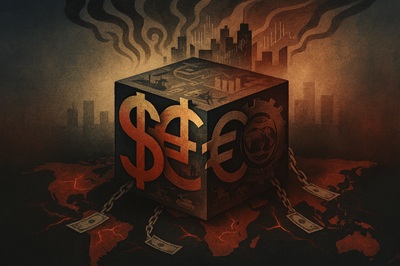
At a time when news is gradually emerging about the United States imposing sanctions on Russia’s two largest refineries and the likely economic repercussions across continents, we present an article by Amandeep Midha who offers an unreserved critique of the present world order and its “pretensions.” Though the article was written prior to the announcement of these latest US sanctions—which came only a few hours ago—Amandeep contends that capitalism’s greatest illusion is its promise of prosperity through freedom, when in reality it delivers hierarchy through debt. Without mincing words, he asserts that when confidence in the dollar falters, war becomes an economic strategy. Cautioning developing economies, he warns that while the dollar’s empire may one day wane, the crucial lesson remains: sovereignty cannot coexist with financial dependency.
Slave Economies of Debt: The Illusion of Capitalism’s Success
By Amandeep Midha
Five headlines, five continents, one story. Yet one little common denominator around Capitalism’s success story, that is written in red ink and military smoke while the IMF merely translates it into debt.
In New York, Pakistan’s president and military chief met with Donald Trump, reportedly discussed the country’s rare earths extraction potential, a bargaining chip to stay afloat under yet another IMF program. In Buenos Aires, Argentina first secured a $20 billion IMF bailout in early 2024, which Washington later doubled to $40 billion, loudly advertised by Donald Trump as a “strategic rescue”. Critics noted it exceeded the entire $35 billion annual budget of USAID, Trump himself had called wasteful. The irony was unmistakable: a single bailout for a collapsing neoliberal experiment consumed more than America’s total development aid to the entire world. Despite the high-profile reforms and libertarian rhetoric of President Javier Milei, Argentina still faces triple-digit inflation, about 40 % poverty, and another cycle of dependency.
Meanwhile, around Venezuela, reports circulated on independent media claim, the United States is preparing to seize ports and airfields, deploying a Navy flotilla, attack submarines, F-35 jets, 2200 additional Marines, and airborne units. Obviously, all this would be far beyond what would be required for drug interdiction or another WMD pretext as many analysts pointed out.
And as if in a twist of symbolic theater, the Nobel Peace Prize 2025 has been awarded to Venezuelan opposition leader María Corina Machado, celebrated in Western media as a “symbol of democratic courage.” Yet Machado has openly supported Israel’s ongoing Gaza offensive, signed cooperation pacts with Israel’s ruling Likud Party, and pledged to move Venezuela’s embassy to Jerusalem. Her stance, condemned by global human-rights groups as support for genocide, underscores how symbols of peace are co-opted to legitimize intervention-friendly actors. By endorsing figures who align with U.S. and Israeli military-financial interests, the Nobel Committee once again turns moral authority into a soft-power weapon. This stance is a continuation of the same war–debt–dollar architecture cloaked in humanitarian language.
And in west Asia, dozens of U.S. KC-135 and KC-46 refueling tankers have been deployed to Qatar, positioned to support long-range strike operations against Iran. These are not defensive assets; they are logistical arteries of aggression. The message is unmistakable: when economic dominance begins to falter, Washington leans on its military-industrial complex to sustain the dollar’s supremacy.
The War–Debt–Dollar Triangle
The United States now owes nearly $70 trillion in combined federal, corporate, and household debt, over four times its GDP. Federal debt alone has ballooned from 35 % of GDP in 1980 to more than 125 % in 2025, among the steepest rise among major economies in the company of France, and even Canada, whose status as a major economy is increasingly questioned.
This relentless borrowing has become structural. The U.S. must issue new debt simply to pay interest on old debt, which means it needs the world to keep buying its Treasury bonds and for that, the dollar must remain the global reserve currency.
When confidence in the dollar weakens, war becomes an economic strategy. Each military buildup in Iraq, Ukraine, or now near Iran forces global demand for dollars and Treasury securities, reinforcing U.S. financial dominance. In effect, the American war machine has become a fiscal tool: it creates “safe haven” demand for U.S. debt even as that debt deepens.
This is why the illusion of capitalism’s success persists in the U.S. It isn’t built on productivity, but on debt monetized by war and enforced through global financial institutions.
The IMF as Global Enforcer
Enter the International Monetary Fund, the financial arm of this empire. The IMF lends in dollars but demands austerity in return: subsidy cuts, privatization, deregulation, and currency devaluation. These measures ensure that debtor nations remain exporters of cheap commodities while guaranteeing repayment to Western creditors.
Argentina has participated in more than twenty IMF programs since 1956. In 2018, it received the Fund’s largest-ever financial package of about $57 billion, followed by another $44 billion in 2022. An additional program valued at roughly $40 billion began in early 2025—about double the initially pledged $20 billion and roughly comparable in scale to the United States’ entire annual foreign-aid budget. Yet, despite these vast sums, inflation continues to exceed 100 percent and poverty hovers near 40 percent. Each successive loan cycle has reinforced Argentina’s dependence on external financing rather than addressing its underlying economic vulnerabilities.
Pakistan’s story is even starker. Since 1958, it has entered 23 IMF programs, averaging one every three years. Each time the same script plays out: the rupee is devalued, fuel subsidies are cut, state enterprises are privatized and yet, growth never becomes self-sustaining. The problem is not religion or governance; it is structural subordination engineered through debt. Pakistan is not a failed state because it is Islamic as advertised by arms of the same empire on divide-and-rule principle of colonial times; it is a failed economy by IMF design.
Lessons from the East
Contrast this with East Asia. South Korea, Taiwan, and later China avoided IMF prescriptions. They used capital controls, state-owned banks, and industrial policy to build manufacturing capacity before opening their markets. South Korea’s GDP per capita rose from under $100 in 1960 to over $30,000 today. Argentina stagnated despite once being among the world’s richest nations in the 1960s. And yes if current trends persist, we may well speak of Canada in similar terms three decades from now, a once-stable economy quietly faltering under debt, deindustrialization, and over-financialization, with some already questioning if it anywhere fits in G7 by any qualification on any parameter?
As Cambridge economist Ha-Joon Chang famously observed, “the free market never built a single developed economy.” Every rich nation protected its industries and its key industrialist entities and individuals, before liberalizing. This is exactly the opposite of what the IMF demands from developing countries.
Meanwhile, the United States sustains the illusion through the rhetoric of corporate fairness and the influence of well-funded NGOs or funded figures like Maria Machado, ensuring that no emerging economy or industrialist grows powerful enough to challenge its global corporate hierarchy.
When a U.S. president travels abroad accompanied by the heads of major defense and energy corporations, Lockheed Martin, Raytheon, ExxonMobil, it is called a business delegation. But when an industrialist from Seoul, Mumbai, or Jakarta grows influential or aligns with national policy, the framing swiftly shifts to crony capitalism or state capture. The double standard is deliberate: it keeps the developing world’s business elite fragmented and politically isolated, ensuring that national industrial strength never consolidates enough to threaten the dollar system.
In the modern world, “free markets” are free only to the extent that they don’t threaten the empire’s balance sheet, as otherwise recent tariff tantrums bluntly revealed.
The Machinery of Illusion
The genius of modern capitalism lies not in production but in illusion. By coupling military dominance with financial hegemony, the United States sustains global demand for its currency even as it runs trillion-dollar deficits.
When crises strike in Asia, Latin America, or the Middle East, capital flees to the “safety” of U.S. Treasuries, strengthening the dollar further. The IMF ensures debtor states enforce austerity, guaranteeing repayment streams flow northward. Poverty in Buenos Aires, fuel riots in Karachi, sanctions on Caracas, and the strangulation of Tehran are all symptoms of the same architecture: a system where the dollar’s strength depends on everyone else’s fragility.
A Future Beyond Dollar Dependence
As BRICS and other emerging blocs explore alternatives to the dollar, a shift may finally be on the horizon. The New Development Bank and the Asian Infrastructure Investment Bank finance infrastructure without enforcing neoliberal orthodoxy. India, in particular, can play a pivotal role in crafting a financial order that supports development rather than dependence, an order where loans build industries, not debt traps.
Until then, the cycle continues: Pakistan offering its minerals, Argentina its sovereignty, Venezuela its defiance, Iran its resistance, all while the IMF offering its chains.
Capitalism’s greatest illusion is that it delivers prosperity through freedom. In truth, it delivers hierarchy through debt. The dollar’s empire may one day wane, but the lesson must remain: sovereignty cannot coexist with financial dependency.
Pakistan is not collapsing because it is Islamic. Argentina is not collapsing because it is Latin. Venezuela and Iran are not targeted because of ideology. These nations are manipulated into dependency engineered to serve global power structures while the illusion of capitalism persists.
Lessons for India
India’s journey offers a rare counter-narrative. During the 1997–98 Asian financial crisis, India remained largely insulated, thanks to limited short-term foreign borrowing, a partially closed capital account, and prudent regulatory oversight. Unlike Thailand, Indonesia, or South Korea, India did not have to approach the IMF for a rescue package. Even after the 1991 balance-of-payments crisis, India paid off its IMF obligations swiftly and kept the institution at arm’s length, choosing gradual liberalization over wholesale dependency.
This autonomy, however, has not come without internal contradictions. India’s economic rise has been powered by urbanization, industrial corridors, and export-led zones, which sometimes mirror the IMF-era factory models of dependency creating massive labor migrations, ecological strain, and social fragmentation.
My personal observation is that IMF-aligned economies often witness massive urbanization and the creation of factory-worker societies in the developing world, disbalancing both the ecosystem and the natural social order. One could argue that China and India’s SEZs (Special Economic Zones) have also done something similar, but with crucial differences in intent and sovereignty.
If one wants to understand why certain regions of the world are more urbanized, industrialized, and yet operate under high-pressure, ghettoized and extractive environments, it is worth asking: who ultimately benefits from this labor? The patterns of urbanization and industrial growth are not purely the product of market forces, but reflect structural financial obligations and global debt relationships.
The Illusion of Free Markets
Finally, one cannot ignore the hypocrisy of so-called western liberal and libertarian economists who champion “free markets” and “economic liberty” in every seminar, think tank report, and op-ed. Ask them why two countries trading bilaterally must settle in U.S. dollars, and suddenly these free-market evangelists freeze. The rhetoric of market efficiency evaporates, replaced by bureaucratic evasions and opaque justifications. Western think tanks, funded by corporate and state interests, actively propagate this illusion preaching liberalization abroad while ensuring that the hollow U.S. dollar remains the mandatory medium of exchange. This is not theory; it is enforcement, coercion disguised as choice, a structural dependency that ensures global economic sovereignty is subordinated to a single imperial currency.
**********

Amandeep Midha is a technologist, writer, and global speaker with over two decades of experience in digital platforms building, data streaming, and digital transformation. He has contributed thought leadership to Forbes, World Economic Forum, Horasis, and CSR Times, and actively engages in technology policy-making discussions. Based in Copenhagen, Amandeep blends deep technical expertise with a passion for social impact and storytelling.

We are trying to create a platform where our readers will find a place to have their say on the subjects ranging from socio-political to culture and society. We do have our own views on politics and society but we expect friends from all shades-from moderate left to moderate right-to join the conversation. However, our only expectation would be that our contributors should have an abiding faith in the Constitution and in its basic tenets like freedom of speech, secularism and equality. We hope that this platform will continue to evolve and will help us understand the challenges of our fast changing times better and our role in these times.
About us | Privacy Policy | Legal Disclaimer | Contact us | Advertise with us