Dr. Meenakshi Saxena has written several insightful articles in recent months. Readers will recall that her essay Dynamics of Ageing – The Psyche of Elderly People (Link) was widely read, while March Towards the End – A Psychological Perspective (Link) also evoked keen interest. In her present article, Rediscovering the Self in Old Age, she examines the needs and aspirations of middle-class elderly people.
Rediscovering the Self in Old Age
Dr. Meenakshi Saxena
With increase in longevity, the number of senior citizens (aged 60 years and above) has increased manifold all over the world. In India, the Ministry of Social Justice and Empowerment has initiated several programs for the elderly. The National Council of Senior Citizens, National Institute of Social Defence, and several state departments are involved in looking after the physical, financial, and other needs of the aged. Old-age homes have been established. Many Help-lines and apps have been launched. Some NGOs, notably the HelpAge India, provide services for multiple needs of the elderly. Golden Agers Senior Citizens Tour packages are also in operation.
However, such schemes do not attract the middle and the upper middle-class elderly living in the metropolitan cities in India. This strata of society includes men and women who retired from highly paid jobs, rich housewives, those living alone, or with only the spouse, and some of them living with their children and grandchildren. They are physically and mentally fit. Their children are either settled abroad, or in a different city / state of the country. The elderly are very proud of their children having done well in life. They understand their children’s inability to spend enough quality time with them due to their professional constraints. Yet, they yearn to gratify their basic needs of affiliation, social interaction, and self-expression. They wish to fulfil their long-postponed aspirations to actualize their self, and to make the best of the remaining years of their life.
Responding to such aspirations of the elderly, some enterprising young men and women have come up with the formation of certain groups and clubs to help them fulfil their desires. Some notable ventures in this direction are the GoHappy Club, HelpAge India’s Active Ageing Centres, Agewell Foundation, The Saamarth Privilege and the Happy Folks Club of India, among others.
Such clubs and groups are becoming increasingly popular in big cities. They organize on-line programs for the elderly to make them techno-savvy for day-to-day dealings, conduct on-line and off-line workshops on yoga, meditation, spiritual discourses, music, dance, arts, crafts, and financial literacy. They organize get-togethers and trips to various cities in India and abroad. More and more people have started becoming members, and are reported to be highly satisfied with their programs.
Talking with people who attended the off-line workshops and get-togethers, and those who returned from trips was a highly enlightening experience. They mentioned how they enjoyed not only the programs, but also the company of each other. They had all the facilities and luxuries at home but they yearned for human company. They wanted someone who would understand their feelings, emotions, and expectations from life. This communication could not be possible with household helpers, neighbours, and the companions in parks, gym, or parties. It was possible only with the like-minded people of similar age groups. The organized efforts of the Senior Citizens Clubs gave them a platform to do so. Here they communicated with each other without any inhibitions, role specifications, and other’s judgements. The reason why they expressed great happiness and gratification after attending get-togethers was that their ‘self’ had a free expression.
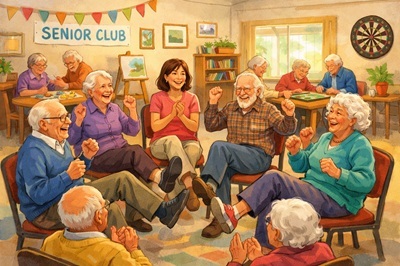
The Clubs and Senior Citizen Groups organize fun games and puzzle solving sessions carried out in small groups. The participants told how they enjoyed the light-hearted competitiveness, and the joy of winning as small children would do. Such exercises give great boost to the neural activity, and are very useful for the ageing people. The ageing people described how they enjoyed music and danced with it with full enthusiasm. The source of joy, indeed, was the interaction with others, focus of attention, and the pleasure of winning points.
It would be interesting to understand as to what motivates them to join the groups, and to stick to them? What actually do they gain out of it? The answer is simple. It gratifies their basic drives of affiliation, communication, utilization of energy, freedom from routine, seeking novelty, freedom from societal and cultural stereotypes, an opportunity to move without other’s judgements and sanctions, a chance to focus totally on the self, and to discover one’s potentialities. They seemed to be celebrating their own ‘self’, that was into full expression in a relaxed atmosphere.
While talking about their family, they revealed that it was a matter of great satisfaction not only for them, but also for their children. They realized that their children loved them, took care of their safety, and wanted them to lead a purposeful life. In many cases, the elderly were introduced to the Clubs by their children only.
The experience of those who had gone on the trips provided a deep insight into the psyche of the ageing people. Even though most of the elderly were able to go on personal tours with all facilities, they preferred to go with others. As they mentioned, they were initially hesitant to go, but they came back with transformed personalities. Travelling to distant places, sightseeing, mixing with people of different cultures, and enjoying foods of various tastes and flavours was one of their most postponed programs. Going on trips fulfilled their long-cherished desire.
With great satisfaction, they told that while on trips, enjoying with the same people for long hours resulted in long term friendships. After hectic days, the evenings and nights were highly relaxing and free from inhibitions. With more trustworthy friends, the elderly talked about their personal lives, their fears, anxieties, guilt and regrets. They talked about the injustices done to them by others, and the strategies they adopted for survival and adaptation.
It was here that catharsis happened in its most authentic form. One could open up more in front of a stranger-turned-friend rather than a member of the family, relative, or even a professional. No amount of cognitive therapy (change in mind set), or behavioural modification by a councillor could be as effective as the one brought out by the fellow travellers who had gone through similar ups and downs in life. After returning from the trips, they described how they learnt about their own physical and mental strengths, overcame fears- even panic and phobias- and came back much better prepared for life. They had discovered their new ‘self’, which they described as the life-time achievement through the trips.
Helping the elderly through such organized efforts would go a long way in achieving their total well-being. It could take the form of a social movement aimed at the welfare of the ageing population. It would be a great service rendered by the younger generation to the older one.
***************

Dr. Meenakshi Saxena retired as Associate Professor in Psychology in indraprastha College for Women, Delhi. She has worked extensively in the fields of Clinical Psychology, Child Development, Delinquency, Women's Studies, Gerontology, and Spirituality.

We are trying to create a platform where our readers will find a place to have their say on the subjects ranging from socio-political to culture and society. We do have our own views on politics and society but we expect friends from all shades-from moderate left to moderate right-to join the conversation. However, our only expectation would be that our contributors should have an abiding faith in the Constitution and in its basic tenets like freedom of speech, secularism and equality. We hope that this platform will continue to evolve and will help us understand the challenges of our fast changing times better and our role in these times.
About us | Privacy Policy | Legal Disclaimer | Contact us | Advertise with us