
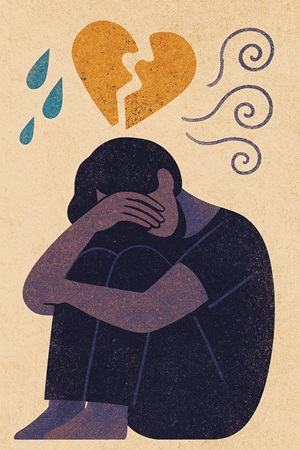
Scriptures offer numerous examples that underscore the futility of excessive grieving. Yet, despite our understanding, the loss of something—or someone—precious often leaves us deeply shaken. In this article, clinical psychologist Dr Meenakshi Saxena explores the many dimensions of grief and offers insights into how we can navigate its emotional terrain and begin the journey toward healing.
Grief, Healing, and the Human Mind: Insights from a Clinical Psychologist
Dr Meenakshi Saxena
Grief is an inevitable experience in everyone’s life. No one would lead a smooth, happy, and stress-free life for ever. Grief causes a turmoil in the physical, psychological, social, and spiritual life of an individual. Unless efforts are made to overcome it, it may lead to perpetual suffering, and breakdown of a person in several domains.
Grief is a sense of grievous loss in life. It may be equated with a condition of severe stress. Grief may emanate from failing to reach an important goal in life, financial loss, failure in significant relationships by death, separation, divorce, rejection, abuse, or abandon, persecution, or torture. Getting into the trap of some unethical persons, and never being able to come out of it may be equally stressful. At times, grief may be caused due to subtle feelings of regret, guilt, and remorse where no corrective measures could now be taken. The neglect of health of self and the near and dear ones, children’s education, breaking communication with the partner etc may produce guilt. Such grief is due to the demoralization of one’s own ego by the self. For some people, even the death of the pet may produce good amount of stress, if that was the major object of love for him. There could be innumerable sources of grief or stress depending on the induvial.
Grief could be acute or chronic. It could be the most painful in acute (sudden) conditions, such as a death of a significant person in life by accident, kidnapping of a child, loss of life and property in some natural disasters etc. It may be chronic (gradual) where one is aware of the impending loss, and is mentally prepared for it. However, when it finally happens, for example the death of a person suffering from a prolonged illness, it could still take one into a state of deep grief.
Manifestation of Grief
Grief, a state of stress, produces widespread changes in one’s physiological, and psychological domains. It is a state of emotional arousal which affects all organs of the body.; the brain, the gut, the heart, the lungs, and others. Modern research has shown how gut is an extended brain with interconnecting nerve cells. Since ancient times, heart has been considered as the most precious organ in the body. The Greeks preserved it while discarding all other internal organs for the preservation of the body in the pyramids for their journey towards heaven. In Chinese medicine, lungs have been of focus of treatment. The blood sugar level, controlled by the pancreas, is highly affected by the stress produced by grief. Abnormal function of pancreas leading to high blood sugar levels is known as the common accompaniment of the states of grief and stress.
Several areas of the brain; the right hemisphere, the hypothalamus, the amygdala, and the endocrine system are important since they control emotionality and consolidation of memories, i.e. producing a reservoir of past experiences. Extensive changes occur in the level of various hormones which may affect metabolism, stress tolerance, sexual function, release of pleasure hormones, sleep patterns, and overall immunity of the body.
Psychologically, manifestation of grief takes place in myriad ways. It may be seen in a mild, moderate, or intense form depending on the nature of loss and the individual. It may be expressed in the form of sadness, isolation, staring into vacuum with a sense of emptiness, lack of interest in professional and household activities, ignoring hobbies, cold and detached behaviour, sudden changes in mood, somatic complaints without any physical basis, irritation, and general change in the personality of a person. It may also involve obsessions with grief, and compulsive behaviour relating to grieving for it. Such changes need to be attended to since they may lead to severe depression or other kinds of abnormal behaviour.
Special attention must be given to children in this context. Abused and neglected children do not have the linguistic capacity to express their grief. To a sympathizer, they would simply say, “will you play with me “.
Grief: A Subjective Experience
The experience, sources, manifestations, and response to healing efforts are highly subjective in nature. It is true that the fire which melts the ice, hardens the egg. The person who has suffered tremendous grief already becomes hard, almost immune to its effects. He becomes stoic to painful experiences. Response of people differs with the kind and the intensity of grief. It also varies with factors of personality patterns, gender, age, socio-economic level, availability of social support systems, and one’s resilience and self-confidence.
Acute grief produced by sudden losses may be perceived to be high by all, but the return to relative normalcy and re-adjustment takes different routes, taking variable time, depending on the above-mentioned factors.
The experience of grief may be coloured by its interpretation by the aggrieved person. The loss of business may not be interpreted only in terms of financial crisis, but also in terms of how others will perceive his capability to handle, rebuke by his elders, pressure from his business partners etc. Similarly, under the pressure of social desirability, one may wear a mask of great grief on someone’s death whereas it may simply be what he wanted, perhaps, in some matters of inheritance. In some cases, however, death of a near and dear one may be taken as a relief saying that he is now freed from the burden of dependence and pain. It may be a relief to his attendants as well.
Alleviation of Grief
Grief, grieving, and mourning are essential components of life. But it cannot continue indefinitely. For the sake of physical and mental health, alleviation of stress, and the rehabilitation of the grief-stricken person is very important.
Overcoming grief, or healing from its disastrous effects, may be taken up by the person himself, via a rigorous analysis of the situation and that of the self. He may employ a cognitive approach, and try to change his perspective on life, and try to adapt with the loss. Such efforts are needed even when help is available from the outside.
As soon as people come to know of a tragedy or a loss in someone’s life, they come to mourn and to show support to the grieving person. They show empathy, sympathy, and they promise help as and when needed by the aggrieved. They refrain from asking for too many details, or to offer verbal advice. In the moments of deep grief, one needs empathy, and not criticism or suggestions. As they say, one should use minimum of words and maximum of hugs to console a grieving soul.
The loss may be so extensive and deep, and a sense of helplessness be so pervasive for some people, that they would cry over the loss. Some mourners would cry with the grief-stricken person. Crying is known as the best way to vent overpowering emotions and provide relief to some extent. Crying has always been considered important physiologically as well as psychologically. “Grief tears” are known to be different from the “normal tears.” They are stickier and contain several molecules of negative hormones.
The enormity of grief may slip some people into a state of numbness. The mourners who come to empathize with him try to strongly push him to tears. In some societies, there is the tradition of calling “Rudaalis”, the group of women whose job is to cry at the top of their voice in front of the grieving people so that even those who go numb would cry.
Crying is a form of catharsis. It is a process to release the pent-up emotions. Several counselling techniques are aimed at helping people to do so. Freudian techniques of free association also help in this process. Through such techniques, the counsellor can diagnose the roots of his grief, and provide some appropriate amelioration to his bruised psyche.
However, counselling methods are long and laborious, and may not succeed in many cases. Catharsis will still be needed. Keeping that in mind, some developed countries have made sound proof rooms, installed with bobo dolls and soft material robots, where anyone could go at the time of intolerable stress of guilt, or aggression. He could shout or cry at the top of his voice, beat the bobo dolls, or talk to the robots to get some catharsis. Some groups of people have been found offering themselves to be beaten (helping people to do catharsis) for commercial purpose.
Research has indicated that catharsis is most difficult when the realization of grief is multiplied with one’s own failures and lapses. Cognitive approach, involving careful gentle advice, may succeed better with such people. The grief-stricken person is first told that the loss is a universal phenomenon, and it is very painful for all. He must not deny or evade pain for any kind of social or personal show off. He must also not dwell in his past. He must close the earlier chapter to start life all over again. Such an advice would mostly apply to the loss of an important relationship. For loss of business etc, they are told to learn from the past and move on. After all, the past was not the final ideal state, one may create another fruitful stage in future.
People are normally afraid of change. The grieving person is advised to accept and welcome change. He must not remain withdrawn, neglect his health, or rely on alcohol or drugs. Maintaining healthy social relationships may be the key to readjustment, and rehabilitation. Most important of all, he must not remain in a state of self-pity. There are multiple determinants of failures and losses. So, he must analyse them instead of indulging in self-blame.
Everyone goes through periods of grief. The journey of life cannot stop at that. One must heal, and for that, healthy healing by the self, and also with the help of well-wishers, and at times, professionals is essential.
************

Dr. Meenakshi Saxena retired as Associate Professor in Psychology in indraprastha College for Women, Delhi. She has worked extensively in the fields of Clinical Psychology, Child Development, Delinquency, Women's Studies, Gerontology, and Spirituality.

We are trying to create a platform where our readers will find a place to have their say on the subjects ranging from socio-political to culture and society. We do have our own views on politics and society but we expect friends from all shades-from moderate left to moderate right-to join the conversation. However, our only expectation would be that our contributors should have an abiding faith in the Constitution and in its basic tenets like freedom of speech, secularism and equality. We hope that this platform will continue to evolve and will help us understand the challenges of our fast changing times better and our role in these times.
About us | Privacy Policy | Legal Disclaimer | Contact us | Advertise with us