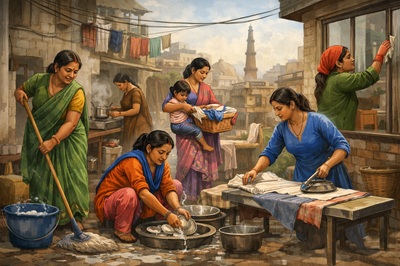
This essay by Dr Meenakshi Saxena offers a wide-angle view of the working conditions of domestic workers in Delhi. The subject of their rights and dignity remains under-reported in mainstream media, making this essay both timely and necessary. Although not explicitly stated, the observations appear to be drawn from a study or survey, and they are presented with clarity and logic.
The piece reminds us that India still lacks a dedicated central legislation for domestic workers, despite decades of debate. Recently, the Supreme Court highlighted this gap and directed the Union government to constitute an expert committee to examine whether a sector-specific law is required. Yet, past experience does little to inspire confidence that such deliberations will lead to concrete action.
In the meantime, this essay invites us to reflect on the everyday realities of domestic workers—an invisible workforce that sustains urban households while struggling for recognition, fair wages, and dignity.
Delhi’s Domestic Workers: An Invisible Workforce
Dr, Meenakshi Saxena
A call from a domestic worker informing her inability to come on a particular day creates panic, chaos, and immediate alternate plans to finish essential household chores before leaving for work. It is equally disturbing for nuclear and joint families, and also for senior citizens living alone. Similarly, frantic calls are made by employers if the worker fails to arrive on time.
Domestic workers are categorized by the nature of their work and the time they devote to a household. Part-time workers sweep, wipe, and clean utensils, usually spending 1–2 hours in a household and working in 3–4 homes, often both morning and evening. Full-time workers devote 10–12 hours, cooking, caring for children, and performing all tasks asked of them. Live-in workers stay in the employer’s premises, available whenever needed, though usually given some rest time in the afternoon and basic arrangements for stay.
In metropolitan cities, demand for domestic workers is very high. They are primarily hired through word of mouth—by fellow workers, relatives, or neighbours. Recently, organized efforts have increased their visibility: agencies now provide police-verified documents and photographs, mainly for live-in workers. App-based services like Urban Company and Pronto also offer trained and reliable workers. Private enterprises such as “Dashboard to Doorbell” provide training before placement, making these workers more efficient and sought after.
Despite this demand, domestic work remains part of the unorganized sector. Labour laws do not apply, as private homes are not classified as workplaces. Workers are treated as independent partners, leaving them with no legal protection, no minimum wage, and no regulation of working hours.
Thousands migrate to Delhi from Uttar Pradesh, Bihar, Jharkhand, Bengal, and Nepal in search of such work. They face immense challenges—finding jobs, accommodation, transport, schools for children, and adjusting to new environments. Most live in cramped one-room rentals with scarce water and electricity, often paying high rents and transport fares. Many are the sole earners in their families, with inadequate support from husbands, yet they aspire to educate their children despite hardships.
The relationship between workers and employers is often strained. Employers frequently treat them as robots, discouraging personal interaction. Workers report irritants such as constant supervision, criticism, denial of toilet use, refusal of leave, poor food quality, accusations of theft, verbal abuse, and even physical mistreatment. Some employers have gone so far as to publicly label workers as thieves, jeopardizing their future employment.
Employers, on the other hand, complain of workers forgetting instructions, taking leave without notice, gossiping about family matters, and influencing other workers. Domestic workers often form close-knit groups, sharing information about households in the locality.
Yet, there are positive stories too. Some live-in workers have been treated like family members, entrusted with household responsibilities, and supported financially during crises such as marriages or medical emergencies. Children in certain households have grown deeply attached to them, seeing them as caregivers.
Overall, however, complaints outweigh praise. When asked what they truly want, workers unanimously said: “We want only two things—a raise in our salary, which is totally inadequate, and respectful behaviour from our employers.”
In times of rising living costs, this is not too much to ask. Empathic understanding and humane treatment of domestic workers—as fellow human beings who keep our households running—are absolutely essential.
************

Dr. Meenakshi Saxena retired as Associate Professor in Psychology in indraprastha College for Women, Delhi. She has worked extensively in the fields of Clinical Psychology, Child Development, Delinquency, Women's Studies, Gerontology, and Spirituality.

We are trying to create a platform where our readers will find a place to have their say on the subjects ranging from socio-political to culture and society. We do have our own views on politics and society but we expect friends from all shades-from moderate left to moderate right-to join the conversation. However, our only expectation would be that our contributors should have an abiding faith in the Constitution and in its basic tenets like freedom of speech, secularism and equality. We hope that this platform will continue to evolve and will help us understand the challenges of our fast changing times better and our role in these times.
About us | Privacy Policy | Legal Disclaimer | Contact us | Advertise with us