
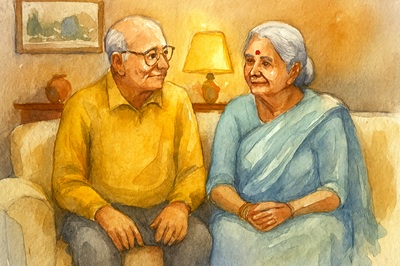
Besides being a biological reality, ageing is also a deeply human experience. In this thoughtful essay, Dr Meenakshi Saxena draws on her long engagement with psychology to explore the inner worlds of seniors—their struggles, hopes, and quiet strengths—reminding us that dignity and companionship remain central to graceful living.
Dynamics of Ageing - The psyche of the Elderly
Dr. Meenakshi Saxena
Ageing has increasingly come into focus with extensive research in gerontology and the remarkable rise in human longevity. Academic studies, popular books, and discussions across print and social media are replete with analyses of the elderly and the complex process of ageing. The physical, physiological, and cognitive changes associated with advancing years have been described in detail in the available literature. In innumerable medical and social science studies, the elderly—whether termed old, geriatric, or senior citizens—have often been examined as subjects of observation and clinical measurement.
Researchers have highlighted the nature and timing of decline, the prevalence of specific problems and common diseases, and the strategies proposed to slow or mitigate the ageing process. Beyond serious academic inquiry, social media too is flooded with content claiming to support seniors: thousands, perhaps even lakhs, of videos offer advice on topics ranging from diet and exercise to the importance of socialization, alongside a plethora of suggestions on how to age successfully and gracefully. Increasingly, ageing is not only seen as a medical or biological phenomenon but also as a social and cultural experience, raising questions about dignity, intergenerational bonds, and the meaning of a fulfilling later life.
However, there remains a continuous need to glimpse into the psyche of the elderly—to comprehend and appreciate their personal struggles and intimate desires, and to understand what they think about their family dynamics, as well as their fears, hopes, feelings, and emotions. Over a fairly long career in the field of psychology, this author has made a conscious effort to interact with a large number of elderly individuals, engaging with them individually in a calm and trustful atmosphere and establishing meaningful lines of communication. In academic parlance, this may be described as a sample of educated, urban men and women who had attained the age of seniority. They belonged to the middle and upper-middle strata of socio-economic status and had retired from stable, respectable jobs.
Based on these extensive interactions, an attempt has been made to coalesce the observations and conclusions regarding the journey of these elderly people. Needless to say, a wide variation was observed in their responses, and only broad generalizations are being included in this article.
In India, the legal age of becoming a senior citizen is 60 years. It is usually the age at which one retires from his regular Government job. Even if one works in the Corporate Sector, the effects of ageing begin to appear. Retirement comes after a brief stressful period called the ‘Retirement Blues.’
A fairly common trend noticed amongst recently retired people was that soon after retirement, vehement efforts were made by the elderly to maintain the status-quo by seeking consultation job in the same institution, or some other regular work elsewhere. Although not many explicitly said this but it was perhaps to conserve the economic and social status.
It was also noticed that after retirement, the elderly began to access the content (print or digital) in which the condition of the ageing population was described. They started making extreme efforts to maintain their physical fitness. Visits to the gym increased. They enjoyed morning walks in the parks where friendships developed with other retirees, and a good amount of catharsis also took place. They joined yoga classes, hobby classes, and senior citizens groups. Women increased their visits to the beauty parlours. Interestingly, the frequency of their visits to the doctors also increased, but with the hope that the doctor would declare them fully fit. They went basically for the positive reinforcement of their health status.
Besides attending to their personal needs, it was observed that the elderly also turned their attention to the house and household matters. Several repairs, renovations, and interior decorations were undertaken to give the home a refreshed look. They became increasingly concerned about what to eat and how to cook. In some cases, prescriptions regarding food and meal timings were drawn up for the family and strictly followed. An increase in intimacy was observed where only the husband and wife lived in the house. Even the annoyance caused by the husband’s consistent demands was accepted with affection.
A big change occurred in the family dynamics where the elderly lived with their grown-up children in the same house. They soon realized that their orders gradually became requests and persuasions. There were clashes on many fronts, i.e., food, timing of dinner, outings, money, saving patterns, night parties etc. Alienation, lack of quality time with children, and neglect were sharply felt in many cases. In the context of their children, the elderly seemed to be caught in a conflict situation. On one hand, they understood that their children were highly stressed because of work pressure, official meetings, unrealistic targets, running the household, bringing up their own children, and sometimes even financial problems. Some of them also appreciated the good facilities provided to them by their children. Maids and other regular help at home, deliveries of all goods at home, financial help to join Senior Citizens groups, excursion groups, and kitty parties etc. Some of the elderly initially liked the idea of old age homes at the beginning of their retirement, hoping for a better social life. Gradually, however, most of them abandoned the thought, as the despicable conditions in many such homes made them shudder.
Some of the elderly felt that the younger generation was trying to manage their parents’ lives in the same way they managed situations in their professions. In their conversations, several expressed distress over what they perceived as the brusque and detached behaviour of their children towards them. A few even blamed themselves for this situation, believing that there must have been flaws in their methods of upbringing which had led to such indifference in their children toward the older generations. Such feelings were expressed among peer groups in the parks, and at several get-togethers. No wonder, most of them opted to stay alone, and manage their life on their own. The money was not a problem for them. Moreover, there has been great emphasis in media on spending by the old on themselves, to keep up their health. They saved only because they did not want to ask for financial help from their children. In their heart of hearts, they longed for love and a sense of belonging.
As age advanced further, the elderly began to perceive their cognitive decline. They took forgetting names of people and places more seriously. Some of the older generation developed interest in solo activities; hobbies, gardening, writing articles, or even writing their autobiography. They also saw people of their age-group dying. Some of them lost their spouse, and felt highly traumatized. To overcome such a situation, some felt more detached and depressed, whereas others moved towards greater amount of socialization. Inspired by such a demand, several entrepreneurs have started organizing travel, vacation, and entertainment tours to different cities, even abroad, for the senior citizens. It has become a big commercial enterprise in the current scenario.
Ageing people now remain healthier and much more active due to medical and self-care. In their conversations, they emphasized achieving their hidden potentials, and getting liberated from the shackles of society. Most of them showed clear defiance of the rules, rituals, regulations, norms, and stereotypes of society. They dressed up, ate, and engaged in entertainment activities according to their will. The strict norms for a widow about dress and food were totally discarded. They did not believe in living in scarcity and dying rich. They went on the spending spree, and spent on themselves freely.
A subtle change in roles and norms was observed in the context of the husband–wife relationship. Contrary to the common belief that women wish to die as a Suhagan, many expressed the desire to live beyond their husband’s death. This was not because they sought longevity, but because they believed that while a woman may be able to manage alone, a man would never be able to do so. They said they had no interest in going to the pyre in their bridal dress; rather, they wished to care for their husbands’ needs until his final moments.
Similarly, several changes occurred in their cognition and comprehension of life. There was a definite trend to move towards spirituality. Philosophical and theological discourses were attended, read in books, and heard on the television. Some of the elderly joined some religious groups also. Some groups of senior citizens met on a fixed day of the weak to discuss spiritual matters over a cup of tea. Such discussions were found to be highly satisfying. Concurrent with this, there was an enormous change in their emotionality. They became more detached with their worldly possessions. Donations to people and Non-Governmental-Organizations were generously made.
They began to feel neglected, ignored, and avoided. Some of them became prone to tears. It was found to be less prominent among women compared to men. Women were found to have adjusted to their situation with greater ease. Some of the old people even developed stoicism for emotional experiences.
By the age of 70-80 years, they began to talk about death in general, their own death, and wondered how it will come to them. As they saw their friends, and near and dear one’s going, they felt depressed. The obsession with death kept increasing. But one thing came out very clearly. They preferred death to disability. Whenever they heard of an old person die in his functional condition, they prayed for the same for themselves. Some of them were angry because euthanasia is not legal in India. They expressed a great desire to end their life if some major problem struck them, from which they could not come out. They said that they would like to die in dignity as they had lived their life in dignity. Some of them had told (even given in writing) that if a disability was certain, and they were not able to take a decision, they should be allowed to go.
The oldest among the elderly, who feared that their end was near, narrated their life experiences. In their conversations, they carried out a detailed self-analysis, and were keen to talk about it with their near and dear ones. They described their happiest and the saddest moments. They got emotional in describing their regrets, and guilt. They talked about their major regrets in life. They felt that during most part of their life-time, they lived according to the expectations of others. They found no time to discover their own interests and inclinations. They could not self-actualize. Also, they did not spend enough quality time with their family, did not do as much travel as they wanted, and did not spend as much time in nature as they could have done. They also felt that they could have taken better care of their health in their youthful years.
The journey of a senior person is marked by many ups and downs. The enthusiasm to lead a meaningful life often wavers, and phases of attachment and detachment come and go. Yet, each journey remains unique in its rhythm and experience. What emerges clearly is that the older generation of today—having worked hard to attain their place and status—does not seek sympathy or pity. What they truly need is understanding, respect, and the warmth of human company with whom they can communicate and share. In the end, ageing is not merely about decline, but about sustaining dignity, nurturing bonds, and finding meaning in companionship.
*************

Dr. Meenakshi Saxena retired as Associate Professor in Psychology in indraprastha College for Women, Delhi. She has worked extensively in the fields of Clinical Psychology, Child Development, Delinquency, Women's Studies, Gerontology, and Spirituality.

We are trying to create a platform where our readers will find a place to have their say on the subjects ranging from socio-political to culture and society. We do have our own views on politics and society but we expect friends from all shades-from moderate left to moderate right-to join the conversation. However, our only expectation would be that our contributors should have an abiding faith in the Constitution and in its basic tenets like freedom of speech, secularism and equality. We hope that this platform will continue to evolve and will help us understand the challenges of our fast changing times better and our role in these times.
About us | Privacy Policy | Legal Disclaimer | Contact us | Advertise with us