Bachat Utsav - Can India’s Festive Cheer Revive Its Real Economy?
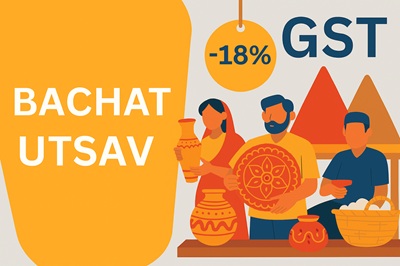
Although the GST Council’s recent decisions have been widely welcomed, some critics have questioned their timing. Why were the rate cuts not introduced earlier, they ask, and why were citizens made to pay higher GST for eight years? K.G. Sharma, however, refrains from critiquing the delay. Instead, he emphasizes that the true value of the “Bachat Utsav” lies in its ability to revive small-scale manufacturing, support artisans, and strengthen the informal economy—the very backbone of festive production and local livelihoods.
Bachat Utsav - Can India’s Festive Cheer Revive Its Real Economy?
Krishan Gopal Sharma
The government's "Bachat Utsav" campaign has arrived amid the festival season, promising relief, savings, and renewed economic optimism. Its launch coincides with a rare fiscal cheer: September's GST collections soared to ₹1.89 lakh crore, up 9.1% year-on-year, even after manufacturing and essential goods rates were lowered. On paper, this looks like a triumph of policy — lower taxes, higher revenue, and apparent consumer confidence. Yet the larger question remains: Can a festival of savings truly reflect the reality of an economy still recovering from years of shocks?
Diwali and Dhanteras are more than cultural milestones; they are economic triggers, especially for small traders, artisans, and manufacturers. Yet, for over a decade, India’s festivals have ironically illuminated China’s economy more than our own. Imported fairy lights, LED bulbs, and even idols of gods, dominate the market, while the small local craftsman, once the heartbeat of festive commerce, struggles to keep workshops open.
Why did India fall behind? The answer lies in a string of disruptive policies and events. First came demonetisation, draining liquidity and striking informal trade. Then the initial GST rollout, with its complexity and compliance burden, hamstrung MSMEs. Finally, the sudden pandemic lockdown erased whatever recovery had begun. The result was shuttered workshops, lost skills, and an economy increasingly dependent on imports for what it once produced in abundance.
Seven years later, the government’s GST rationalisation is finally here. The simplification of slabs and rate cuts on daily essentials have been packaged under the banner of Bachat Utsav, or “festival of savings.” Yet, the announcement itself was unusual. The Prime Minister declared it from the ramparts of the Red Fort on Independence Day — weeks before the GST Council, the constitutional body of Centre and States, formally approved the rates. Even if the Council’s eventual decision matched the announcement, the optics raise questions about federal balance, institutional process, and the interplay between political theatre and policy.
Still, the announcement worked. The surge in GST revenue suggests that compliance mechanisms are stabilising and consumption remains resilient. Urban traders and some MSMEs report upticks in festive orders. Digital payments are increasingly seamless, and rural markets show early signs of revival, buoyed by good harvests and slightly better procurement prices. The message is clear: the economy is not collapsing, and there is reason for cautious optimism.
Yet beneath the celebratory numbers, challenges remain. Job insecurity is high, wages for informal and gig workers stagnate, and the debt burden from pandemic years still weighs heavily on small businesses. Inflation in essentials — rent, electricity, healthcare, education — continues to strain households. Corporate retail and large firms benefit more from the reforms than family-run units, widening the inequality gap. The Bachat Utsav, while politically festive, touches different realities unevenly.
The government’s goals are multi-layered. Politically, Bachat Utsav projects generosity and economic competence. The timing, before festivals and ahead of potential electoral cycles, signals optimism and a sense of forward-looking governance. Economically, the government seeks to demonstrate that lower rates need not mean lower revenues, leveraging compliance and consumption to stabilise the fiscal picture. Psychologically, it restores confidence, especially among urban and neo-middle-class consumers, that reforms can deliver both relief and progress.
But the festival of savings cannot be measured by optics alone. For the poorest Indians, who consume little from the formal economy and depend on subsidised rations, the idea of saving is aspirational at best. Survival, not savings, governs their decisions. Meanwhile, state governments worry about revenue loss, and the potential for performative governance looms. If policy is celebrated more than implemented, temporary gains could be followed by fatigue and frustration.
The article’s critique is not merely of optics but of substance. Bachat Utsav is meaningful only if it revives small manufacturing, supports artisans, and strengthens the informal economy — the very backbone of festival production and local livelihoods. Lower rates, simplification, and a festive narrative may provide momentary cheer, but lasting revival requires credit support, predictable policy, and trust-building between the Centre, States, and businesses.
For urban and middle-class consumers, GST relief may translate into modest savings. For rural and informal sectors, these measures are unlikely to change day-to-day realities immediately. The festival can ignite temporary demand, but structural transformation — revival of MSMEs, sustained consumption, and equitable growth — is still a long road ahead.
The true test of Bachat Utsav will lie not in one month’s collections but in whether ordinary Indians feel relief in their daily lives. When artisans’ workshops thrive, small traders expand, and ordinary families can spend without fear, the festival of savings will transcend marketing and become a lived reality. Until then, it remains both a celebration and a reminder: policy brilliance in Delhi must meet resilience in villages, towns, and bazaars across the country.
This Diwali, as markets light up and consumption rises, the glow of Bachat Utsav should illuminate not just the nation’s accounts but the lives of the millions who make its economy pulse. The festival can inspire hope, but for that hope to endure, it must be backed by inclusive growth, genuine support for the small producer, and policies that translate from stagecraft into substance.
************
Krishan Gopal Sharma; kgsharma1@gmail.com; Freelance journalist, retired from Indian Information Services. Former senior editor with DD News, AIR News, and PIB. Consultant with UNICEF Nigeria. Covered BRICS, ASEAN, Metropolis summits and contributed to national and international media.
(Views are personal)


