
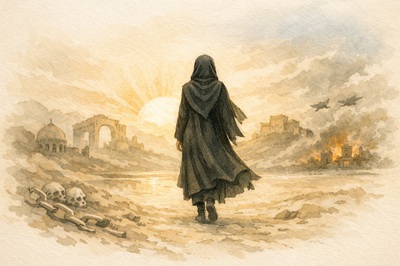
In yet another powerful piece, Amandeep Midha underlines the strenghts of civilisational states. The daughter of slain Libyan leader Muammar Gaddafi warns Iran against trusting Western assurances—a caution that unfolds into a meditation on civilisational endurance. From Persia to Bharat, the essay traces how deep cultural memory, deterrence, and narrative strength form the unbreakable bones of survival.
The Bones that do not break: How Civilisation-states Endure
Amandeep Midha
Aisha Gaddafi, the daughter of slain Libyan leader Muammar Gaddafi, issued a stark warning to the people of Iran recently. In a public address that has circulated widely across the Middle East and North Africa, she drew a direct line between her father's fate and the negotiations currently being pressed upon Tehran by Western powers. "Negotiations with wolves do not lead to the salvation of the herd," she said. "They merely set the date for the next hunt."
Her testimony was personal and precise. The West, she recalled, assured her father that if he gave up his nuclear weapons and ballistic missile programmes, the world would open its doors to him. He believed it. He made the concessions. He welcomed the inspectors, paid the reparations, and shook hands. And then, in 2011, NATO's bombs turned Libya into ruins and Muammar Gaddafi was killed in a drainage ditch outside Sirte. Aisha Gaddafi watched all of it. She has not forgotten. And she is now telling Iran: do not make the same mistake. Concessions to the enemy do not lead to peace. They lead to destruction.
It is the kind of warning that Western chancelleries will dismiss as the bitterness of a bereaved daughter. That dismissal is itself the problem.
The Libyan Lesson the World Actually Learned
In 2003, Muammar Gaddafi made what many Western analysts celebrated as a triumph of coercive diplomacy. He surrendered his nuclear programme, opened his country to inspectors, paid reparations for Lockerbie, and re-entered the international community. Tony Blair flew to Tripoli. BP signed oilfield contracts. The Colonel appeared at G8 summits. For eight years, the bargain appeared to hold.
Then came 2011. A domestic uprising, a UN resolution, and a NATO air campaign. The rockets Gaddafi had surrendered could not shoot back. The deterrent he had traded away was gone. His state collapsed in months. He was captured by militia and killed on camera.
The lesson the rest of the world drew was not the one Washington intended. North Korea accelerated its nuclear programme. Iran hardened its negotiating conditions. India quietly expanded its strategic triad. Every serious defence ministry on earth updated its threat calculus with one new axiom: a state that voluntarily disarms under Western assurance is a state that has removed the only structural obstacle to regime change. Disarmament, the world concluded, is not a guarantee. It is an invitation.
This is why Iran's strategic calculus, whatever outsiders make of it, cannot be dismissed as mere obstinacy or ideological refusal. Tehran has watched Libya. Tehran has studied the pattern. The Islamic Republic has chosen a different path: maintain irreducible deterrence, refuse asymmetric concessions, and accept the costs of standing firm. It is a choice born not from hostility but from clarity. As Justice Markenday Katju once observed with characteristic bluntness: when you poke into a hornet's nest, it is the bees that decide when it is over. Iran appears to have learned this lesson viscerally.
The Distinction That Changes Everything
To understand why some states survive this logic and others do not, one must grasp a distinction that Western foreign policy analysis almost never makes: the difference between a nation-state and a civilisation-state.
A nation-state derives its legitimacy from a social contract, a constitution, an institutional arrangement struck in roughly historical time. It can be dissolved, partitioned, and reformed. Libya was a nation-state in this sense: a colonial construction held together by oil revenue and one man's charisma. When both were removed, it had no deeper architecture to fall back on.
A civilisation-state is something else entirely. It derives legitimacy from accumulated memory, from millennia of continuous cultural, spiritual, and political experience that predates the Westphalian order by centuries. Iran is not merely the Islamic Republic. It is Persia: a civilisation that absorbed the Macedonian conquest, the Arab conquest, and the Mongol conquest, and emerged from each with its language, its poetry, and its strategic instincts intact. India is not merely the Union of India. It is Bharat, a civilisational continuum running from Kautilya's Arthashastra to the present. These states carry a form of strategic depth that no sanctions regime, no air campaign, and no negotiated disarmament can fully reach.
This is what Aisha Gaddafi's warning illuminates from the other side. Her father governed a state without civilisational depth. Iran, whatever one thinks of its government, is not that.
What Endurance Requires
Civilisation-states do not survive through battlefield victories alone. They absorb, adapt, and outlast. Three mechanisms recur across history.
Strategic patience, the willingness to absorb tactical losses without surrendering the civilisational core. Iran has endured decades of sanctions that crippled its GDP without dismantling the state's internal legitimacy. That is not a weakness. It is a form of stamina that nation-states with shorter institutional memories rarely sustain.
Irreducible Deterrence, the maintenance of a minimum capability that makes existential attack prohibitive. This is not aggression. It is the architecture that has prevented direct great-power war for eighty years. Libya abandoned it on Western assurance. The result is studied in every strategic affairs faculty in the world, and not as a success story.
Civilisational narrative, a coherent account of what the civilisation is for, not merely what it opposes. Persia survived as an idea long before it survived as a state in any modern sense. So did Bharat. The populations of these civilisations have repeatedly outlasted the political forms imposed upon them, foreign and domestic alike.
And when bombs and sanctions prove insufficient, the playbook extends further. The West has long harboured and selectively activated Kurdish militant networks: deploying them against Iran when Tehran is the target, against Iraq when Baghdad needed destabilising, against Turkey when Ankara stepped out of line. The same proxies, the same grievances, instrumentalised on rotation depending on which civilisation-state needs pressuring that season. It is a cynical architecture. But it has a ceiling. Civilisational states are not erased by mercenaries. They have absorbed far worse and remained.
What India Must Read Here
Harari's deepest insight in Sapiens was that Homo sapiens did not conquer the world through superior strength or intelligence. We conquered it through the ability to construct and sustain shared fictions, stories large enough and durable enough to organise millions of strangers around a common purpose. The civilisations that survive longest are not the ones with the most powerful armies in any given century. They are the ones whose stories prove impossible to fully destroy.
Bharat endured Mahmud of Ghazni's raids, the Mughal conquest, British colonialism, and Partition, not because it had powerful allies but because it possessed a civilisational core that no conqueror could fully erase. The Sanskritic-Sufi synthesis, the bhakti tradition, the deep philosophical pluralism, these were not soft cultural ornaments. They were the distributed architecture of survival.
The contemporary imperative is to understand strategic autonomy not as Nehruvian nostalgia but as a structural necessity. An India that trades civilisational depth for the comfort of a Western security umbrella has exchanged something irreplaceable for something revocable by any American election cycle. The bones that do not break are not made of treaties. They are made of self-sufficiency, credible deterrence, economic resilience, and the quiet confidence that comes from knowing your civilization has survived worse.
Aisha Gaddafi is not counselling permanent hostility toward the West. She is counselling permanent lucidity about it. This is the distinction that separates the hardened negotiator from the broken supplicant. When Iranian President Pezeshkian penned a letter to the American public appealing to them to "look beyond the machinery of misinformation" amid the aggression against his country, he was not rejecting dialogue. He was establishing a precondition: that dialogue happen between parties who see each other clearly, not between a civilisation-state and an interlocutor pretending to offer guarantees it cannot keep and will not honour. What one can see clear-eyed is the one resource that civilisation-states can neither outsource nor afford to surrender. The measure of a civilisation-state is not whether it wins a particular war. It is whether it is still standing, still coherent, still itself, after the empire that attacked it has crumbled, after the guarantees have expired, after the wolves have moved on to the next herd.
Persia is still here. Bharat is still here. The wolves that hunted them are footnotes.
**************

Amandeep Midha is a technologist, writer, and global speaker with over two decades of experience in digital platforms building, data streaming, and digital transformation. He has contributed thought leadership to Forbes, World Economic Forum, Horasis, and CSR Times, and actively engages in technology policy-making discussions. Based in Copenhagen, Amandeep blends deep technical expertise with a passion for social impact and storytelling.

We are trying to create a platform where our readers will find a place to have their say on the subjects ranging from socio-political to culture and society. We do have our own views on politics and society but we expect friends from all shades-from moderate left to moderate right-to join the conversation. However, our only expectation would be that our contributors should have an abiding faith in the Constitution and in its basic tenets like freedom of speech, secularism and equality. We hope that this platform will continue to evolve and will help us understand the challenges of our fast changing times better and our role in these times.
About us | Privacy Policy | Legal Disclaimer | Contact us | Advertise with us