
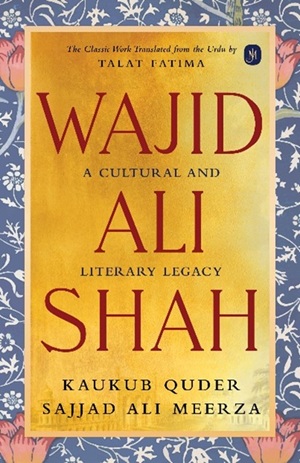
History remembers Wajid Ali Shah as a dethroned Nawab, but this book by Kaukub Quder Sajjad Ali Meerza restores him as a poet-king whose passion for thumri, kathak, and theatre outshone his political fate. Dr Sudhirendar Sharma's review highlights how the misunderstood ruler emerges as a cultural icon, reclaiming his place in India’s artistic heritage.
The king who didn’t win any war but knew how to dance
Sudhirendar Sharma
Given his creative urge and innovative temperament, Wajid Ali Shah enriched thumri as a style of song, sitar as a musical instrument, and kathak as a dance. Such was his aura in the realm of arts that those who were considered proficient became minnows before him. Even in exile from his beloved Lucknow to far away Calcutta, Wajid Ali Shah used the farewell of a bride from her father's home as a metaphor for his banishment while singing his own creation babul mora naihar chhooto jaye, a timeless classical thumri in raag bhairavi.
Nawab Wajid Ali Shah was neither a ruler of a huge empire, nor did he rule for a long period of time. The erstwhile ruler of Awadh in Lucknow is embedded in popular imagination as the ill-fated king, an opulence-loving character who lost his throne to the British. Known for his eccentricities, Shah never wielded his sword but painted the canvas of his kingdom with rich colors of music and dance. History often prefers narratives filled with battles and braveries, and that is perhaps the reason the British dethroned the king who pursued arts and aesthetics instead.
It remains a mystery till date why Wajid Ali Shah had his left breast and nipple artistically exposed between the gold borders of his royal dress all the time. Shah’s portrait in the picture gallery near the Husainabad Clock Tower in Lucknow was reportedly kept behind a curtain, because it is said that a British lady had fainted after seeing it. Such essentricites only contributed to justifying the nefarious designs of the British who didn’t waste time to dethrone him.
British historian Rosie Llewellyn-Jones constructed the imagery of the king through many facets of his personal and political life in The Last King of India. She wrote that the actual reign of the poet-ruler had lasted only nine years (1847- 56) but the erstwhile ruler spent the last 30 years of his life as a deposed ruler (on pension from the British East India Company) at Garden Reach near Calcutta, ruling a mock-kingdom with 6,000 subjects. Even in exile against all odds, he had continued pursuing his interests in arts and culture.
However, a deep dive into the realities of the 19th century reveals the real persona of the misunderstood king, who was undoubtly less of a king and more of a poet, and an author and a creative person par excellence. Dr Kaukub Quder Sajjad Ali Meerza, the great grandson of Wajid Ali Shah, challenges colonial narratives and highlights his artistic contributions that positions Awadh's last ruler as a major cultural force. By bringing his literary and poetic contribution into scholarship, Wajid Ali Shah reveals that the king was a multifaceted artist.
Originally written in Urdu, the 600-page volume has been translated by Dr Talat Fatima, the great-great granddaughter of Wajid Ali Shah, to widen its reach and correct historical misunderstandings. It introduces readers to Shah's lesser-known talents in poetry, drama, and architecture, and restores a neglected voice in rich cultural heritage.
As the book suggests, Wajid Ali Shah excelled in many fields of art and creativity. A teetotaler all his life, he had a fascination for Lord Krishna, and was sometimes referred to as Kanhaiya, which was reflected through his passion for grand theatrical events. Had he been born a century later, Wajid Ali Shah undoubtedly would have found a career in the film world, with the chance to realize, on an epic scale, rahas or dance drama he had directed in Lucknow – some of which lasted for over a month. History has seemingly been unkind to him, not crediting him as one of the most important cultural icon of his day and for the ebullient creativity he represented.
Wajid Ali Shah was born with remarkable creative abilities. He loved writing masanvi (free from rhyming), the longest of which has as many as 48,150 couplets. Amazing! He composed c to express his temporal love at the age of twenty-six and expressed his divine love at the age of sixty-two named Sabatul Quloob. Though written in persian, both of these reflect class. Wajid Ali Shah was a man of strong character and did not allow any woman to serve him unless she was married to him. No surprise, he is said to have married nearly 375 women, reflecting both his eccentricity and strong personal codes.
It is a brilliantly told historical account of a creative King who remained woefully mis-understood during his time, but one who comes out as a man of character who lived his life on his own terms.
Wajid Ali Shah
by Kaukub Quder Sajjad Ali Meerza
Translated by Dr. Talat Fatima
Hachette, New Delhi
Extent: 629 pages. Price: Rs. 1299

Sudhirendar Sharma is an independent writer, researcher and academic.

We are trying to create a platform where our readers will find a place to have their say on the subjects ranging from socio-political to culture and society. We do have our own views on politics and society but we expect friends from all shades-from moderate left to moderate right-to join the conversation. However, our only expectation would be that our contributors should have an abiding faith in the Constitution and in its basic tenets like freedom of speech, secularism and equality. We hope that this platform will continue to evolve and will help us understand the challenges of our fast changing times better and our role in these times.
About us | Privacy Policy | Legal Disclaimer | Contact us | Advertise with us