
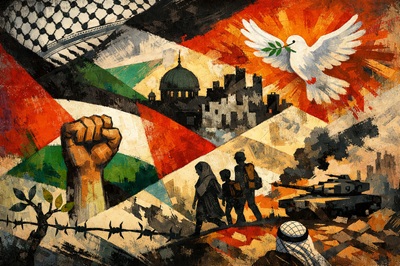
As with his earlier writings, Amandeep Midha's latest piece is also vivid, persuasive, and intellectually alert. It does not merely recount history; it asks why some histories are remembered more readily than others, and what it means when a wound is refused erasure. For readers who value thoughtful, well-argued commentary, this is an essay that deserves close attention.
Palestine: The Wound That Was Named, Not Made
Amandeep Midha
“Naming a wound is refusing to let it be forgotten, and impunity depends on forgetting.”
On 15 May 1948, the day after the British Mandate for Palestine formally ended, roughly 700,000 Palestinians — nearly half the Arab population of the land — were expelled or fled in fear from their villages, towns, and cities. They left behind some 530 villages, many of which were later demolished. Some carried house keys they believed they would use again within weeks. Their grandchildren still carry those keys. This is the Nakba: Arabic for “the Catastrophe.”
Most Indians have never heard the word. Those who have often encounter it through the prism of religion: a Muslim cause, an Arab grievance, a matter of Islamic solidarity. That framing is too narrow, and it obscures one of the most significant unresolved questions in modern international law.
The Nakba is not merely a religious event. It is a colonial event. It is a refugee event. It is an event that has more in common with India’s own history than many Indians are willing to acknowledge.
What 1947–48 Meant
The years 1947–48 marked the retreat of empire. Britain drew a line through Punjab in August 1947. Six months later, it withdrew from Palestine. In both cases, it left behind populations who had been promised incompatible futures, and structures of violence that would shape the region for generations.
India lost an estimated one million lives in Partition. Between 12 and 14 million people were displaced. We have named this. We have memorialised it. We have written novels and made films about it. We understand, deeply, what it means for people to be uprooted from the land where their ancestors are buried, not because of what they believed, but because of the category into which they were placed by colonial rule.
Palestinians were placed in a category too. They were the Arab majority on a land that the Zionist movement — shaped by European nationalism rather than Middle Eastern religion — sought to constitute as a Jewish-majority state. Displacement was not incidental to this project; a number of historians, including Israeli historians such as Benny Morris, have argued that it was, in significant measure, a planned outcome.
A Brief Chronology
1917 — The Balfour Declaration: Britain promises a “national home for the Jewish people” in Palestine, while also noting the rights of the “existing non-Jewish communities,” a contradiction it never resolved.
1947 — The UN Partition Plan (Resolution 181) proposes dividing Palestine. Arabs, who formed the majority and owned most of the land, reject it. The plan assigns 56% of the land to a Jewish state in which Arabs would make up about 45% of the population.
1948 — 14 May: the State of Israel is declared. 15 May: the British Mandate ends. The Nakba is already underway; the Deir Yassin massacre had occurred in April. By year’s end, more than 700,000 Palestinians have become refugees.
1949 — UNRWA, the United Nations Relief and Works Agency for Palestine Refugees in the Near East, is established by the UN General Assembly to provide relief and work assistance to Palestinian refugees.
1967 — The Six-Day War. Israel occupies the West Bank, Gaza Strip, Sinai, and Golan Heights. The occupation of Palestinian territory begins and continues to shape the conflict to this day.
2024 — The International Court of Justice rules that Israel’s occupation of Palestinian territory is unlawful and must end. The ruling is historic; compliance remains limited.
Why UNRWA Was Created
The United Nations Relief and Works Agency for Palestine Refugees, or UNRWA, was not created as an act of charity. It was created as a legal acknowledgment. The international community, in 1949, recognised that a specific population had been displaced in a manner that violated its rights, and that some form of remedy was necessary.
Because return was blocked, and because no state had the will or the power to enforce a settlement, UNRWA was established as a temporary body to care for refugees in the meantime. It was meant to be temporary. It has now existed for 75 years. Its continued existence is itself a measure of how unresolved the question of return remains.
UNRWA currently supports millions of registered Palestinian refugees and their descendants through education, healthcare, and basic relief. It is not simply a welfare scheme. It is also an institutional reminder that a wrong was done, has not been remedied, and continues to shape lives across generations.
Recent pressure on donor countries to reduce funding, including the temporary suspension of support by several Western governments in early 2024 after Israeli allegations concerning some staff members, should be understood in this context. Whatever one’s position on the allegations, to weaken UNRWA is not merely an administrative step. It also risks eroding the institutional memory of why the agency exists.
Why Mandela Spoke of Palestine
“We know too well that our freedom is incomplete without the freedom of the Palestinians,” Nelson Mandela said in 1997.
Mandela said this not as a Muslim or as a student of Islamic theology, but as a man who had spent 27 years in prison for the proposition that a system assigning rights by race or ethnicity is illegitimate.
The ANC’s support for Palestinian liberation was not religious solidarity. It was a recognition of structural parallels. Apartheid South Africa and Israel maintained warm relations for decades, including military cooperation, intelligence sharing, and a shared discourse of demographic management. The ANC saw in the Occupied Territories an architecture that was familiar: bantustans, passes, demographic separation, and security law used to suppress political organisation.
Mandela was joined over the years by figures such as Desmond Tutu, who explicitly compared what he saw in the West Bank to apartheid. He was also part of a wider anti-colonial tradition that linked struggles across regions on the basis of principle, not religion. India, too, was among the states that opposed the 1947 Partition Plan and later supported Palestinian self-determination in international forums.
None of this was driven by religious sentiment. It reflected a consistent principle: colonial dispossession does not become legitimate simply because it is ratified by power, time, or international procedure.
The Indian Response
The dominant Indian instinct on Palestine today, especially among the urban educated middle class, is often to read it through the lens of terrorism. October 7, 2023 was a horrific act of violence. Hamas carried it out. Hamas has an Islamist ideology. From this, some conclude that the Palestinian cause itself is Islamist, and that supporting it is equivalent to endorsing terrorism.
That conclusion is too crude. It would be like arguing that the Indian freedom struggle was invalidated by episodes of violence, or that the anti-apartheid struggle lost legitimacy because armed resistance formed part of it. Colonial resistance has rarely been neat. It has rarely been only Gandhi. That does not erase the underlying claim.
The Palestinian people are not Hamas. Gaza is not Hamas. The civilian population of Gaza, including a very large number of children, should not be reduced to a militant organisation. Many of them are descendants of families displaced in 1948 and still live with the consequences of that original rupture.
When Indians dismiss the Palestinian question as merely an Islamist issue, they flatten a complex historical and legal conflict into a single ideological frame. That may be emotionally convenient, but it is not serious analysis.
Reading the Nakba as an Indian
To read the Nakba as an Indian is not an act of religious solidarity. It is an act of historical literacy. It is the recognition that 1948 belongs to the same broad history as 1947, as empire, as partition, as the redrawing of lives by political power.
It is also a reminder that India’s own long-standing foreign-policy language has often emphasised self-determination, anti-colonialism, and non-interference. A foreign policy that supports Palestinian rights is therefore not an alien idea for India. It is closer to one strand of India’s own historical principle.
India was among the early countries to recognise the Palestine Liberation Organisation. It supported UN resolutions on Palestinian rights through much of the Cold War. The gradual warming of India-Israel defence and intelligence ties since the 1990s, and especially after 2014, reflects a strategic choice that deserves clear-eyed discussion rather than automatic justification.
The Key
In Palestinian homes across the diaspora, in Amman, Beirut, and the camps of Lebanon and the West Bank, there is often a key. It is usually an iron key, large and heavy, the kind that once opened the door of a house in Haifa, Jaffa, Lydda, or Jerusalem. Families have kept such keys for decades. Children have grown up hearing what house it opened, on what street, in what city now transformed by history.
No Indian who has read about Partition, or listened to the stories of families who kept photographs of houses they would never see again, should find this image unfamiliar. We know what this key means. We have our own versions of it.
The Nakba asks only that we extend to others the recognition we seek for ourselves: that displacement is displacement, that a wrong remains a wrong until it is addressed, and that time alone does not convert injustice into legitimacy.
It has never been simply about religion. It has always been about land, law, and the question of whether historical wrongs can be normalised by silence and time.
They cannot.
***********

Amandeep Midha is a technologist, writer, and global speaker with over two decades of experience in digital platforms building, data streaming, and digital transformation. He has contributed thought leadership to Forbes, World Economic Forum, Horasis, and CSR Times, and actively engages in technology policy-making discussions. Based in Copenhagen, Amandeep blends deep technical expertise with a passion for social impact and storytelling.

We are trying to create a platform where our readers will find a place to have their say on the subjects ranging from socio-political to culture and society. We do have our own views on politics and society but we expect friends from all shades-from moderate left to moderate right-to join the conversation. However, our only expectation would be that our contributors should have an abiding faith in the Constitution and in its basic tenets like freedom of speech, secularism and equality. We hope that this platform will continue to evolve and will help us understand the challenges of our fast changing times better and our role in these times.
About us | Privacy Policy | Legal Disclaimer | Contact us | Advertise with us