This article by Amandeep Midha masterfully draws a parallel between the Opium Wars and the modern fentanyl crisis, highlighting a striking role reversal in US-China dynamics. Its elegant prose and historical depth make it compelling reading.
Amandeep Midha
In the autumn of 1839, Commissioner Lin Zexu sat in Canton and wrote a letter to Queen Victoria. It was a patient, precise document, a moral appeal from one civilisation to another. He asked her to stop the East India Company from flooding China with opium. He pointed out that Britain would not permit the drug on its own streets. He asked, with genuine philosophical curiosity, how a government that protected its own people from a poison could justify exporting that same poison to another people. He received no reply. The following year, British warships arrived.
What followed then is what China calls the “Century of Humiliation”, and the name is not hyperbole. The Treaty of Nanking in 1842 forced China to cede Hong Kong, open five ports on foreign terms, and pay reparations for the opium it had tried to destroy. More unequal treaties followed, with Britain, France, Russia, Japan, each extracting another concession, another port, another slice of sovereignty. Japan's victory in 1895 was perhaps the most psychologically devastating, because it came not from a distant Western empire but from a neighbour that had simply modernised faster. The Boxer Indemnity of 1901 was the final humiliation of that sequence: eight foreign powers occupied Beijing, looted the imperial capital, and imposed reparations so enormous China took until 1939 to finish paying them.
The century did not merely weaken China materially. It fractured its sense of civilisational centrality, the deep assumption held for millennia that China was the middle kingdom, the natural organising point of world affairs. Every Chinese leader since Mao has governed in the shadow of that fracture. Xi Jinping has been more explicit about it than any predecessor. His governing slogan, the great rejuvenation of the Chinese nation, is not primarily an economic project. It is a civilisational one. The century of humiliation is not history to Xi. It is the brief to be reversed.
That is the history. Now consider what is about to happen.
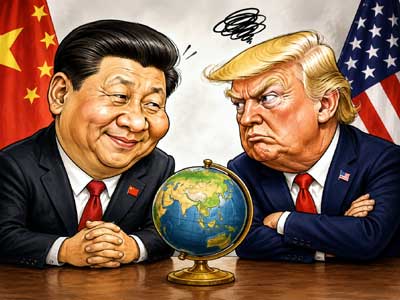
Donald Trump is preparing to fly to Beijing. On the agenda, among other things: fentanyl. The flow of chemical precursors from Chinese factories to Mexican cartels to American streets, where the resulting synthetic opioid kills approximately 70,000 Americans every year. The American working class, already hollowed out by deindustrialisation, is being consumed by it. Entire counties in Ohio and West Virginia have been structurally altered by overdose death rates.
Trump is flying to Beijing to ask Xi to stop it. The most powerful elected leader in the world, travelling to the capital of a country once forced to sign humiliating treaties at gunpoint, to appeal for relief from a substance flowing from its territory and destroying his population.
Lin Zexu wrote his letter in 1839. He got warships. Trump is bringing tariffs. History does not always repeat. Sometimes it simply reassigns the roles.
The Structure of the Inversion
This is not a claim that Beijing designed Fentanyl as a weapon. What is not contested is that China's chemical industry produces the precursor compounds, that the Chinese state has the regulatory capacity to restrict that production, and that it has not exercised that capacity with anything approaching the seriousness the crisis demands. Whether that is deliberate strategy or the rational indifference of a government that sees limited incentive to solve an adversary's domestic problem is, in a meaningful sense, beside the point. The structural outcome is the same.
One civilisation's social fabric is being corroded by a substance the other civilisation profits from, or at minimum, declines to stop. The drug changes. The architecture does not.
The Opium War was never really about opium. It was about trade imbalance, market access, and one civilisation refusing to accept the other's terms. The Fentanyl crisis is never really about fentanyl. It sits inside a larger confrontation: trade imbalance, technology decoupling, Taiwan, the South China Sea, the fundamental question of which civilisation writes the rules of the next century. The drug is the headline. The contest underneath is the same one it has always been.
What India Carried
India is not a bystander to this history. The opium that destroyed Chinese society in the nineteenth century was not produced in Britain. It was grown in Bengal and Bihar, processed at the Patna and Ghazipur factories, and shipped through Calcutta to Canton, today's Guangzhou. India was the cheap factory floor of the original chemical war, its agricultural capacity used as the mechanism to bleed China.
Independent India carries no policy guilt for this. But it is worth remembering when India now observes, from a position of genuine strategic freedom, the civilisational reckoning playing out in Beijing's summit rooms. India was once the instrument of someone else's war. It is nobody's instrument now. The Western powers that seek to woo India today against China have not fully internalised this. Their approach remains transactional, a new utility for an old pattern, and India recognises the pattern precisely because it has lived inside it before. What India brings to its observation of the Trump-Xi summit is therefore not moral superiority but something more durable: the clarity of a country that has been on every side of this kind of confrontation and learned, at considerable cost, what each side feels like from the inside.
Two Men, Two Timescales
Trump thinks in deals. Xi thinks in centuries. This asymmetry is the most important and least discussed feature of the US-China confrontation.
The pattern across both his terms speaks for itself. In his first term, Trump withdrew from the Trans-Pacific Partnership on his very first day in office, before the ink of his inauguration had dried. He walked out of the Paris Agreement on climate change, pulled the United States out of the Iran nuclear deal branding it the worst deal ever, a deal that had taken two years and hundreds of specialists to construct, withdrew from UNESCO, walked out of the UN Human Rights Commission, ended funding for the UN agency UNRWA supporting Palestinian refugees, and terminated US membership in the WHO. He has destabilised NATO burden-sharing commitments, leveraged Ukraine's survival as a bargaining chip, and spent two years lecturing allies about the existential dangers of economic dependence on China.
And now he is flying to Beijing to ask China for a favour.
The man who tore up every agreement he did not personally author, who shamed allies for engaging with adversaries, who made unreliability a governing philosophy, is travelling to the capital of the country he has spent two terms demonising, to request its cooperation. There is a word for this. It is not statesmanship. It is not even pragmatism. It is the behaviour of a power that has spent its credibility so freely it must now negotiate without it.
Xi will receive him knowing exactly what Trump's commitments are worth. The room understands the asymmetry before a word is spoken.
Trump will arrive with tariffs as his instrument, fentanyl as his grievance, and Taiwan as the card he may or may not play. Xi will receive him with formal courtesy, make commitments on precursor chemistry sufficient to satisfy the press conference, and return to the longer work that is his actual mandate.
When Xi receives Trump's fentanyl appeal, he will be receiving it as the leader of a civilisation that made the same appeal 187 years ago and received warships in reply. That history will be present in the room. It is always present. It is the wallpaper.
Trump is not the first Western leader to arrive in Beijing hoping to resolve a civilisational reckoning with transactional pragmatism. The invoice from that century is not denominated in dollars. It is denominated in sovereignty, in centrality, in the right to write rules for its own civilisation. Fentanyl is one line item on a very long document. Trump will not be the last Western leader to leave Beijing having settled less than he arrived expecting to.
*************************

Amandeep Midha is a technologist, writer, and global speaker with over two decades of experience in digital platforms building, data streaming, and digital transformation. He has contributed thought leadership to Forbes, World Economic Forum, Horasis, and CSR Times, and actively engages in technology policy-making discussions. Based in Copenhagen, Amandeep blends deep technical expertise with a passion for social impact and storytelling.

We are trying to create a platform where our readers will find a place to have their say on the subjects ranging from socio-political to culture and society. We do have our own views on politics and society but we expect friends from all shades-from moderate left to moderate right-to join the conversation. However, our only expectation would be that our contributors should have an abiding faith in the Constitution and in its basic tenets like freedom of speech, secularism and equality. We hope that this platform will continue to evolve and will help us understand the challenges of our fast changing times better and our role in these times.
About us | Privacy Policy | Legal Disclaimer | Contact us | Advertise with us