
In early 1982, while preparing for the entry-level examination for a government media post under the then Central Information Service, later restructured as the Indian Information Service, I was called for an interview after clearing the written test. One question from the panel has stayed with me ever since. I was asked why the BBC was regarded as more credible than local media, meaning AIR, at a time when there was no private electronic media in India. The question irritated me, especially because Britain and Argentina were then engaged in the Falklands War. I responded by asking how the BBC could claim greater credibility while taking what appeared to me to be a plainly partisan stand on the Falklands. That answer — or perhaps that counter-question — seemed to be well received, and I cleared the test.
This article by Amandeep Midha brought that memory back. Its central argument is clear: ownership, ideology, and editorial framing can shape journalism even in systems that claim to be neutral. Midha places an old debate in a current context and raises questions that remain highly relevant today. For anyone interested in media, whether as a reader or a practitioner, this is a worthwhile article.
The Receipt
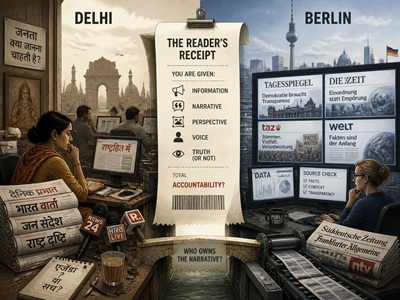
A Letter to Readers in Delhi and in Berlin
Amandeep Midha
This writing is for two readers at once. The Indian who has spent a lifetime being lectured by the European press, and the European who has spent a lifetime believing his press was the one that lectured fairly. Neither needs scolding. Both deserve a mirror held steady.
For thirty years the European press has held a particular place in the global imagination. Press freedom. Editorial independence. The wall between the owner and the newsroom. India’s press is communal. Russia’s is the Kremlin. China is the party. Turkey is Erdoğan. Only the European press, the story went, was free.
Many believed it. European universities taught it. Rankings reinforced it. Many Indian editors quietly accepted that the gold standard was being printed somewhere west of the Rhine.
Now read what the chief executive of one of Europe’s largest media empires has told his own staff. Not an Indian columnist’s accusation. His own words.
On 30 April 2026, in a meeting whose audio was reported by Jewish Insider, Mathias Döpfner of Axel Springer told employees the company has “essentials,” that anyone uncomfortable with them should find another employer. He listed them: freedom, free markets, individual liberty, freedom of expression. And then, placed immediately alongside these, support for the State of Israel. A leaked email earlier published by Die Zeit was less symbolic in phrasing: Zionism above all else. Israel is my country.
One can pause on the architecture of that sentence briefly. Not the politics around it, but the sheer architecture of editorial intent. Axel Springer owns Politico, the Telegraph, Bild, and Business Insider. Their owner has, in writing, ranked a foreign state as a defining commitment of his empire. The reader who has bought these papers for years was never told.
Imagine the reverse. If a German editor had written “Germany above all else,” how long would he last? If a French editor wrote “La France d’abord,” would the Telegraph defend him? If an Indian editor in a major newsroom had openly declared “India first, above all editorial balance,” would it be treated as patriotism, bias, or an editorial scandal? We know the answer. These same papers have ended careers for sentences far gentler than the one their proprietor has signed his name to.
This is not a charge against any individual reader. It is a charge against a structure. Bias is a tilt. Hypocrisy is a structure. The structure has built its global moral authority on a rule it has, in writing, declared inapplicable to itself.
It gets worse. In that same April meeting, Döpfner instructed his staff that calling Iran’s leadership “aggressors” was too soft. The correct word, he said, is “terrorists.” “Mass murderers.” The owner is no longer suggesting. He is correcting vocabulary. The same owner who insists there is a wall between his opinion and his newsrooms. There is no wall. There never was.
A thought experiment. If Rupert Murdoch had been European, this conversation would have happened a generation earlier. The method was European in everything but passport. Buy the title. Install the editor. Set the line. The Sun for Thatcher. Fox News through the post-Iraq era. The Times of London adjusted in quieter ways. An Anglosphere taught what to think about Brussels, Beijing, Tehran and Delhi through a small number of concentrated editorial hands whose loyalties were never publicly interrogated. Döpfner has merely written down what Murdoch operated for decades without paperwork.
In India, some journalists have long used the term “embedded journalism,” including journalists such as Ravish Kumar, to describe the proximity between power, narrative, and reportage. The instinct is not misplaced. But even that framing sometimes inherits an older assumption, that Western institutions remain, by default, the reference point for journalistic purity. That assumption deserves re-examination, not reverence. The issue is not East versus West. It is the quiet normalisation of ownership and ideology everywhere it hides behind the language of independence.
And before any Indian reader feels too comfortable, the mirror must turn. Indian newsrooms have their own essentials, less written, no less real. Owners with political phones to answer. Editors who have learned which stories age out by morning. The disease is ownership without disclosure, wherever it occurs.
There is a reason older works of political cinema still feel uncomfortably contemporary. Films such as New Delhi Times, recently resurfaced on platforms like YouTube, are worth revisiting, not as nostalgia, but as reminder. They show how editorial proximity to power, ownership interests, and narrative framing are not regional anomalies. They are structural conditions.
What they also reveal, when watched today, is something more disquieting. The mechanics of influence are not uniquely Indian or uniquely Western. They are simply more openly theorised in some contexts than others. The Western press, often held up as the benchmark, operates within the same incentives: ownership, alignment, access; but wraps them in a more polished language of institutional neutrality.
We were told they were pipes. Then platforms. Now arbiters. Somewhere along that journey, they also became editors, without ever accepting the responsibilities of editors.
Open Instagram or X and observe the labels. Accounts linked to Al Jazeera are marked “Qatari Government.” Chinese outlets carry “Chinese Government.” Russian outlets, “State-Affiliated Media.” The label is precise, persistent, and visible before a single word is read.
Now perform the same exercise for outlets backed by Western states or aligned closely with Western foreign policy ecosystems. The label softens. It disappears. Sometimes it was never there.
Ask yourself why.
This is not a conspiracy. It is more mundane, and therefore more powerful. Power rarely needs to hide when it can define neutrality itself. The platform does not need to censor. It needs only to be classified. To frame. To signal, before the reading begins, which voice arrives with a question mark attached and which arrives with an invisible seal of normalcy.
The reader thinks he is choosing. The architect has already chosen the terms of his choice.
This is the European myth in its digital afterlife. The same civilizational confidence that once declared objectivity to be geographically located now expresses itself in code. Labels are not applied simply on state ownership. They are applied based on distance from a moral center that no one voted for, yet everyone is expected to recognise.
The result is elegant. You do not have to ban Al Jazeera. You mark it. You do not have to silence Beijing. You prefix it. You do not have to argue with Moscow. You annotate it. And in doing so, you shift the burden of proof permanently onto the speaker, never onto the listener.
But where is the label for alignment?
Where is the tag that reads: “Consistently supportive of NATO frameworks”? Where is the quiet disclaimer: “Editorial line historically aligned with U.S. foreign policy objectives”? Where is the small grey text beneath certain headlines: “Ownership interests intersect with political lobbying ecosystems”?
It does not exist. Because that would require the system to describe itself.
And systems, like empires, are rarely fluent in self-description.
What is the deeper injury, common to readers in Berlin and Delhi alike? Journalism is a trade. The injury is to the wisdom of a society. A society does not think with its brain. It thinks with its information diet. Feed it for decades on copy curated by men with declared loyalties they never named, and it loses the muscle.
The Soviet citizen at least knew his Pravda was directed. He listened to the BBC under a blanket. He survived because he never confused the paper for the world. Readers of any free press today often do. That is the wound.
So what is left for any of us who want to remain literate?
Read laterally. Open Haaretz, Daily Sabah, Al Jazeera, the South China Morning Post on the same morning. Read Le Monde alongside The Hindu and The Indian Express. Read primary filings, not just summaries. Notice what your paper does not cover. Absence is information. What your paper refuses to print is its confession.
Read slowly. The doctrinal press lives on speed. Push notifications. Briefings. Threads. Wisdom dies at that tempo. Sit with a fact longer than the news cycle wants. Ask who owns this paper, who funds this think tank, who appointed this editor. The answers are rarely far away.
Döpfner has done all of us a favour he did not intend. He has issued a receipt: support, or leave. Frame it. Place it where you eat breakfast—in Berlin or in Delhi.
Beneath it, write the only honest reply a literate world can still afford:
We will neither support nor leave. We will read past you. That is the work. It belongs to readers.
************

Amandeep Midha is a technologist, writer, and global speaker with over two decades of experience in digital platforms building, data streaming, and digital transformation. He has contributed thought leadership to Forbes, World Economic Forum, Horasis, and CSR Times, and actively engages in technology policy-making discussions. Based in Copenhagen, Amandeep blends deep technical expertise with a passion for social impact and storytelling.
Disclaimer : The views and opinions expressed in this article are those of the author and do not necessarily reflect the views of is web magazine. The article is published in good faith for informational and editorial purposes.

We are trying to create a platform where our readers will find a place to have their say on the subjects ranging from socio-political to culture and society. We do have our own views on politics and society but we expect friends from all shades-from moderate left to moderate right-to join the conversation. However, our only expectation would be that our contributors should have an abiding faith in the Constitution and in its basic tenets like freedom of speech, secularism and equality. We hope that this platform will continue to evolve and will help us understand the challenges of our fast changing times better and our role in these times.
About us | Privacy Policy | Legal Disclaimer | Contact us | Advertise with us