
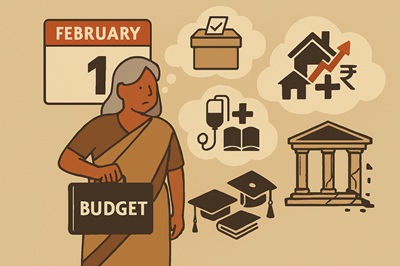
The Union Budget for the financial year 2026–27 is scheduled to be presented tomorrow, on a Sunday. Analysts expect it to be a populist budget, given its timing close to assembly elections in some states. The middle class, as always, looks forward to further income tax reliefs. Our columnist, K.G. Sharma, argues for making public systems more reliable—a pious hope, or perhaps wishful thinking, in these times when healthcare and education are gradually being handed over to the private sector, while public institutions in these areas continue to crumble.
Why we need fewer announcements and a roadmap for stronger public systems in Budget
Krishan Gopal Sharma
As Budget debates grow louder and more theatrical each year, the everyday concerns of ordinary citizens often fade into the background. A practical budget is not judged by applause or headlines, but by whether it quietly strengthens the public systems that allow people to live, plan and aspire with dignity.
Beyond the Noise of Budget Day
Budgets are usually remembered for what they announce, not for what they quietly fix. On Budget day, public discourse is dominated by headline figures, political exchanges and symbolic gestures. Yet for most citizens, the real test comes later — when the noise subsides and daily life resumes. What matters then is not rhetoric, but whether essential public services work reliably enough to reduce uncertainty in ordinary lives.
For a large section of Indian society, dignity is shaped by modest but fundamental realities: whether children can attend school without disruption, whether illness leads to care rather than debt, whether food and medicines remain affordable, and whether daily travel to work is safe and predictable.
The Case for Quiet Repair
The realistic expectation from this year’s Union Budget is not dramatic reform, but quiet repair — the repair of public systems that shield citizens from the volatility of markets in essential areas such as education, healthcare, food security and mobility. When these basics are assured, families can plan, aspire and progress with confidence rather than merely cope with uncertainty.
Quiet repair may lack spectacle, but it delivers something far more valuable: reliability. A staffed school, a functioning health centre or a dependable bus service improves everyday life more meaningfully than repeated policy reinventions.
Education: Certainty, Continuity and Trust
Education illustrates why repair matters more than reinvention. Over recent years, faculty shortages, examination delays, administrative diversion of teachers and the consolidation or closure of neighbourhood schools have steadily eroded trust in public education.
While successive budgets have increased education allocations in absolute terms, outcomes on the ground remain uneven. Parents and students are not asking for novelty. They are asking for continuity — full classrooms, predictable academic calendars, and access to essential learning materials without financial strain. Education should offer confidence and stability, not anxiety.
Healthcare: Reducing Fear Before Reducing Costs
Healthcare remains one of the most immediate sources of household anxiety. Despite incremental increases in public health spending over recent budgets, access to reliable primary care remains uneven. The weakening of first-point facilities pushes families towards private providers even for routine treatment, sharply increasing out-of-pocket expenditure.
Insurance schemes, while useful, cannot substitute for functioning public clinics. A dignity-centred approach prioritises staffing, diagnostics and medicines at the local level so that illness does not immediately translate into financial distress.
Essentials Beyond Market Volatility
Certain essentials — food, basic medicines, educational necessities and public transport — cannot be left entirely to market forces without exposing vulnerable households to instability. These are not discretionary purchases; they are foundations of daily life.
When prices fluctuate sharply or access becomes uncertain, the burden falls disproportionately on the poor, women, children and the elderly. A practical budget recognises that while markets drive efficiency, dignity requires public guarantees.
Employment: Stability Over Symbolism
Employment remains among the most sensitive expectations from any budget. Citizens do not expect instant solutions to a complex challenge, but they do expect seriousness and coherence.
This means sustained support for micro, small and medium enterprises, skill development aligned with real labour demand, and encouragement of labour-intensive sectors that create stable jobs rather than episodic opportunities. Employment is not merely income; it is dignity, predictability and self-worth.
What Would a Dignity-Centred Budget Actually Provide?
If these expectations are to be met, the budget must translate intent into credible provisions, not additional announcements.
First, it would adopt a repair-first approach, prioritising staffing, maintenance and operations of existing schools, colleges and health centres before launching new schemes. Time-bound filling of teacher and healthcare vacancies would signal seriousness more than any new programme name.
Second, it would create ring-fenced allocations for primary education and primary healthcare — ensuring that neighbourhood schools and clinics remain functional, with guaranteed provision of essential textbooks and generic medicines. This would reassure families that access to learning and care will not depend on market prices or administrative discretion.
Third, the budget would focus on predictability in essentials. Stable funding for food security, affordable public transport for workers, students and the elderly, and mechanisms to prevent sudden price shocks would directly reduce daily household anxiety.
Fourth, employment provisions would favour durability over symbolism. Instead of headline job targets, sustained support to MSMEs, predictable regulatory environments and skill programmes tied to verified employment outcomes would offer real security.
Finally, governance itself would become part of the budget’s credibility. Consolidating overlapping schemes, publishing clear eligibility rules and outcome indicators, and investing in last-mile delivery would address concerns repeatedly raised by audit institutions. After years of scheme-driven governance, citizens now value clarity over proliferation.
At its heart, such a budget would consciously aim to create space for individual planning — allowing families to plan education, healthcare, work and savings without constant fear of sudden shocks.
Reframing the Budget Conversation
Yet even a well-designed budget risks losing meaning if public debate remains trapped in spectacle. Budget day discussions are often reduced to shouting matches over numbers and narratives, while the implications for ordinary households are buried in fine print.
A practical budget should compel a different set of questions the morning after:
Will the cost of living fall or rise?
Will access to education and healthcare improve?
Will daily life become more predictable for the poor, the vulnerable and the working household?
The onus should lie on the budget to demonstrate its impact on everyday dignity.
A Constitutional Measure of Success
India’s democracy is anchored not merely in elections or growth metrics, but in the constitutional promise of dignity, equality and opportunity. A budget faithful to that promise does not require theatrics. It requires steadiness.
When governance focuses on quiet repair — making public systems reliable, accessible and fair — trust is rebuilt not through slogans, but through lived experience. A republic grounded in constitutional values deserves such a budget.
*********

The author is a retired officer of the Indian Information Service and a former Editor-in-Chief of DD News and AIR News (Akashvani), India’s national broadcasters. He has also served as an international media consultant with UNICEF in Nigeria and continues to write on politics, media and ethics.
(Views are personal.)

We are trying to create a platform where our readers will find a place to have their say on the subjects ranging from socio-political to culture and society. We do have our own views on politics and society but we expect friends from all shades-from moderate left to moderate right-to join the conversation. However, our only expectation would be that our contributors should have an abiding faith in the Constitution and in its basic tenets like freedom of speech, secularism and equality. We hope that this platform will continue to evolve and will help us understand the challenges of our fast changing times better and our role in these times.
About us | Privacy Policy | Legal Disclaimer | Contact us | Advertise with us