
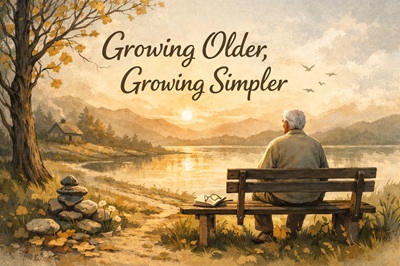
This piece by Frank Noronha is neither a poem nor a conventional article — it's a personal philosophical essay or you may like to call it a "reflective essay" or "meditation." The form is quite deliberate: short paragraphs, occasional one-line statements standing alone, almost like verse at times. This is a stylistic choice to give the writing a contemplative, unhurried quality. The central theme is aging as simplification and awakening, not decline. Frank uses the Mahabharata story of King Yayati as a springboard to reflect on how, as we grow older, we naturally (or ideally) shed the noise of ambition, social performance, ego-defence, and fear — and return to something quieter and more essential in ourselves. Read it as Frank wrote it — unhurriedly, and with an open mind.
Growing Older, Growing Simpler: Reflections on Age, Understanding, and the Quiet Return to Oneself
Frank Noronha
A dear friend, Santosh, recently shared with me a beautiful reflection based on the story of King Yayati from the Mahabharata, explaining why in South Indian tradition certain ages - 60, 70, 80, 90, and 100 - are celebrated with such significance.
I must thank Santosh profusely for sending it to me. It was not merely an interesting cultural explanation but something deeply reflective and quietly illuminating. It felt less like reading about tradition and more like holding a mirror to my own life.
The story of King Yayati is simple yet profound.
He had everything - power, pleasure, wealth, success, authority. Yet when old age arrived suddenly, he was shaken. In that confrontation with aging, he discovered a truth that perhaps all human beings must eventually face:
*Pleasures have limits, but desires do not.*
That sentence alone contains enormous wisdom.
We spend so much of life believing that one more achievement, one more possession, one more recognition, one more security will complete us. Yet desire has no natural ending. It simply changes shape and continues. At some point, one begins to see this not as philosophy, but as lived fact.
This is where the five turning points described in the article become meaningful - not merely as birthdays but as inner milestones.
Sixty: Priorities Change
At sixty, the emphasis shifts from accumulation to understanding.
The question slowly changes from:
“What more can I get?”
to
“What truly matters now?”
This is not renunciation in a dramatic sense. It is clarity.
The need for applause weakens. Social performance becomes tiring. One begins to ask quieter questions. Much of what once seemed urgent loses its importance.
I find this deeply relatable.
At sixty-eight, I can see this movement clearly within myself. I no longer feel drawn toward social games, unnecessary gatherings, formal obligations or maintaining appearances. It is not bitterness. It is simplification.
A few genuine conversations, silence, meaningful presence, a simple meal, a good book, sometimes even watching a film quietly at home - these feel more real than the restless pursuit of relevance.
Seventy: Peace Becomes Greater Than Proving
This insight touched me deeply because it mirrors something another dear friend recently wrote to me.
She said that much of human life is still driven by old tribal patterns - belonging, approval, hierarchy, fear of exclusion, fear of being misunderstood. We think we are making choices freely but often we are simply responding to ancient conditioning.
How true this is!
How often do we attend events we do not want to attend, maintain relationships we do not truly inhabit and say yes when our inner being is quietly saying no?
Not because we are loving.
But because we fear judgment.
Because we want to be accepted.
Because old conditioning moves before conscious choice.
At some point, peace becomes more valuable than proving oneself.
Not rebellion. Not withdrawal. But a clean and quiet simplicity.
As she beautifully put it:
“A ‘yes’ that is light. A ‘no’ that is clean.”
That, to me, feels like true freedom.
Eighty: Presence Itself Becomes Healing
By eighty, perhaps words matter less.
One’s very presence begins to communicate something deeper than advice.
People do not come seeking answers alone. They come seeking stillness.
A human being who has lived, suffered, observed and softened becomes a kind of silent reassurance.
There is a grace in those who no longer need to impress.
Their very being says:
“Life can be lived. Everything passes. Be at peace.”
I saw something of this while watching my own brother through his final illness.
The body was weakening, the medical interventions increasing and the outer drama intense. Yet somewhere beneath all of that there was a strange stillness. A silent witnessing. Not emotional drama, not philosophy - just a deep not-knowing.
That stillness taught me more than many books.
Ninety: The Ego Quietly Retires
There is a beautiful phrase in the article:
“You no longer feel the need to correct others.”
What freedom lies in that.
How much of life is spent defending identity.
My opinion.
My belief.
My hurt.
My role.
At some point, if one is fortunate, one begins to see how exhausting that burden is.
You stop asking:
“Am I right?”
and begin asking:
“Why must I be right?”
This is not weakness. It is maturity.
Even grief itself changes.
When my brother passed away, I noticed something surprising: I was not grieving in the dramatic way people expected. There were moments of moist eyes, yes, but mostly there was quietness.
People asked, “Are you sad?”
But what I felt was not sadness exactly. It was stillness.
And then guilt arose:
“Am I hard-hearted?”
But perhaps love does not always appear as emotion.
Sometimes love appears simply as presence.
As showing up.
As sitting beside a hospital bed.
As whispering, “Be at peace. Don’t struggle too much.”
As allowing someone to go.
One Hundred: Life Moves Beyond Personal Story
At a hundred, perhaps one no longer lives as an “individual” in the usual sense.
One sees life whole.
The urgency softens.
The personal drama becomes lighter.
One begins to sense that life was never truly under personal control anyway.
This is where another question enters:
Does understanding come with age?
Or does it come whenever it comes?
I am not sure.
I do not believe wisdom belongs automatically to age. There are young people with extraordinary clarity and old people still trapped in endless ambition.
Nor do I know whether we truly possess free will in the way we imagine.
Sometimes it feels as though life is already scripted, unfolding like a river. We call it “my decision,” but perhaps much is already moving through us.
Still, whatever the philosophy may be, one fact remains:
Whenever understanding comes, it comes then.
That is what matters.
Not whether it came at forty or seventy.
Not whether it was earned or given.
Only that it is seen.
A Mirror, Not a Judgment
This story from Santosh is valuable not because it tells us how we should be but because it offers a mirror.
Not to make ourselves right.
Not to make ourselves wrong.
But simply to look.
Where am I living from?
Accumulation or clarity?
Performance or peace?
Fear or simplicity?
Am I still trying to become someone?
Or am I beginning to return to what I already am?
That, perhaps, is the real celebration.
Not the birthday.
But the quiet purification of the human being.
Final Thought
To grow old is not to become less.
It is to become simpler.
Purer.
Kinder.
Less interested in appearance.
More available to truth.
Less concerned with possession.
More available to peace.
And perhaps that is what our sages were really celebrating all along.
Not age.
But awakening.
For that reminder, I remain deeply grateful to Santosh.
It is indeed a beautiful and inspirational story.
**********
Frank Noronha's previous article in this web-magazine was equally reflective :
The Grave of Attention: Reflections by Frank Noronha
Frank Noronha IIS ( Indian Information Service) is a retired Principal Director General, Press Information Bureau, Government of India, compiler of two volumes of interviews with philosopher U.G. Krishnamurti, and Managing Trustee of a charitable trust in Bengaluru supporting underprivileged children.

We are trying to create a platform where our readers will find a place to have their say on the subjects ranging from socio-political to culture and society. We do have our own views on politics and society but we expect friends from all shades-from moderate left to moderate right-to join the conversation. However, our only expectation would be that our contributors should have an abiding faith in the Constitution and in its basic tenets like freedom of speech, secularism and equality. We hope that this platform will continue to evolve and will help us understand the challenges of our fast changing times better and our role in these times.
About us | Privacy Policy | Legal Disclaimer | Contact us | Advertise with us