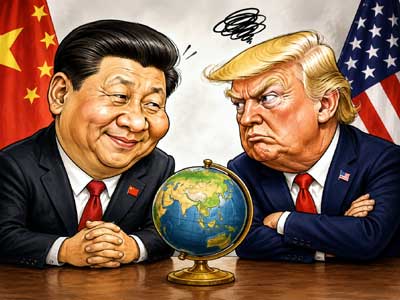
Amandeep Midha does not spare the developed world in this scathing indictment of the West. His argument is that the 2026 World Cup is not merely a sporting event; it is also a test of who gets to enter, who gets to watch, and who gets to speak. In this reading, the tournament becomes as much about borders and power as about football. Midha’s central claim is that visa policy and border enforcement have already made access unequal before the first whistle is blown.
World Cup 2026 and the Selective Morality of Western Gatekeepers
Amandeep Midha
The 2026 FIFA World Cup is not being written about by sportswriters. It is being written about by immigration lawyers. That alone tells you everything about the theatre masquerading as a global sporting celebration.
Rewind to 2022. Qatar hosted. The Western media apparatus descended with relentless moral certitude. Human rights, labour conditions, migrant workers, the death toll of stadium construction. The coverage was unyielding and, importantly, framed as an act of civilisational conscience. Newspapers editorialised. Universities hosted symposiums. The narrative was simple: the West would not let an autocratic state evade accountability through the currency of sporting spectacle.
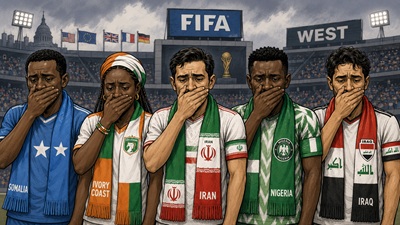
Germany’s players covered their mouths during their team photo before the match against Japan, protesting FIFA’s refusal to allow rainbow-themed armbands that were viewed as a symbolic protest against laws in Qatar, where homosexuality is illegal. The German football federation declared at that moment: “This is not a political position; human rights are not negotiable.” That statement had resonance. It suggested a principle. That when the West gathers for sport, it draws a line: certain values transcend national boundaries and sovereign prerogatives.
Four years later, in 2026, the tournament lands on the continent whose values produced that very gatekeeping. The United States, Canada, and Mexico. And suddenly, the moral architecture inverts entirely.
The same German team that silently declared “human rights are not negotiable” in Qatar now plays in the United States. They face opponents who have been humiliated at the border. They compete in a tournament whose host nation has denied entry to a Somali referee of the year. They watch as visa bonds of fifteen thousand dollars exclude entire nations. And they remain silent. The German sporting director Rudi Voeller has urged players to avoid making political statements. There will be no specialist media training on the issues. The mouth will remain uncovered.
Consider the specifics. Omar Abdulkadir Artan, a Somali referee set to become the first from his country to officiate at a World Cup and named referee of the year in 2025 by the Confederation of African Football, was denied entry into the United States by Customs and Border Patrol citing “vetting concerns” despite having been vetted by the Department of State and issued a valid visa. A man at the apex of his profession, honoured by his peers, turned back at the border. Not because he lacked documentation. But because a bureaucracy decided, unilaterally, that his nation’s geopolitical status trumped FIFA’s authority and his professional credentials.
This is not a border control issue. This is a statement about who belongs at the table when the world gathers to play.
Iranian federation staff members, more than a dozen of them including federation president Mehdi Taj, were denied visas. The U.S. permitted Iranian players entry only days before their first match and restricted the team to entering the United States only on match days, forcing them to base their operations in Tijuana, Mexico, despite playing their entire group stage on the U.S. West Coast. An entire nation’s support apparatus, dismantled by visa denial. A team forced to commute across an international border on match days as though they were visiting contractors, not sovereign representatives in a tournament their federation pays to join.
Aymen Hussein, Iraq’s star player, and the Iraq team photographer were both detained and questioned by Customs and Border Patrol for seven hours at Chicago’s O’Hare airport when they attempted to enter the country. The message: you are permitted to play, but you will be made to feel that permission is conditional, temporary, revocable.
The architecture of exclusion extends further. A travel ban affecting citizens of 39 countries, including World Cup participants Haiti, Iran, Ivory Coast, and Senegal, has prevented most ordinary fans from those countries from obtaining visas to attend matches in the United States, though exemptions were granted for athletes, coaches, and essential support staff. A separate visa bond program initially required fans from five African nations to pay deposits of up to $15,000, a requirement that was temporarily suspended in May 2026 for ticketed fans.
Fifteen thousand dollars to attend a football match. Let that settle. A Senegalese or Ivorian family wishing to watch their nation play must post a bond equivalent to several months of wages. The stated rationale: security. The actual practice: rationing access by wealth, which is another word for rationing by race and geography.
The 2022 Qatar criticism had a surface logic. Labour conditions were genuine. Worker mortality was real. These facts matter. But they served another function in the Western imagination: they vindicated a particular story about who has the right to host, whose standards matter, which nations can be trusted with global platforms. The coverage was moralistic in tone precisely because it required that tone to obscure a simpler truth: the West was reasserting hierarchy. Qatar was permitted to host only if it would submit to external judgment about its worthiness.
Four years later, the United States hosts, and the West suddenly discovers that border sovereignty is sacred. That geopolitical status justifies exclusion. That a nation’s security apparatus can override international sporting norms because national security is self-evidently supreme. That a coach or administrator can be deemed untrustworthy not through transparent process but through confidential vetting that is never explained and never appealed.
International sports lawyer Khayran Noor stated that “human rights organisations and advocacy groups have repeatedly raised concerns regarding immigration enforcement practices and treatment of migrant communities in the US.” The silence from the institutions that spent 2022 lecturing Qatar is not accidental. It is constitutional to the entire enterprise. Moral outrage at non-Western states doubles as permission to practice unremarkable authoritarianism when the West plays host.
The structure of this hypocrisy is worth naming. In 2022, Western media treated human rights discourse as universal. In 2026, Western states treat sovereignty as an exception carved out specifically for themselves. A Somali referee cannot enter because his nation is on a travel ban list. A Tanzanian journalist cannot cover the tournament because her nation is designated as high-risk. An Iranian team official is denied because “vetting concerns” is a phrase that requires no elaboration.
In Qatar, the West demanded transparency, accountability, and adherence to international norms. In 2026, the West improvises. It issues single-entry visas so that supporters cannot move freely between matches held in neighbouring countries. It denies visas to journalists from nations it has designated as hostile, achieving in practice what it would denounce as censorship if undertaken by a rival. It permits players to enter while choking off their support systems, a form of competitive degradation dressed in the language of security.
The 2022 World Cup criticism was not wrong. Labour exploitation was real. But it was never primarily about labour standards. It was about reasserting that the West sets the terms of global legitimacy. That non-Western states must pass a character test administered by Western institutions. That if you wish to host the world, you must first accept judgment from Washington, Brussels, and the Anglo-American media establishment.
This logic cannot withstand what has happened in June 2026. When the United States hosts, the character test evaporates. Security becomes paramount. Geopolitics override protocol. The referee who offended nobody and broke no law is sent home because his nation is inconvenient. The team is permitted to play but not to prepare. The fans are permitted to watch only if they can afford the bond.
The lesson to the world is not subtle. Hosting the World Cup is not an honour when you do not conform to Western alignment. It is a test of submission. Qatar 2022 was designed to communicate that the West would judge you. 2026 is designed to communicate that the West will simply exclude you, and that this exclusion is natural, obvious, and requires no justification beyond the utterance of a single word: security.
The football world has discovered that ceremony cannot survive this kind of truth-telling. That a tournament is a sham when its host nation weaponises the border against participants. That global sport only exists in the spaces the West permits it to exist.
In 2022, Qatar was told that human rights standards are non-negotiable. In 2026, those standards vanished the moment they would have applied to the West itself. That is not security policy. That is the foreign policy of an empire reconciling itself to decline by asserting raw power over the institutions it once shaped through consensus.
The archive will record this World Cup for what it is: the moment the West revealed that its commitment to universal standards is proportional to its structural advantage. When advantage erodes, standards are quietly shelved. The referee from Somalia learns this at an airport. The players from Iran learn it in Tijuana. The fans from the Global South learn it when calculating whether fifteen thousand dollars is a reasonable price for belonging.
The tournament continues. The matches will be played. Some teams will advance. But no one will mistake this for the “global celebration” the rhetoric promised. It is something far more instructive: a masterclass in how power maintains itself when ideology alone is no longer sufficient.

We are trying to create a platform where our readers will find a place to have their say on the subjects ranging from socio-political to culture and society. We do have our own views on politics and society but we expect friends from all shades-from moderate left to moderate right-to join the conversation. However, our only expectation would be that our contributors should have an abiding faith in the Constitution and in its basic tenets like freedom of speech, secularism and equality. We hope that this platform will continue to evolve and will help us understand the challenges of our fast changing times better and our role in these times.
About us | Privacy Policy | Legal Disclaimer | Contact us | Advertise with us