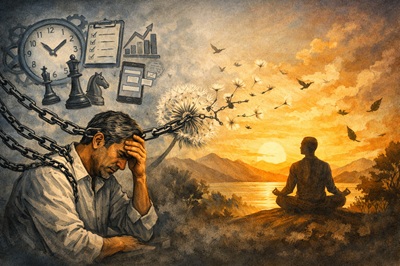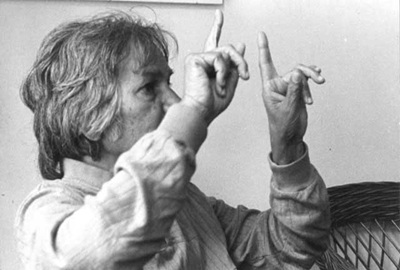
Few thinkers have unsettled the spiritual marketplace as radically as U.G. Krishnamurti. Often called the “anti‑guru,” he rejected every system of enlightenment, insisting that truth cannot be taught, only lived. He left behind no disciples, no method, and no movement—only a trail of minds forced to look inward without illusion. In his essay, What U.G. Really Gave Me – Part I, Frank Noronha revisits that encounter not as homage but as inquiry—how an unorthodox philosopher’s refusal to guide became, paradoxically, a form of guidance.
What U.G. Really Gave Me – Part I
Frank Noronha
People often ask me, "After spending more than forty years with U.G. Krishnamurti, what did he actually give you?"
It is an honest question. And perhaps my answer is not what most people expect.
The strange thing is that U.G. did not really give me anything.
He took things away.
He took away many of the answers I thought I had. He questioned almost every certainty I clung to. He quietly dismantled many of my spiritual ambitions. He left me with questions that were far more alive than the answers I had accumulated from books, teachers and traditions.
That may not sound like a gift.
But looking back today, it has perhaps been the greatest gift of my life.
"You only listen to your own interpretations."
One statement of U.G.'s has remained with me all these years.
He would often say,
"You cannot listen to me. You cannot listen to anybody. You only listen to your own interpretations."
Sometimes he would add, almost mischievously,
"You always listen to what you want to listen to."
When I first heard him say this, I found it rather dismissive. Surely we listen to people. Surely we understand what they are saying.
Over the years, however, I began to see what he meant.
Every word that reaches us is immediately filtered through our own conditioning - our upbringing, beliefs, fears, hopes, memories and accumulated knowledge.
When we listen to another person, we are also listening to ourselves.
That insight changed the way I read books, attended talks and even listened to great spiritual teachers.
Whether it is Jesus, Buddha, Krishna, Shankara, J. Krishnamurti or U.G., what finally remains is always our own interpretation.
Perhaps that is inevitable.
Are concepts really the problem?
Many people assume that U.G. was against concepts.
I don't think that is what he meant.
As I understood him, concepts are necessary. Without them we could not communicate. We could not recognise our homes, read a newspaper, write a letter or ask for directions.
Concepts are indispensable for practical living.
The problem begins when we mistake the concept for reality.
The word becomes more important than the thing it points to.
The map becomes more important than the territory.
That, I think, was his concern.
He used to say that the moment we see something, hear something or feel something, accumulated knowledge immediately rushes in and translates it.
A tree is no longer simply seen.
Instantly it becomes "tree."
Then begins the whole chain.
Recognition.
Comparison.
Memory.
Association.
Judgement.
Like.
Dislike.
Preference.
Before we know it, we are no longer looking.
We are thinking.
And we imagine we are experiencing life directly, whereas we are mostly experiencing our knowledge about life.
Thought and the senses
One day U.G. was having an informal conversation with a gathering of doctors. During that talk he made a statement that has never left me.
He said,
"You have no idea how extensively thought interferes with the senses."
At first I did not understand the depth of that statement.
Gradually I began observing myself.
I realised that I rarely looked at anything without immediately naming it.
Everything had to become something.
Everything had to be recognised.
Everything had to fit into what I already knew.
Thought never seemed to rest.
The senses, according to U.G., have their own intelligence.
But thought constantly interferes.
It names.
It labels.
It compares.
It judges.
It interprets.
It separates.
The intervention is so rapid that we never notice it.
One day he asked me a question that seemed absurd at the time.
"Why do you always have to name what you see?"
I had no answer.
Then he continued.
"You look at your watch and immediately read the time. Nobody asked you the time. Why are you doing it?"
I laughed.
It sounded like one of U.G.'s impossible questions.
Years later I realised that he was pointing towards something extraordinarily simple.
Recognition had become automatic.
Compulsive.
It happened without any practical necessity.
The mind seemed incapable of simply looking.
According to him, this endless psychological commentary consumes enormous energy.
If we are not naming what we are seeing, then we are usually remembering the past or planning the future.
Practical thinking has its place.
Life would become impossible without it.
But psychological thinking rarely comes to an end.
It continues endlessly because it gives continuity to the one who thinks.
Perhaps that continuity is what we call "me."
A watch that changed the way I looked
Among the many examples U.G. gave, one has stayed with me more vividly than any other.
He said he could look at his watch without reading the time.
The eyes simply saw the watch.
Nothing more.
Only if someone asked him the time would thought come into operation. It would read the watch, answer the question and immediately become quiet again.
He once described it beautifully.
"There is a sense of wonderment in that looking."
He was careful to explain that he was not saying to himself, "I am in a state of wonderment."
The moment that sentence appears, thought has already entered.
He was merely trying to convey the flavour of perception before thought translates it.
Whether this is literally possible or not, I cannot verify.
But I have never forgotten the example.
It made me realise how compulsively I interpret everything.
Perhaps we all do.
The event that changed everything
The most extraordinary part of U.G.'s life was what happened to him at the age of forty-nine.
Many people have called it enlightenment.
He rejected that word completely.
He called it a calamity.
That itself tells us something.
He insisted that it had nothing whatsoever to do with meditation, discipline, yoga, austerity or spiritual practice.
It did not happen because of anything he did.
Nor because of anything he failed to do.
It happened in spite of everything he had done.
He therefore described it as an "acausal" event.
According to him, the entire psychological structure created by culture, tradition, religion, ambition and accumulated experience was suddenly flushed out of his system.
He compared it to an atomic explosion.
Whether one accepts that description literally or symbolically is a different matter.
But one thing became absolutely clear to me.
He was not offering a path.
He was not offering a method.
He was not inviting imitation.
In fact, he repeatedly warned people against turning his life into another spiritual ideal.
The thinking structure, he said, immediately converts every extraordinary event into another project for self-improvement.
That is its nature.
It wants continuity.
Even spirituality becomes one more way of strengthening the self.
The natural state
U.G. often spoke about what he called the "natural state."
Many people misunderstood him.
They imagined he was describing some sublime mystical condition filled with bliss, ecstasy or divine love.
He denied that completely.
He would say that the natural state has nothing whatsoever to do with religious experience.
It is simply the body functioning naturally.
The senses functioning without the constant interference of psychological thought.
He even described thought as "an interloper."
A fascinating word.
According to him, thought intrudes into the life of the senses because it has a profit motive.
Its only interest is to give continuity to itself.
That observation shook me.
When I began looking honestly at my own life, I noticed how every experience quickly became my experience.
Every success became my success.
Every hurt became my hurt.
Every fear became my fear.
Thought seemed to be continuously weaving the story called Frank.
Perhaps that is all the self really is—a story kept alive through continuous interpretation.
If that is so, then every act of psychological thinking quietly strengthens the sense of being a separate individual.
Whether U.G. was right or wrong, I cannot say.
But I can say this.
I have seen that movement operating within myself.
And once you notice it, you cannot completely forget it.
There is no method
Perhaps this was the hardest thing for me to accept.
U.G. insisted that what happened to him could never become a method.
There was no technique.
No meditation.
No guru.
No grace.
No discipline.
Nothing could produce it.
He would often say,
"If enlightenment really happens, you will die."
He did not mean merely the psychological ending of the self.
According to him, thought, brain and body function as one indivisible unit.
If that movement were to snap completely, the organism itself would undergo an unimaginable transformation.
He would sometimes smile and say,
"If you really knew what this was, you would not touch it with a bargepole. You would run away from me."
What most of us seek, he said, is something entirely different.
We want permanent happiness.
Pleasure without pain.
Bliss without sorrow.
Security without uncertainty.
And because that is what we want, there will always be gurus ready to promise it.
U.G. never made such promises.
Perhaps that is why I trusted him.
He refused to sell hope.
He refused to become anyone's saviour.
He simply kept inviting us to look at the movement of thought as it actually operates.
Nothing more.
Nothing less.
***********

Frank Noronha IIS ( Indian Information Service) is a retired Principal Director General, Press Information Bureau, Government of India, compiler of two volumes of interviews with philosopher U.G. Krishnamurti, and Managing Trustee of a charitable trust in Bengaluru supporting underprivileged children. Mob: 9910417002

We are trying to create a platform where our readers will find a place to have their say on the subjects ranging from socio-political to culture and society. We do have our own views on politics and society but we expect friends from all shades-from moderate left to moderate right-to join the conversation. However, our only expectation would be that our contributors should have an abiding faith in the Constitution and in its basic tenets like freedom of speech, secularism and equality. We hope that this platform will continue to evolve and will help us understand the challenges of our fast changing times better and our role in these times.
About us | Privacy Policy | Legal Disclaimer | Contact us | Advertise with us