
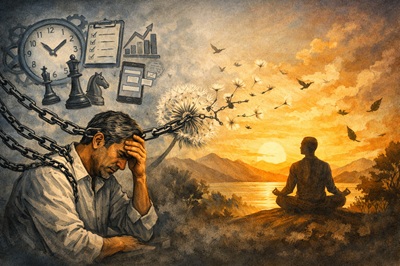
Over the past weeks, readers of Raag Delhi have encountered Frank Noronha’s quietly luminous reflections — essays that turn ordinary experiences into meditations on awareness. His latest piece, The Burden of Control, continues this inward journey with a rare philosophical rhythm. In lucid, introspective prose, Noronha leads the reader into unseen corners of the self, revealing how the mind’s constant urge to control life becomes the hidden architect of disturbance. Yet, through this exploration, he gestures toward a gentler truth — that peace may arise not from mastery, but from surrender.
The Burden of Control — Frank Noronha Reflects
Frank Noronha
As I grow older, I notice something operating within me almost constantly — the urge to control life.
Not only the major things. Even the smallest things.
I want conversations to go a certain way. I want people to respond according to my expectations. I want situations to unfold smoothly. I want health, relationships, family matters, and even my inner life to move according to some invisible script I carry within me.
And when they do not, disturbance begins.
What is this strange movement within us that constantly wants life to obey us?
I have watched this carefully in myself. The instinct to control is so automatic that most of the time it goes unnoticed. It appears almost like a survival mechanism. One part of the mind says:
“If you do not control things, everything will fall apart.”
And perhaps, at a practical level, some control is necessary. Human life requires responsibility. We must make decisions, organise, plan, and act intelligently.
But psychologically, the movement goes much deeper.
The mind wants certainty.
It wants guarantees.
It wants tomorrow secured before tomorrow arrives.
And this is where suffering quietly enters.
Because life repeatedly refuses to cooperate fully with our plans.
Even when we do our best, things still go wrong. Bodies fall sick. Relationships change. Misunderstandings happen. Carefully made plans collapse overnight. People we love disappear from our lives without warning.
Yet the urge to control continues.
So what is one supposed to do?
Should one stop caring altogether?
Should one become passive and indifferent?
That too seems false.
Perhaps the real issue is not action itself, but the inward demand that life must unfold according to our psychological expectations.
I notice this very clearly in the movement of thought.
Thoughts arise continuously within me, and my emotional state seems deeply connected to them. When hopeful thoughts appear, there is enthusiasm and lightness. When fearful thoughts arise, there is anxiety, resentment, comparison, fear of loss, and a sense of scarcity.
The quality of thought shapes the quality of feeling.
But then another question arises:
Do I actually control the thoughts that appear?
If I am honest, I do not think I do.
Thoughts simply come.
One moment the mind is peaceful. The next moment it is occupied by fear. One memory suddenly appears and sadness enters. One image about the future arises and anxiety tightens the body.
Thought seems to have a life of its own.
And what is remarkable is how quickly identification happens. The moment a thought appears, there is an immediate feeling:
“This is happening to me.”
But who exactly is this “me”?
A name?
A body?
A collection of memories and experiences?
I do not fully know.
Perhaps much of human life is this continuous movement between thought, emotion, memory, and reaction. A constant attempt to manage inner and outer uncertainty.
Modern life only intensifies this condition. Every day we are flooded with news, opinions, fears, desires, comparisons, and endless information. Events happening thousands of miles away affect our mood, our fears, even our sense of security. Human consciousness has become deeply entangled with mental noise.
And slowly one begins to see that much of life is not being lived directly. It is being lived through interpretation.
Even spirituality can become another interpretation.
Many teachings say that thoughts arise from awareness and disappear back into awareness. They say our true nature is not the thoughts themselves but the silent presence in which thoughts appear.
Intellectually, this sounds beautiful.
But understanding it as an idea is very different from actually living it.
In daily life I remain deeply identified with thoughts, emotions, memories, and external events. Praise affects me. Criticism affects me. Hope lifts me. Uncertainty disturbs me.
The identification is immediate.
Yet occasionally there are moments when something else becomes visible.
A thought arises — and instead of immediately becoming trapped inside it, there is simple observation.
Fear appears — and it is seen.
Anxiety moves through the mind — and it too is seen.
In such moments there is a certain quietness.
Not because all problems disappear.
Not because certainty has been achieved.
But because for a brief moment thought is no longer completely dominating consciousness.
Perhaps peace is not the result of finally controlling life.
Perhaps peace begins when one sees clearly that life cannot be fully controlled.
There is humility in that realization.
A softer way of living.
Doing what one can practically, while inwardly loosening the constant struggle to force life into psychological order.
Not resignation.
Not passivity.
Just a quieter participation in the unfolding of life.

Frank Noronha IIS ( Indian Information Service) is a retired Principal Director General, Press Information Bureau, Government of India, compiler of two volumes of interviews with philosopher U.G. Krishnamurti, and Managing Trustee of a charitable trust in Bengaluru supporting underprivileged children.

We are trying to create a platform where our readers will find a place to have their say on the subjects ranging from socio-political to culture and society. We do have our own views on politics and society but we expect friends from all shades-from moderate left to moderate right-to join the conversation. However, our only expectation would be that our contributors should have an abiding faith in the Constitution and in its basic tenets like freedom of speech, secularism and equality. We hope that this platform will continue to evolve and will help us understand the challenges of our fast changing times better and our role in these times.
About us | Privacy Policy | Legal Disclaimer | Contact us | Advertise with us