In his latest essay, The Burden of Becoming, Frank Noronha extends the contemplative thread woven through his recent writings on Raag Delhi — from the gentle acceptance of aging to the probing of control. Here, he turns to the restless human urge to “become” — to chase success, meaning, or even peace — and asks whether this endless pursuit itself is the source of our unease. With honesty and simplicity, he reminds us that perhaps life does not demand answers, only the courage to live it as it is.
The Burden of Becoming
Frank Noronha
Lately, I have found myself asking a question that has visited me in different forms throughout my life:
What is all this life about?
At sixty-eight, I am no closer to a final answer than I was at fourteen.
The questions have changed their clothing over the years, but they remain essentially the same.
As a young man, I wanted success, recognition, adventure, influence, and perhaps a little admiration from the world. Later, I wanted security. Then I wanted meaning. After that came spirituality. Somewhere along the way, I wanted peace.
Yet, when I look honestly at my life, I notice that the movement behind all these pursuits has been remarkably similar. I always wanted to become something other than what I was.
Society encouraged it.
Religion encouraged it.
Education encouraged it.
Motivational speakers encouraged it.
Even spirituality encouraged it.
The message was always the same: you are not enough as you are; you must improve yourself, purify yourself, heal yourself, fulfil yourself, awaken yourself, realize yourself, become yourself.
The destination kept changing, but the movement remained the same.
Become.
Become.
Become.
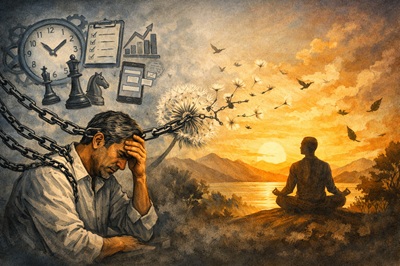
And perhaps that is why I have lately begun to wonder whether this endless urge to become something is the source of much of our restlessness.
Every morning, for the past few weeks, I have noticed a subtle anxiety upon waking. Nothing dramatic. Just a faint uneasiness. A feeling that something remains unfinished. Something needs attention. Something must be accomplished.
The mind immediately starts preparing its list.
The trust needs attention.
The legal matters need sorting out.
Relationships need maintenance.
The body needs care.
The future needs planning.
The spiritual life needs improvement.
Even peace becomes another project.
I sometimes wonder if this constant occupation with becoming is what prevents us from simply living.
The irony is that I spent much of my professional life in administration, where change was part of the job. Policies had to be implemented. Problems had to be solved. Systems had to be improved.
Looking back, however, I do not feel that I achieved anything extraordinary. Life simply happened. Responsibilities arrived. Positions were offered. Decisions were made. One assignment followed another.
The world later described it as achievement.
But from the inside, it often felt like responding to whatever was placed before me.
Perhaps that is how most lives unfold.
We create elaborate stories about ourselves afterwards.
One of U.G. Krishnamurti's questions has stayed with me for decades:
"Is it operating in you?"
Whenever somebody quoted a scripture, a philosophy, or a spiritual teaching, he would ask that question.
Not whether it was true.
Not whether it was profound.
Not whether great sages had said it.
Simply:
Is it operating in you?
That question has become increasingly important to me.
I can speak about Awareness, Consciousness, Source, Love, God, the Self, the Ego, Enlightenment, and many other impressive concepts.
But is any of it operating in me?
I do not know.
What I do know is that I still get anxious.
I still get irritated.
I still seek approval.
I still enjoy being appreciated.
I still want comfort.
I still dislike discomfort.
I still feel hurt.
I still feel lonely at times.
And strangely enough, acknowledging all this feels more honest than claiming a state I have not reached.
One thing I increasingly notice is how deeply society lives inside us.
We often imagine ourselves to be independent individuals making personal choices.
Yet most of what we call "my desires" are borrowed.
The need to succeed.
The need to matter.
The need to leave a legacy.
The need to be respected.
The need to become spiritually advanced.
Even the desire to be free may not be entirely our own.
Sometimes I wonder whether I have ever had a question that was completely mine.
Or have I simply inherited the questions of humanity?
What is the purpose of life?
Who am I?
What happens after death?
How can I find peace?
How can I be loved?
How can I avoid suffering?
Perhaps these questions belong to the collective human inheritance.
U.G. once said that the questions disappeared for him.
Not because he found answers.
But because he saw that the questions themselves were not his.
I do not know if that is true.
But I understand something of what he meant.
There are moments when life becomes intensely practical.
My brother's illness.
His passing.
The memorial service.
The responsibilities that followed.
The trust that now requires attention.
During such moments, philosophy quietly moves to the background.
Action takes over.
One simply does what needs to be done.
Curiously, in those moments of complete involvement, the sense of a separate "me" often becomes less prominent.
There is only the task.
Only the situation.
Only the response.
Then, when everything settles, the old questions return.
The old search resumes.
The old dissatisfaction reappears.
Perhaps this is the human condition.
What has touched me deeply in recent months is the death of my brother.
Not merely because I loved him.
But because death presents a fact that no philosophy can completely soften.
Something leaves.
The body remains.
But something leaves.
What exactly leaves?
I do not know.
I have heard countless explanations.
The soul.
Consciousness.
Awareness.
Energy.
Spirit.
Perhaps one of them is correct.
Perhaps none of them are.
What I know is that standing before death strips away many certainties.
And perhaps that is not a bad thing.
Perhaps certainty is overrated.
These days I find myself becoming more comfortable with not knowing.
Not as a philosophy.
Not as a spiritual achievement.
Simply as a fact.
I do not know what life is.
I do not know what death is.
I do not know who I am.
I do not know whether there is enlightenment.
I do not know whether there is reincarnation.
I do not know whether there is a higher purpose.
Yet life continues.
The heart continues to beat.
The breath continues to move.
The sun rises.
Food tastes good.
A conversation with a friend brings warmth.
A memory brings tears.
A child's laughter brings joy.
And somehow, life carries on without waiting for my conclusions.
Perhaps there is a strange freedom in that.
Not the freedom of having all the answers.
But the freedom of no longer needing them quite so desperately.
Maybe life was never asking me to solve it.
Maybe it was only asking me to live it.
And perhaps, for now, that is enough.
*************************

Frank Noronha IIS ( Indian Information Service) is a retired Principal Director General, Press Information Bureau, Government of India, compiler of two volumes of interviews with philosopher U.G. Krishnamurti, and Managing Trustee of a charitable trust in Bengaluru supporting underprivileged children.

We are trying to create a platform where our readers will find a place to have their say on the subjects ranging from socio-political to culture and society. We do have our own views on politics and society but we expect friends from all shades-from moderate left to moderate right-to join the conversation. However, our only expectation would be that our contributors should have an abiding faith in the Constitution and in its basic tenets like freedom of speech, secularism and equality. We hope that this platform will continue to evolve and will help us understand the challenges of our fast changing times better and our role in these times.
About us | Privacy Policy | Legal Disclaimer | Contact us | Advertise with us