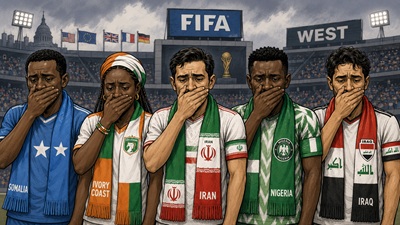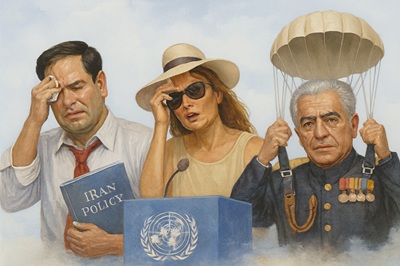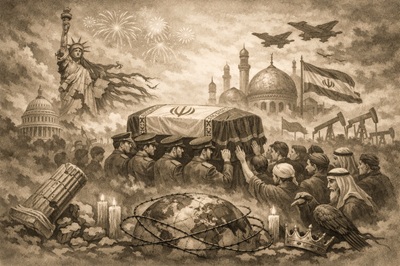
The Danish philosopher Søren Kierkegaard is often quoted as saying, “When a tyrant dies, his reign ends. When a martyr dies, his reign begins.” In Iran, the week-long funeral ceremonies for the country’s slain Supreme Leader Ali Khamenei began on July 4, the same day the United States marked 250 years of independence. That coincidence would not have escaped geopolitical writer Amandeep Midha, whose biting essay argues that America’s imperial decline is now difficult to ignore.
Two Funerals on One Date : The Decline No One Announces
Amandeep Midha
Empires do not announce their decline. The world simply stops looking at them the way it used to. On July 4, America marks two hundred and fifty years since a group of British settlers decided that distance from London was the same thing as freedom. The same week, in Tehran, Qom and Mashhad, millions are gathering for the funeral of a man the United States and Israel killed in an airstrike on February 28, the opening act of a war neither side has fully ended. The calendar did not force this collision. Iran chose the dates, and the symbolism is not subtle. A slain Supreme Leader's coffin, wrapped in the flag once flown over Imam Hussein's shrine, moving through five cities across two nations, timed to overlap with Washington's own carefully choreographed birthday party. Grief as geopolitics. Mourning as a message.
A Franchise Losing Its Audience
The message is this: the world is no longer certain America gets to be the main character. For decades, the fourth of July was exported like a franchise. Embassies from Lagos to Lahore threw parties funded by taxpayers who never got a vote in Philadelphia. Local elites showed up in black tie to toast a revolution that was, at its founding, a settler argument about which Europeans got to tax and govern which land, dressed up later in the language of universal liberty. The gap between the story and the history was always there. What has changed is that fewer people outside America feel obliged to pretend the gap doesn't exist.
A Statement, Not a Policy
Killing a head of state, even one Washington considers a sponsor of terror and a nuclear threshold state, is not a policy decision in the ordinary sense. It is a civilisational statement. It tells every government watching that no office, however theocratic or repressive, offers protection once Washington decides the calculus favors decapitation. Iran calls it murder. International law, at minimum, calls it a killing that sits in deeply contested territory, and Washington has not troubled itself to make the legal case in public, because it does not need to. Power rarely explains itself to the powerless. But publics remember what governments decline to justify, and Iranian, Iraqi, Pakistani and Lebanese streets are not confused about what they watched happen to their region over the past four months.
A Hundred Countries at the Procession
What is striking is not that Iran is angry. Iran was always going to be angry. What is striking is how much of the rest of the world is watching this funeral procession, a hundred-plus countries sending representation, Russia and China at the front, India sending a Bihar governor and a junior minister, and reading it as a referendum on American judgment rather than Iranian legitimacy. A theocracy that gunned down its own protesters in December and January, whose currency collapsed, whose public is genuinely split on the regime, is nonetheless finding that the manner of its leader's death has done more to rally sympathy than three decades of Iranian diplomacy ever managed. That is not an accident of religious calendar. That is the cost of American strategic overreach, paid in the currency states value most: the presumption of restraint.
The Currency of Restraint
Restraint is the thing empires spend down without noticing. The United States has spent the last twenty-five years cashing in on it, Iraq, Libya, Afghanistan, drone campaigns run by joystick from Nevada, and each time the argument was some version of necessity. Necessity is a word that stops persuading once it is used too often. Killing the Supreme Leader of Iran does not read, in Delhi or Jakarta or Riyadh, as an isolated act of self-defense. It reads as confirmation of a pattern: that Washington will act first and litigate the justification later, confident that its own media will not call it what regional publics already call it.
Not Victimhood, Just Perception
None of this means Iran is a victim in any simple sense. A government that answers economic despair with live rounds against its own citizens does not deserve reflexive sympathy just because an adversary crossed a line. But foreign policy does not run on moral consistency. It runs on perception, and the perception settling over Tehran's funeral processions this week is that America miscalculated, that it opened a war it has not been able to close cleanly, and that a fragile sixty-day negotiating window, signed at Versailles of all places, on a memorandum France is already refusing to bless without further concessions on missiles and proxies, is not a victory lap. It is a government trying to manage the exit costs of a decision it made without asking anyone's permission, including, it turns out, its own closest allies.
Paris Withholds Its Signature
France's position deserves more attention than it has received. Paris has not vetoed the deal. It has done something more pointed: it has told Washington, in public, that America's signature is not sufficient. The lifting of UN sanctions requires French consent as a permanent Security Council member, and Foreign Minister Barrot has made clear that consent is not coming until Iran concedes on its ballistic missile programme and its regional proxies, neither of which the American memorandum addresses. Britain is aligned with Paris. That is not the posture of allies confident in Washington's handling of the file. That is the posture of allies who watched an American negotiating team, led by a real estate developer and a special envoy, move fast and now find themselves cleaning up the diplomatic residue.
Pause, Not Settlement
The open question is whether this settles or merely pauses. American domestic politics does not run on the same clock as Iranian grief. Midterm elections have their own gravitational pull, and wars that end in ambiguous memoranda have a way of resuming once the electoral calendar makes conflict useful again. Whether the outcome differs this time depends less on Iranian capability, degraded but not destroyed, than on whether America's own public and its European partners have the patience to prevent Washington from mistaking a funeral for closure. A regime that just buried its Supreme Leader across five cities and watched a hundred countries show up to pay respects is not a regime negotiating from a position of humiliation. It is a regime that has just been handed a propaganda instrument it did not have to build itself. Washington built it.
What Is Actually Being Buried
America did not lose the war it started. But it may have lost something it valued more than any single battlefield outcome: the assumption, held for decades by friend and rival alike, that its power was also its right. That assumption is what is actually being buried this week, and no fireworks display over the National Mall will be loud enough to drown out the sound of it going into the ground.
*************

Amandeep Midha is a technologist, writer, and global speaker with over two decades of experience in digital platforms building, data streaming, and digital transformation. He has contributed thought leadership to Forbes, World Economic Forum, Horasis, and CSR Times, and actively engages in technology policy-making discussions. Based in Copenhagen, Amandeep blends deep technical expertise with a passion for social impact and storytelling.

We are trying to create a platform where our readers will find a place to have their say on the subjects ranging from socio-political to culture and society. We do have our own views on politics and society but we expect friends from all shades-from moderate left to moderate right-to join the conversation. However, our only expectation would be that our contributors should have an abiding faith in the Constitution and in its basic tenets like freedom of speech, secularism and equality. We hope that this platform will continue to evolve and will help us understand the challenges of our fast changing times better and our role in these times.
About us | Privacy Policy | Legal Disclaimer | Contact us | Advertise with us