
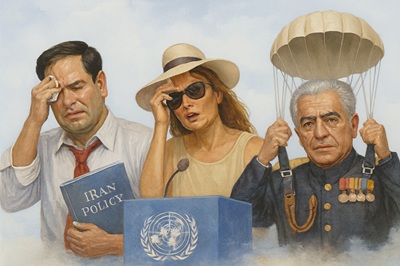
In this incisive critique of U.S. policy toward Iran, Amandeep Midha dismantles the fantasy of regime change via exile restoration. He argues that Iran cannot be “unlocked” by parachuting in Reza Pahlavi, and that such visions reflect a profound misunderstanding of Iran’s civilisational depth. Situating current U.S. strategy within a broader historical and geopolitical framework, Midha reminds us that Iran is not a hollow state but one of the world’s oldest continuous civilisational projects—having absorbed and outlasted empires from the Macedonians to the Mongols, Arabs to Turks. In this way, this essay effectively challenges the intellectual poverty of contemporary imperial thinking.
The Parachuted Monarch & The Weight of a Civilisation
Amandeep Midha
Let us begin with a simple proposition: empires, in their twilight, do not merely overreach, they aestheticise their overreach. They cast it in the grammar of liberation, of historical necessity, of the gift of order to the ungrateful. And when the aesthetic no longer holds, they send in the celebrities. Or in the present case, the First Lady.
Melania Trump's appearance before the United Nations Security Council, that solemn chamber where the fate of nations is theoretically debated, was not a diplomatic event. It was a category error dressed as statecraft. One does not question her sincerity; one questions, rather urgently, what it tells us about the intellectual seriousness with which this imperial administration approaches global order. When symbolism replaces strategy, the symbol chosen reveals everything.
Rubio: The Dove in Hawk's Clothing
Marco Rubio is many things, a capable parliamentary performer, a man with genuine ideological commitments, a politician who has survived the remarkable pirouette of American conservatism across two decades. What he is conspicuously not is a wartime foreign minister. He lacks the cold architecture of Kissinger, the ruthless transactionalism of Baker, even the blunt institutional muscle of Powell. He is, at his core, a rhetorician in an era demanding a strategist.
A wartime minister must be comfortable with ambiguity, with moral compromise, with the management of adversaries you cannot destroy and allies you cannot trust. Rubio's instinct, refined through years of Senate grandstanding, is to escalate the rhetoric and wait for the room to applaud. That works in Florida. It does not work in Tehran, in Moscow, or in the quiet offices of Beijing where they are watching, very carefully, how coherently Washington reads a board. The Iran file above all others demands someone who understands that maximum pressure without a credible endgame is not policy, it is provocation with no return address.
The Fantasy of the Parachuted Shah
And so we arrive at the centrepiece of current Western strategic dreaming: the notion circulating in Washington and Tel Aviv with the confidence of men who have never set foot in a Persian bazaar, that Iran can be delivered to Reza Pahlavi, son of the last Shah, by some combination of Israeli air power, American financial strangulation, and popular uprising choreographed from abroad.
This plan, if one can grace it with that word, rests on at least three assumptions, each more extraordinary than the last. First, that Iranian popular dissatisfaction with the clerical order is equivalent to a desire for monarchical restoration. Second, that a man who has spent his adult life in exile retains the organic legitimacy needed to survive being seen as a foreign-installed figurehead. Third, and this is the most breathtaking, is that Iran is a hollow state waiting to collapse, rather than a civilisational entity with a memory longer than the American republic itself.
Iran is not Libya. It is not even Iraq. It is one of the oldest continuous civilisational projects on earth, Achaemenid, Parthian, Sassanid, Safavid: the people who absorbed Macedonians, Mongols, Arabs, and Turks, metabolised them all, and emerged speaking Persian. The current Islamic Republic may be unpopular with large sections of its own population. But unpopularity with a government is not the same as civilisational exhaustion. The Iranians who protest in the streets of Tehran are not waving flags for a Pahlavi restoration; they are asserting their own sovereignty over their own future. That is a distinction Washington consistently refuses to make, because making it would complicate the fantasy.
No Boots, But What Ground?
The strategic logic currently favoured runs as follows: Israeli air strikes degrade Iran's nuclear infrastructure; American sanctions complete the economic choking; internal pressure tips into collapse; and then, somehow, Pahlavi descends, is received as liberator, and Iran pivots westward. No American boots on the ground. Clean hands. A tidy transformation.
The internal incoherence of this vision is so thorough it almost demands admiration. It ignores every lesson of the post-2001 era: Afghanistan, Iraq, and Libya; where removal of a government produced not a grateful liberal democracy but a power vacuum filled by forces far less amenable to Western interests than the regime they replaced. It ignores that the Revolutionary Guard, the Basij, the network of loyalties built over forty-five years, do not simply dissolve because the economy is painful. It ignores the basic fact that civilisational states generate their own immune systems that external pressure, particularly when framed as existential, tends to produce nationalist consolidation rather than fragmentation.
And it ignores history's most consistent lesson about exile monarchs: they are useful props for imperial narratives and catastrophic leaders in actual practice. From the White Russian pretenders to the Shah himself, whose American-backed restoration in 1953 set in motion the very revolution that now torments Washington, the parachuted monarch has an unbroken record of failure measured in decades of blowback.
The Civilisational State & The Imperial Blind Spot
There is a deeper intellectual failure worth naming precisely. The Anglo-American strategic tradition has, for two centuries, operated with a mental model of the state as essentially institutional, a set of governmental structures that can be captured, reformed, or replaced while the underlying population remains more or less inert, waiting for better management. This model worked tolerably well on states that were, in fact, relatively shallow colonial constructs. It has never worked on civilisational states.
A civilisational state: China, India, Iran, Russia, in their different ways, is not simply a country with an old history. It is a polity whose political imagination, whose sense of grievance and pride and destiny, runs far deeper than any particular government. You can change the government. You cannot, through external pressure alone, alter the civilisational consciousness that will judge whatever comes next by its own ancient criteria.
The Iranians did not overthrow the Shah because they wanted American liberal democracy. They overthrew him because they wanted, in the vocabulary available to them in 1979, Iranian dignity on Iranian terms. Whatever dissatisfaction exists today with the Islamic Republic, it is being processed through that same civilisational grammar. To imagine this can be short-circuited by Israeli air power and a telegenic exile is not a strategy. It reflects a kind of imperial self-absorption.
The Aesthetic of Decline
Which brings us back, full circle, to Melania at the Security Council and Rubio at the podium. These are not incidental details. They are the aesthetic of an empire that has substituted performance for policy, sensation for strategy, and the management of its own domestic attention span for the hard, unglamorous work of understanding the world as it actually is.
The tragedy is not that the West is powerful and overreaches, empires have always done this. The tragedy is that it is overreaching from a position of increasing conceptual poverty. The intellectual infrastructure required to think seriously about civilisational states: the area expertise, the linguistic competence, the institutional memory have been systematically defunded, dismissed, or overridden by think-tank certainties and the rhythm of the news cycle.
Iran will not be unlocked by a parachuted Shah. The Security Council will not be moved by celebrity presence. And Marco Rubio is not the architect of a strategy capable of navigating the most consequential geopolitical theatre of this decade. These are simply facts, delivered by history in advance, available to anyone willing to read the record.
The question that hangs over all of this is one that civilisational states have always posed to empires in their hubris: How long before the cost of the delusion becomes undeniable? History answers that question consistently. The only variable is the body count accumulated in the meantime.
***********

Amandeep Midha is a technologist, writer, and global speaker with over two decades of experience in digital platforms building, data streaming, and digital transformation. He has contributed thought leadership to Forbes, World Economic Forum, Horasis, and CSR Times, and actively engages in technology policy-making discussions. Based in Copenhagen, Amandeep blends deep technical expertise with a passion for social impact and storytelling.

We are trying to create a platform where our readers will find a place to have their say on the subjects ranging from socio-political to culture and society. We do have our own views on politics and society but we expect friends from all shades-from moderate left to moderate right-to join the conversation. However, our only expectation would be that our contributors should have an abiding faith in the Constitution and in its basic tenets like freedom of speech, secularism and equality. We hope that this platform will continue to evolve and will help us understand the challenges of our fast changing times better and our role in these times.
About us | Privacy Policy | Legal Disclaimer | Contact us | Advertise with us