Donald Trump’s threat to “blow up Oman” was vintage Trump—provocative, outrageous, yet hardly surprising. The remark drew global condemnation, but Amandeep Midha places it in a wider frame: the West’s seventy-year habit of dropping bombs at will while preaching a “rules-based international order.” Trump’s bluntness may have shocked, but the pattern long predates him. In his latest essay, Midha traces this continuity of violence and impunity, showing how one sentence at a Cabinet meeting revealed the true operating logic of Western power.
"Or We Have to Blow Them Up?"
The West's Seventy-Year Record of Bombing, Bullying, and Calling It Order
Amandeep Midha
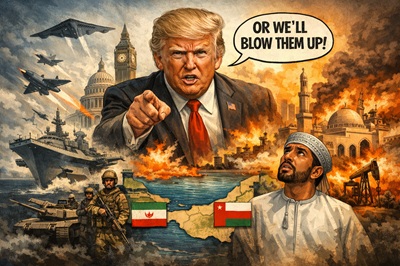
There is a sentence that deserves to hang above the entrance to every Western foreign policy seminar, every transatlantic summit communiqué, every lecture hall where a professor opens with the phrase "rules-based international order." It was spoken not in some Cold War basement, not by a defence contractor pitching the Pentagon, but by the sitting President of the United States, Donald Trump, at a White House Cabinet meeting on May 27, 2026. A reporter asked whether Washington would accept a deal allowing Iran and Oman to jointly control the Strait of Hormuz. The most powerful man on earth replied: "Oman will behave just like everybody else, or we'll have to blow them up. They understand that. They'll be fine."
Not threatened. Not sanctioned. Not negotiated. Blow them up.
The target was Oman: A decades-long American ally, the quiet diplomatic back-channel through which Washington and Tehran have communicated for years, the country without which US-Iran nuclear talks would not have been possible. A state that did nothing except occupy geography inconvenient to American strategic appetites. It did not matter. The logic applied regardless: comply, or face destruction.
Iran's foreign ministry called it "another dangerous sign of the normalization of lawlessness and bullying in international relations." One does not have to admire the Iranian government to recognise when it has correctly named something.
Strip away the Atlantic Charter sentimentality, and this is what remains, the operating logic of Western power, reduced to its honest core. They dressed it in legal Latin for seven decades. On May 27, 2026, a sitting president simply forgot to lower his voice.
This is not a column about Donald Trump. It is a column about the world his sentence describes, and has described, accurately, since 1945.
The Arithmetic of Violence
The United States has conducted nearly 400 military interventions since 1776, roughly one every seven months. More than a quarter took place after the Cold War ended in 1991, after the ideological rationale of containing Soviet communism had dissolved and nothing remained as justification except appetite.
The post-9/11 wars alone killed an estimated 940,000 people through direct violence, of whom more than 432,000 were civilians. Brown University's Costs of War project places the indirect toll, from destroyed healthcare systems, economies, and infrastructure, at 3.6 to 3.8 million, bringing the total to at least 4.5 million dead, and counting.
That is not a foreign policy record. That is a civilisational audit.
The Architecture of Impunity
What sustains this system is not military superiority alone. It is the institutional architecture constructed to insulate Western power from accountability.
The United States has not ratified the Rome Statute of the International Criminal Court. When the ICC sought to investigate American actions in Afghanistan, the Trump administration sanctioned its prosecutors. The UN Security Council veto has been deployed by the US more than any other permanent member, most consistently to shield allies from accountability and to prevent multilateral constraint on American operations. The very institution designed to enforce international law has been blocked from functioning, from inside, by its architect.
The rules-based order was never designed to apply universally. It was designed to codify the hierarchy to give Western dominance the appearance of principle while preserving its operational freedom.
The Gaza Mirror
When Russia invaded Ukraine in 2022, Western institutions mobilised with extraordinary speed. The ICC issued arrest warrants. Sanctions cascades were executed within days. European leaders competed to demonstrate moral clarity.
The Global South asked a reasonable question: Will this framework apply consistently?
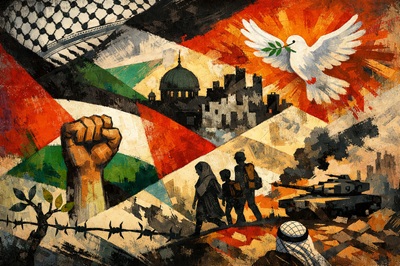
The answer arrived in Gaza. An Israeli bombardment that killed over 50,000 Palestinians drew not ICC warrants from Washington but weapons deliveries, not legal accountability but vetoes of ceasefire resolutions. Western governments that had invoked sovereignty and international humanitarian law with operatic intensity for Ukraine reduced those same principles to "mere footnotes and suggestions."
The rules apply to adversaries. They do not apply to allies. They are not law. They are leverages.
The Strategic Consequence
The consequence of this record is not merely moral. It is strategic, and it is accelerating.
The Global South has watched the Ukraine-Gaza contrast and drawn the obvious inference: Western institutions are tools of Western interest, not universal law. This is driving BRICS expansion, bilateral currency arrangements, and the fracturing of multilateral consensus on climate, trade, and security. A world in which the United States has conducted 400 interventions, killed millions of civilians, ignored international court rulings, and vetoed accountability for its allies, and then expressed bewilderment that the non-Western world declines to treat it as a neutral arbiter, is not suffering from a communication problem. It is confronting the consequences of a structural legitimacy deficit, decades in the making, now coming due.
Trump's sentence is useful not because it is shocking, but because it is honest. That the target was Oman, a US ally, a diplomatic interlocutor that had done nothing except exist at the wrong latitude, is not incidental. That is the point. The threat was not really about Iran. It was about whether any nation in that region retains the sovereign right to its own foreign policy. The answer, from a Cabinet meeting in Washington, was unambiguous: no.
The order was never as rules-based as advertised. The only question now is what replaces it and whether those who inherit the ruins will do better, or simply repeat the cycle with different coordinates.
****************

Amandeep Midha is a technologist, writer, and global speaker with over two decades of experience in digital platforms building, data streaming, and digital transformation. He has contributed thought leadership to Forbes, World Economic Forum, Horasis, and CSR Times, and actively engages in technology policy-making discussions. Based in Copenhagen, Amandeep blends deep technical expertise with a passion for social impact and storytelling.

We are trying to create a platform where our readers will find a place to have their say on the subjects ranging from socio-political to culture and society. We do have our own views on politics and society but we expect friends from all shades-from moderate left to moderate right-to join the conversation. However, our only expectation would be that our contributors should have an abiding faith in the Constitution and in its basic tenets like freedom of speech, secularism and equality. We hope that this platform will continue to evolve and will help us understand the challenges of our fast changing times better and our role in these times.
About us | Privacy Policy | Legal Disclaimer | Contact us | Advertise with us