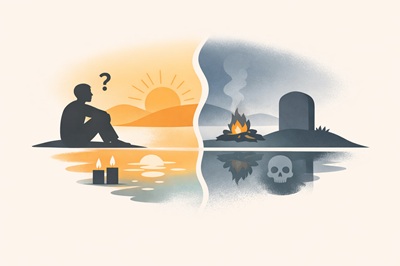
The thought of death has always perplexed human beings—perhaps all living beings. Who can say for sure? Frank Noronha, who has earlier shared four essays in his series Reflections, now turns to the theme of death in his inimitable style. He raises many questions, but one stands out: Is death itself frightening, or is it the thought of death that creates fear? Let us read on to see how he explores this timeless dilemma.
The Thought of Death: Reflections by Frank Noronha
As one grows older, death slowly ceases to be an abstraction. In youth it belongs to others, to distant tragedies, to newspaper columns, to funerals one attends and then forgets. But with age, the circle begins to narrow. Friends of one’s own generation begin to disappear. Familiar voices fall silent. One wakes up in the morning with a strange realization:
“One more day has been used up.”
The body may still function reasonably well. One may still laugh, eat, converse, and move about. Yet somewhere in the background there is a quiet awareness that the remaining number of mornings is not infinite.
And that realization changes the texture of living.
What disturbs me is not merely the biological fact that the body will die. The body itself does not seem disturbed by death. It functions intelligently within its limits. It breathes, digests, sleeps, heals, weakens, and one day it stops. There is a naturalness about this process.
The disturbance begins elsewhere.
It begins in thought.
Thought projects itself into the future and imagines disappearance. Thought imagines separation from one’s wife, children, friends, and all that is familiar. Thought imagines the ending of memory, identity, continuity. And then fear appears.
So I begin to ask myself:
Is death itself frightening?
Or is it the thought about death that creates fear?
The more I observe, the more it seems that thought is the real source of disturbance. Yet there is a paradox here. I cannot simply command thought to stop. Thoughts arrive on their own. I do not know from where they come. I only know they are there when they arise.
Some thoughts comfort me.
Some thoughts wound me.
Some offer hope.
Some produce terror.
And they all compete for attention.
It is as though there are countless voices within, each demanding to become the centre of consciousness. One thought says life has meaning. Another says it is all accidental. One says God awaits. Another says death is total extinction. One thought brings pleasure, another anxiety. And I seem to have very little control over which thought appears next.
I do not invite them consciously. Yet once they appear, I sit with them, entertain them, serve them tea, argue with them, resist them, believe them.
Then another question arises:
If thoughts come and go by themselves, who exactly is the “me” trying to control them?
This becomes even more mysterious in sleep.
When I dream at night, my eyes are closed. The physical senses are inactive, yet entire worlds appear. Faces are seen, voices heard, emotions felt, landscapes traversed. If the senses alone are the instruments of perception, how does the dream world arise?
And what is the nature of that witnessing presence which knows the dream, knows waking, knows fear, knows thought?
Religions and philosophies have tried to answer these questions for centuries. Some speak of the soul. Some of reincarnation. Some of heaven and hell. Some of pure consciousness. Others dismiss everything and say there is nothing beyond the death of the body.
I have listened to these explanations. I have read accounts of near-death experiences, mystical states, and spiritual revelations. Yet none of them provide final certainty. They may comfort the mind temporarily, but they do not dissolve the fundamental not-knowing.
And perhaps that is the real frustration — uncertainty.
The mind longs for closure. It wants assurance. It wants someone to say definitively:
“This is what happens after death.”
But nobody truly knows.
As UG Krishnamurti once remarked to me:
“There is no way of knowing what happens after death. If you want to know, you have to die now.”
There is brutal honesty in that statement.
The difficulty is that one cannot return from death to report the experience. The territory remains fundamentally uncharted. And so thought continues its restless movement, endlessly speculating, fearing, hoping, imagining.
Yet while speaking and observing all this, another insight begins to emerge quietly.
Perhaps the real issue is not death at all.
Perhaps the real issue is psychological continuity — the deep demand that “I” must continue in some form. Thought wants permanence. It wants tomorrow. It wants extension. It wants to carry its memories, attachments, relationships, achievements, and identity forward indefinitely.
And death stands as the great interruption to that continuity.
But life itself does not seem concerned with continuity in the way thought is. Every moment something is ending. Cells die. Seasons disappear. Conversations conclude. Relationships change. Entire civilizations vanish. Impermanence is woven into existence itself.
Thought alone rebels against this fact.
And perhaps that rebellion is what creates suffering.
Still, none of this produces complete peace. The fear returns. The questions return. One hears of another friend dying and immediately the mind whispers:
“When will it be my turn?”
There is no final answer to silence that whisper.
But maybe peace does not come through obtaining certainty. Maybe certainty is impossible. Maybe peace begins only when one no longer demands guarantees from life.
The mind wants conclusions.
Life offers movement.
The mind wants permanence.
Life reveals change.
And somewhere between these two, human beings live out their days — thinking, fearing, loving, questioning, hoping.
Perhaps wisdom is not the attainment of answers, but the capacity to remain with the mystery without immediately escaping into belief or despair.
Then death is no longer merely an enemy looming in the future. It becomes part of the strange total movement of existence itself.
Not something separate from life.
But woven into it from the very beginning.
As William Shakespeare wrote, life may sometimes appear to be “a tale told by an idiot.” Yet even in that apparent absurdity, there is still tenderness, love, beauty, and the simple fact of being conscious for a brief while beneath the stars.
And perhaps, finally, that is all one can honestly say.
***********

Frank Noronha IIS ( Indian Information Service) is a retired Principal Director General, Press Information Bureau, Government of India, compiler of two volumes of interviews with philosopher U.G. Krishnamurti, and Managing Trustee of a charitable trust in Bengaluru supporting underprivileged children. Mob: 9910417002

We are trying to create a platform where our readers will find a place to have their say on the subjects ranging from socio-political to culture and society. We do have our own views on politics and society but we expect friends from all shades-from moderate left to moderate right-to join the conversation. However, our only expectation would be that our contributors should have an abiding faith in the Constitution and in its basic tenets like freedom of speech, secularism and equality. We hope that this platform will continue to evolve and will help us understand the challenges of our fast changing times better and our role in these times.
About us | Privacy Policy | Legal Disclaimer | Contact us | Advertise with us