
Amandeep Midha is clearly in fine form. With the Afghan Foreign Minister still in India, he has already sent in an article for publication on India’s pragmatic engagement with the Taliban-ruled nation. This is unusually swift for our web magazine, but we are doing our best to keep pace with his speed. The piece is as timely as it is thought-provoking — a dispatch that arrives before the dust has even settled.
India’s Quiet Handshake with the Taliban
Amandeep Midha
When Afghanistan’s Foreign Minister Amir Khan Muttaqi landed in New Delhi this week, it was one of those moments that reveal how quietly the world shifts. There were no grand announcements, no ideological posturing, only calm conversations and deliberate gestures. Among them, a significant one was India gifting twenty ambulances to Afghanistan. It was a small but meaningful act that spoke of continuity, of people-to-people care, even as governments change and regimes collide.
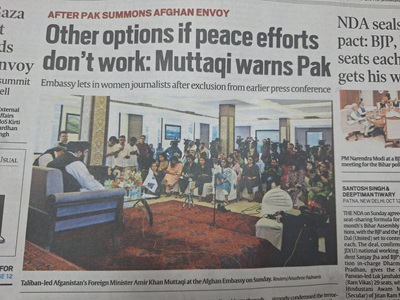
Yet, the visit sparked sharp reactions. At the first press conference Friday, no women journalists were invited. The absence drew anger, especially among Indian journalists and civil society voices who saw it as a step that legitimised the Taliban’s worldview. On social media, criticism turned to ridicule. Some mocked the Indian government for engaging at all, claiming it was compromising principles to court theocrats. Here also, the Indian government acted astutely and leaned on the visiting Afghan minister to hold another press conference which is more gender-inclusive. Apparently with Kabul's approval, he held another press conference on Sunday which was attended by a large number of women journalists who asked probing questions on gender discrimination in Afghanistan.
The outrage of those dismissing India’s engagement mirrors the old American vocabulary of diplomacy built on sanctions, isolation, and conditional recognition. This approach once kept South Asia fragmented and suspicious of itself. India, in contrast, seems to have learned that moral grandstanding from afar rarely changes anything on the ground. Engagement does. When asked who now controls Afghanistan’s embassy in Delhi, Muttaqi replied, “Those who worked against us in the past also work with us now.” It was a striking answer, both humble and assertive. The message was that Afghanistan belongs to all Afghans, that yesterday’s opponents need not be today’s exiles. Whether or not that spirit holds true in practice, it conveniently aligns with India’s own foreign policy instinct: continuity without confrontation, and presence without endorsement.
India’s gradual re-entry into Kabul’s diplomatic landscape marks a turn toward strategic realism. After years of maintaining only a technical mission, New Delhi has now upgraded to a functioning embassy. It is a clear signal that India will not watch Afghanistan’s future unfold from afar. The decision comes with full awareness of the contradictions: the Taliban’s restrictions on women, the fragile human rights situation, and the lack of inclusive governance. Yet India knows that absence creates vacuums, and vacuums are where extremism grows. Presence, even a cautious one, keeps channels open for dialogue, trade, intelligence sharing, and trust building.
This move also carries deep domestic meaning. For a government often accused by its opponents of fostering anti-Islamic sentiment, engaging directly with a Muslim-majority neighbour governed by an Islamist movement draws a clear distinction. India’s issues are not with Islam but with extremism and the politics of terror that Pakistan has long represented. The distinction is crucial both at home and abroad. For domestic voters, particularly Indian Muslims, this outreach sends a subtle but powerful message. It reinforces that India is not opposed to any religion. It shows that the government is confident enough to engage the Islamic world on equal terms while firmly guarding national interests. It also blunts Pakistan’s long-standing propaganda that tries to project India as anti-Islamic. By engaging the Taliban on its own terms, India asserts both self-respect and inclusivity, signaling that its foreign policy is guided by pragmatism rather than prejudice.
Many Western observers, still rooted in the geopolitics of the past, see India’s outreach as inconsistent. They fail to recognise that India does not moves according to Washington’s moral grid. The United States can afford to isolate Afghanistan; it is thousands of miles away. India cannot. Its borderlands, trade routes, and regional aspirations all intersect with Afghan stability. If the West views engagement as appeasement, India sees it as realism, the kind that defines mature powers.
The gifting of ambulances fits neatly into that logic. It is humanitarian diplomacy, but also subtle signalling. It tells Afghans that India’s friendship does not depend on who governs them. It tells the region that India’s foreign policy still retains empathy, even in difficult circumstances. And it tells the West that India will not conduct its diplomacy through someone else’s script.
Those ridiculing India for talking to the Taliban miss the point. Dialogue does not equal endorsement; it equals relevance. The alternative to conversation is irrelevance, and India has chosen the former. The West, for decades, preached democracy to Afghanistan and left it in ruins. India, for its part, built roads, hospitals, and power lines. It earned goodwill not by invading or sanctioning but by showing up. That legacy endures in every Afghan who still sees India as a friend.
The controversy over the embassy’s control, whether it rests with the Taliban or remnants of the old republic, captures this moment of transition. India has allowed continuity. Some diplomats from the previous era remain, while new faces arrive under Taliban authority. The ambiguity is deliberate. It allows India to deal with Kabul as it exists today without rushing into formal recognition. It keeps India’s influence alive in both narratives: the old Afghanistan and the new. This is literally diplomacy by patience, not pressure. It is what differentiates India’s approach from the sanction-driven strategies that have long failed to create peace. Rather this fits along more with Chinese kinda diplomacy template rather than anything western diplomacy egofully stuck in moral superiority. By engaging the Taliban while maintaining its distance, India is signalling quiet confidence that it can talk to any government without losing its moral core.
In the end, this moment is not about the Taliban as much as it is about India. It marks the country’s evolution from a regional player to a regional decider. It reflects that our foreign policy does not seek approval but autonomy. It suggests that South Asia’s future will not be written in Washington or Brussels but in its own capitals, through conversations that acknowledge complexity rather than pretending to erase it. Muttaqi’s remark about former adversaries working together may have been intended as an Afghan message, but it resonates beyond Kabul. It describes what India itself is learning to do: to work with those it once opposed, to engage those it does not yet trust, and to find stability not in purity but in presence.
For those yearning for India to act like an obedient outpost of Western diplomacy, this is unsettling. For those who believe in India’s civilisational pragmatism, it is precisely what maturity looks like. The world may shout in outrage, but India’s quiet handshake tells a different story, one of realism, reassurance, and the steady return of a nation learning, once again, to think for itself.
**********

Amandeep Midha is a technologist, writer, and global speaker with over two decades of experience in digital platforms building, data streaming, and digital transformation. He has contributed thought leadership to Forbes, World Economic Forum, Horasis, and CSR Times, and actively engages in technology policy-making discussions. Based in Copenhagen, Amandeep blends deep technical expertise with a passion for social impact and storytelling.

We are trying to create a platform where our readers will find a place to have their say on the subjects ranging from socio-political to culture and society. We do have our own views on politics and society but we expect friends from all shades-from moderate left to moderate right-to join the conversation. However, our only expectation would be that our contributors should have an abiding faith in the Constitution and in its basic tenets like freedom of speech, secularism and equality. We hope that this platform will continue to evolve and will help us understand the challenges of our fast changing times better and our role in these times.
About us | Privacy Policy | Legal Disclaimer | Contact us | Advertise with us