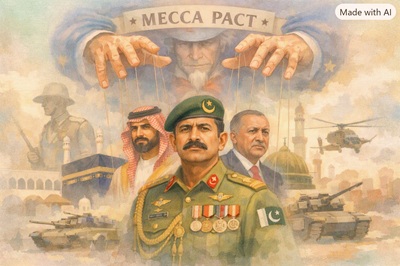
The Mecca Accord signed by Pakistan, Saudi Arabia, and Turkey has been described as a major shift in Middle Eastern politics. Some analysts see it as a turning point, yet Amandeep Midha argues otherwise. In this essay, he contends that the pact does not mark a new geopolitical order but reinforces an old one — a continuity of imperial logic where power changes hands but not its underlying structure.
Bhure Sahib Has Arrived: The Mecca Pact and the New Face of Old Power
Amandeep Midha
"They are not taking our freedom. They are taking our masters." paraphrased from Bhagat Singh
The Applause and the Illusion
When Pakistan, Saudi Arabia, and Turkey signed the Mecca Joint Defense Agreement on August 7, 2026, much of the world's commentary reached for a familiar narrative: the United States is retreating, and a new multipolar Middle East is being born. Council on Foreign Relations scholar Steven A. Cook called it a shift that "reduces the United States' decades-long leadership role." Atlantic Council analysts hailed it as "an inflection point in the emerging multipolar order."
With respect to these distinguished analysts, they are watching the magician's hand, not the trick.
What the Mecca Pact represents is not the end of American power in the Middle East. It is the franchising of it. And the franchise holder, the Pakistani military establishment, has played this role before. The blood on its hands is Palestinian.
Colonialism Did Not Leave. It Changed Uniforms.
Bhagat Singh, the revolutionary executed by British India in 1931, understood something that still eludes mainstream geopolitical analysis: the departure of gore sahib (the white master) does not guarantee freedom, it can simply usher in bhure sahib (the brown master), who administers the same system of control with the same structural loyalty to power, and with considerably more local credibility.
Post-colonial history vindicates him. The British left India but left behind an economic architecture, legal institutions, and an army officer class trained in their image. The French left West Africa but retained the CFA franc, military bases, and political networks. American power in the Middle East is now attempting a similar transformation: Not retreat, but re-delegation.
Consider what the Mecca Pact actually assembles: Saudi Arabia's petrodollars and geography, Turkey's NATO-derived military expertise and defense industry, and Turkey remains a NATO member throughout this supposedly post-American arrangement; and Pakistan's boots, battlefield experience, and most critically, its nuclear arsenal. The Muslim world's only nuclear-armed state is now formally embedded in Gulf security. Without a single American soldier being visible, a U.S.-compatible nuclear deterrent now anchors the regional order.
Gore sahib has not left. Bhure sahib has simply been handed the keys.
The Pakistani Army's Palestinian Record: What Islamabad Will Not Tell You
There is historical precedent for the Pakistani military serving Western-aligned Arab monarchies, and its victims were Palestinian.
September 1970. Jordan. A young Pakistani Brigadier named Muhammad Zia-ul-Haq, later to become Pakistan's military dictator, took command of the Jordanian 2nd Division during what history records as Black September. King Hussein of Jordan, backed by Pakistani military expertise and training, moved to crush the Palestine Liberation Organisation operating from refugee camps around Amman. The violence was catastrophic. Yasser Arafat claimed up to 25,000 Palestinians were killed. Israeli Defense Minister Moshe Dayan, hardly a sympathetic witness to Palestinian suffering, reportedly noted that King Hussein "killed more Palestinians in 11 days than Israel could kill in 20 years."
Brigadier Zia earned the epithet "butcher of Palestinians" for his role. He went on to become one of the most important U.S. Cold War proxies in South Asia, the general who executed Prime Minister Bhutto and ruled Pakistan until 1988, a key partner in the CIA's Afghan Mujahideen operation against the Soviets. His career was a masterclass in how Pakistani military power is deployed: not for Pakistani national interest, but for the geopolitical convenience of whoever holds the external purse strings.
That same institutional army: same uniforms, same GHQ Rawalpindi, same culture of strategic ambiguity and external dependency; has now deployed several thousand troops, fighter aircraft, drones, and air defense systems to Saudi Arabia ahead of the Mecca signing. It opened security talks with Kuwait in July 2026. The Mecca Pact does not introduce the Pakistani army to the Middle East. It formalizes an operational presence already underway.
Pakistani leaders speak loudly today of solidarity with Palestine. They do not mention 1970.
Structural Dependency Is Not Independence
The counter-argument deserves a fair hearing. Pakistan has shown genuine independent agency tensions with India, occasional friction with Washington. Turkey under Erdoğan has defied U.S. preferences on Russian arms purchases, Syrian policy, and NATO enlargement. These are real facts, not propaganda.
But tactical independence is not structural independence. Pakistan's military is dependent on Gulf petrodollar flows, U.S. weapons systems, IMF bailouts backed by American influence, and the implicit security guarantee that comes from being deemed strategically useful to Washington. Turkey cannot leave NATO, the logistics, the Article 5 commitment, the F-16 fleet, the Incirlik base, without catastrophic cost. Saudi Arabia has never been closer to a formal U.S. defense treaty than it is today, simultaneously negotiating the Mecca Pact and Abraham Accords adjacency.
These three actors can maneuver within the American-led system. They cannot challenge its foundations. The Mecca Pact places them more firmly inside the regional order, not outside it.
The colonial analogy holds precisely here. The East India Company's Indian sepoys had tactical autonomy:they chose their regiment, their specialty, their battles. But they served the Company's strategic ends. When the order came, they marched. When the order in 1970 was to crush the PLO in Amman, the Pakistani Brigadier marched, and Palestinians died.
Two Blocs, One Architect
Cook argues the Middle East may split into two blocs: the Abraham Accords constellation and the Mecca Agreement alternative. He is right about the map but wrong about the cartographer.
The Abraham Accords were American-brokered normalization between Israel and Arab states: a direct U.S. diplomatic product. The Mecca Pact emerged against the backdrop of the 2026 Iran war and Saudi Arabia being struck by Iranian drones, a conflict in which U.S. and Israeli military action feature centrally. Washington now has two institutional levers in the regional security architecture rather than one. One lever is branded Israeli-Arab normalization. The other is branded Muslim collective defense. Both serve the same fundamental function: containing Iran and maintaining U.S.-compatible stability in the world's most energy-critical region.
This is not multipolarity. This is sophisticated imperial portfolio management.
What Bhagat Singh Would Have Seen
Bhagat Singh was executed at 23, but his political imagination outpaced his contemporaries by decades. He understood that freedom requires not merely the exit of the colonial power but the dismantling of the colonial structure, the economic dependency, the military subordination, the institutional mimicry.
The Mecca Pact dismantles none of that. It deepens it. It places Pakistani military power, chronically underfunded domestically, perpetually dependent on external patrons, at the service of Gulf monarchies whose own survival is underwritten by American security guarantees. It wraps this arrangement in the language of Islamic solidarity and regional autonomy.
The Palestinians, of all people, should recognize this pattern. They have seen it before, in September 1970, in Amman, when a Pakistani Brigadier helped a Hashemite king kill tens of thousands of them in service of regional stability, Western interests, and a carefully maintained order.
Gore sahib did not leave the Middle East. He handed the lathi to bhure sahib and called it liberation.
***************

Amandeep Midha is a technologist, writer, and global speaker with over two decades of experience in digital platforms building, data streaming, and digital transformation. He has contributed thought leadership to Forbes, World Economic Forum, Horasis, and CSR Times, and actively engages in technology policy-making discussions. Based in Copenhagen, Amandeep blends deep technical expertise with a passion for social impact and storytelling.

We are trying to create a platform where our readers will find a place to have their say on the subjects ranging from socio-political to culture and society. We do have our own views on politics and society but we expect friends from all shades-from moderate left to moderate right-to join the conversation. However, our only expectation would be that our contributors should have an abiding faith in the Constitution and in its basic tenets like freedom of speech, secularism and equality. We hope that this platform will continue to evolve and will help us understand the challenges of our fast changing times better and our role in these times.
About us | Privacy Policy | Legal Disclaimer | Contact us | Advertise with us