As debates intensify over the growing role of artificial intelligence in our lives and its potential threat to humanity, K. G. Sharma argues that AI can democratise access to knowledge, particularly for those lacking basic educational resources. Its greatest contribution, he suggests, may not be in supplying answers but in enabling more people to ask meaningful questions and grasp complex ideas.
THE UNLOCKED LIBRARY
Krishan Gopal Sharma
When Artificial Intelligence Changes Who Gets to Ask Difficult Questions
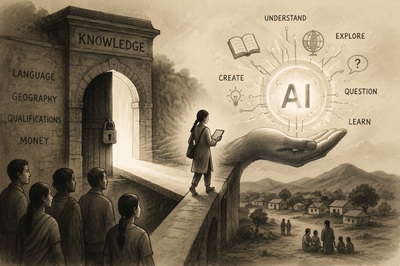
For centuries, knowledge had an address. It lived in monasteries, universities, courts, archives and libraries. It was protected by walls, qualifications, geography, language and, often enough, money. A poor child could possess extraordinary curiosity and still find that the books, teachers and institutions capable of answering the most difficult questions were somewhere beyond reach.
Today, something unusual is beginning to happen. A young student in a small village can pick up a modest smartphone and ask about constitutional law, astronomy, history or biology. The answer may not always be correct, and it will certainly not be complete. But the question no longer necessarily has to wait for admission to a university, access to a specialist or a place inside a prestigious library.
That may be one of the quieter revolutions of artificial intelligence.
When Knowledge Had Gatekeepers
For much of human history, access to knowledge depended upon more than curiosity. Literacy itself was once a privilege. Books were scarce, libraries were few, and higher education belonged overwhelmingly to those who could afford it or had access to institutions that could provide it. Even after mass education and the printing revolution widened access, another barrier remained: interpretation.
A government notification might be publicly available, yet understanding its implications could require a lawyer or an experienced bureaucrat. A scientific paper might be freely published, yet remain virtually incomprehensible without years of specialist training. A court judgment could be placed online and still remain inaccessible to a citizen unfamiliar with legal language. The information might be public. The ability to understand it was not necessarily so.
The internet weakened some of these barriers. It made an extraordinary quantity of information searchable and brought libraries, archives, newspapers and databases much closer to ordinary people. But artificial intelligence potentially takes the next step. It can take material that is already available and begin a conversation about it.
The internet largely asked: Where is the information?
AI increasingly allows us to ask: What does it mean?
That distinction could prove more consequential than it first appears.
From Finding Information to Understanding It
Consider a pensioner trying to understand a government order, a small entrepreneur attempting to make sense of a regulatory requirement, or a student confronted with a scientific concept far beyond the language of a school textbook. Earlier, the first barrier was often finding the material. The second, and often greater, barrier was understanding it.
An AI system can potentially explain a complicated document in plain language, translate it into another language, identify unfamiliar terms, compare interpretations and suggest questions that the reader may not have thought to ask. It can help a citizen understand the difference between a legal provision and an opinion about that provision, or help a student move from a textbook definition to a more intuitive explanation.
None of this turns the reader into a lawyer, scientist, historian or economist. Nor should it.
AI does not abolish expertise; it can lower the threshold at which a citizen begins to engage with expertise.
That distinction is vital. The purpose of an unlocked library is not to persuade everyone that they have become scholars. It is to ensure that scholarship, public knowledge and serious questions are no longer surrounded by an impenetrable wall.
The first conversation becomes possible.
And sometimes the first conversation is where intellectual independence begins.
The Universal Desk
There is another way of looking at this transformation. For a journalist, researcher or policy professional, knowledge has traditionally come with a desk — a physical place surrounded by books, documents, contacts, databases and colleagues. Artificial intelligence potentially creates a Universal Desk, available wherever there is a connected device and sufficient digital access.
A student in a small town can ask for an explanation of a difficult scientific concept. A citizen can ask what a lengthy public document actually says. A retired person can explore a subject that formal education never made accessible. A small entrepreneur can interrogate a complex regulation before deciding whether professional advice is necessary.
The distinction between starting the inquiry and mastering the subject is important here. AI cannot remove the need for teachers, researchers, lawyers, doctors, scientists or journalists. Nor should it.
What it can do is make the first step less intimidating.
This has particular significance for countries such as India, where geography, income and language can still determine how easily citizens enter formal knowledge systems. The ability to ask a question in a familiar language and receive an explanation at an appropriate level is not merely a technological convenience. It can be a bridge.
The village student does not suddenly possess the resources of a great university.
But the university is no longer the only place where the question can begin.
The New Divide
Yet there is a danger in celebrating this transformation too easily.
The library is not actually open to everybody.
UNESCO reports that around 2.6 billion people — nearly one-third of the world's population — remained without internet access in 2024, and warns that the existing digital divide could become an AI divide. Rural populations, girls, persons with disabilities and marginalised communities are among those particularly affected.
Even among those who are connected, access is unequal. Devices differ. Connectivity differs. Languages differ. Some users have access to more capable AI services than others. Digital literacy varies enormously. So does the ability to distinguish a well-supported answer from a plausible-sounding mistake.
There is therefore a paradox at the heart of the AI revolution.
A technology capable of democratising knowledge can also create a new hierarchy of knowledge.
Those who understand how to question an AI system, verify its claims, examine its sources and challenge its assumptions may gain considerably more from it than those who simply accept whatever appears on the screen.
The new divide may therefore not be merely between those who have AI and those who do not.
It may increasingly be between those who know how to think with AI and those who merely consume what it tells them.
That is why AI literacy matters as much as access. UNESCO's AI competency framework for students places human-centred thinking, ethics, critical judgement and responsible use alongside technical knowledge.
The objective should not be to create a generation that asks machines everything.
It should be to create a generation that becomes better at asking questions.
The Question Matters More Than the Answer
This may ultimately determine whether the unlocked library becomes a democratic institution or simply another machine for producing convenient answers.
Used badly, AI can become an intellectual shortcut. It can encourage laziness, reproduce errors with confidence and make people less inclined to investigate for themselves. A fluent answer can create an illusion of understanding without the hard work that genuine understanding requires.
Used well, however, AI can function rather differently.
It can be a patient explainer, a research companion, a translator between specialised discourse and everyday speech, a second pair of eyes and an intellectual sparring partner. It can ask: What is your evidence? It can suggest: Check that date. It can challenge: Have you considered the argument on the other side?
The difference is not technological.
It is human.
The democratic value of AI may therefore lie less in the number of answers it can produce than in the number of better questions it enables ordinary people to ask.
That is where the idea of intellectual empowerment becomes more meaningful than the fashionable language of disruption.
A child does not need to become a professor overnight. A citizen does not need to become a constitutional lawyer. A pensioner does not need to become an economist.
They need the confidence to ask: Why?
Then: How do we know?
And perhaps the most important question of all:
What am I not being told?
The Library Is Still Unfinished
The unlocked library, therefore, should not be mistaken for a finished revolution.
Its doors may be wider, but they are not equally wide for everyone. Its books may be more accessible, but not every book is reliable. Its new assistants may be extraordinarily capable, but they can still make mistakes. And access to information without the ability to judge information can simply create a faster route to confusion.
The task ahead is consequently larger than providing people with AI tools. It is to improve connectivity and affordability, strengthen digital and AI literacy, preserve the value of human teachers and professional expertise, protect privacy, expand access across languages and ensure that increasingly powerful systems remain accountable to the people who use them.
The human element is particularly important. Technology should expand a person's capacity to think, not quietly replace it. An AI system can explain a law; it cannot decide what justice means for a society. It can summarise a historical argument; it cannot assume responsibility for how that history is remembered. It can offer possibilities; the judgement about what to believe, question or do must remain with the human being.
That is why the real measure of technological progress has never been how sophisticated the machine becomes.
It is what happens to the person who previously stood outside the door.
Perhaps the greatest promise of artificial intelligence is not that machines will eventually know everything. It is that millions of people who were once told that certain questions were too complicated, too technical or simply not meant for them may begin asking those questions anyway.
The library has not become equal. The old gatekeepers have not disappeared. The door is not open to everyone.
But something has changed.
For perhaps the first time, an ordinary citizen can stand outside the door, hold up a phone and begin asking what is inside.
And perhaps every intellectual revolution begins that way — not when everyone receives the answer, but when no one is afraid to ask the question.
Author's Note
There is something quietly personal about writing about an unlocked library after spending decades around institutions, information and the machinery through which public knowledge reaches citizens.
The tools have changed dramatically. The fundamental questions have not: who gets to know, who gets to understand, and who gets to ask?
Artificial intelligence will not answer those questions for us. That responsibility remains human.
But if used wisely, it may help move the starting line a little closer to everyone.
And perhaps that is where the real promise lies: not in giving every person the same answers, but in giving more people the confidence to ask their own questions.
*****************

The writer is a retired officer of the Indian Information Service and a freelance writer. He also worked as an international media consultant with UNICEF Nigeria and contributes regularly to various publications.Mail - kgsharma1@gmail.com
(Views are personal.)

We are trying to create a platform where our readers will find a place to have their say on the subjects ranging from socio-political to culture and society. We do have our own views on politics and society but we expect friends from all shades-from moderate left to moderate right-to join the conversation. However, our only expectation would be that our contributors should have an abiding faith in the Constitution and in its basic tenets like freedom of speech, secularism and equality. We hope that this platform will continue to evolve and will help us understand the challenges of our fast changing times better and our role in these times.
About us | Privacy Policy | Legal Disclaimer | Contact us | Advertise with us