
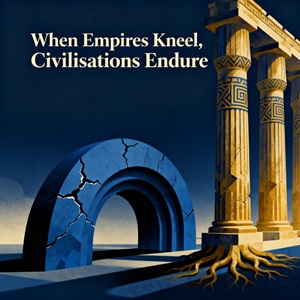
Amandeep Midha has become one of RaagDelhi’s most incisive voices on global affairs, combining the precision of a technologist with the perspective of a long-term expatriate. His ability to link headline events with underlying civilizational currents makes his essays far more engaging than what is usually found in foreign affairs writing. This new article advances the inquiry into what India must do in an era when old empires bow to necessity. We hope readers will find it thought-provoking and insightful.
When Empires Kneel, Civilisations Endure
Amandeep Midha
India's Moment of Reckoning in a World Where Power Bows to Necessity
When Donald Trump floats the idea of a US-China "G2" summit on social media, the global intelligentsia should decode the subtext with surgical precision. For Trump, a maestro of transactional statecraft, meaning resides not in rhetoric but in action. His China policy reveals a pattern: the former President who once waged trade wars has now perfected the art of strategic accommodation, some might say genuflection.
Consider the scorecard: reversed tariffs, a 10% discount granted to Beijing, canceled port fees for Chinese vessels, suspended export bans, and the quiet burial of Section 301 investigations. The spoils of this concession? A single year of rare earth supply, a resource so critical to modern technology that its scarcity could cripple entire industries. This isn't victory; it's a subscription service to survival. Next year, the empire must renew its contract, kneeling once more at the altar of necessity.
Industrial Symphony of the Dragon
While Washington negotiates yearly lifelines, Beijing orchestrates the future. China doesn't just manufacture products; it manufactures dominance across sectors that will define the 21st century: electric vehicles that are reshaping global automotive markets, drones that redefine surveillance and logistics, solar panels powering the green transition, and algorithms that increasingly govern digital life.
The velocity of Chinese industrial scaling defies conventional business timelines. Mixue Bingcheng, a F&B chain unknown to most Western consumers a decade ago, has eclipsed the golden arches and the green mermaid, reaching 45,000 outlets in merely 26 years. McDonald's needed 67 years to achieve 45,300 stores. This isn't an anomaly; it's a pattern of execution.
In artificial intelligence, the contrast is even starker. DeepSeek, developed for approximately $6 million, delivers performance comparable to ChatGPT, which consumed $3 billion in development costs. This 500:1 efficiency ratio isn't just about frugality; it represents a fundamentally different approach to innovation, one that prioritizes iterative excellence over capital-intensive moonshots.
The dependencies run deeper still. China produces 60 to 70% (earlier it was upto 97%) of the antibiotics coursing through American veins, sustaining U.S. healthcare infrastructure. It holds $765 billion in U.S. Treasuries, enough financial leverage to send shockwaves through global markets with a single policy shift. Wall Street, despite its swagger and century of dominance, operates increasingly as a paper tiger whose roar depends on Beijing's goodwill.
Even military supremacy, America's last uncontested domain, faces asymmetric challenges. Pentagon strategists privately acknowledge that China's hypersonic missile systems are a really serious threat as it could theoretically neutralize an entire U.S. aircraft carrier fleet (some reports suggest within 20 minutes), rendering decades of naval investment vulnerable to new physics of warfare.
The taxonomy of deference becomes clear: America bows not from respect but from economic and geopolitical necessity. Japan bows from historical gratitude and strategic alignment, a junior partner acknowledging senior protection. The United States bows from survival, a recognition that confrontation carries costs it cannot bear given its debt situation..
Precarious Equilibrium of the Elephant
In this reconfigured geometry of power, India occupies a position both perilous and pivotal. For decades, New Delhi has cultivated Washington as a counterweight, a convenient partnership against the rising dragon beyond the Himalayas. The Quad, defense agreements, technology transfers, each represented a bet on American staying power.
But if Washington now embraces Beijing in earnest, India's strategic calculus crumbles. Our technology ecosystem exists on borrowed infrastructure: cloud computing runs on American servers, semiconductors flow from allied fabs, artificial intelligence models train on Western frameworks, and operating systems originate from Silicon Valley. A single policy shift in Washington could paralyze India's digital economy overnight, a little glimpse of it was seen when Nyara energy was hit by European sanctions and access to intranet and emails by employees severed.
The vulnerabilities cascade across sectors. Our brightest students populate American universities, their research funding increasingly contingent on geopolitical alignments.
Our start-ups depend on international collaborations that could pivot eastward if the wind changes.
Our manufacturing ambitions, particularly in electronics and renewable energy, remain intertwined with Chinese supply chains we publicly denounce but privately depend upon.
Our pharmaceutical industry, despite being dubbed the "pharmacy of the world," sources 70% of its active ingredients from China.
India finds itself wedged between a transactional empire and a civilisational neighbor. China, despite border tensions and nationalist rhetoric, remains structurally and economically indispensable. Geography doesn't lie: we share a 3,488-kilometer border. History doesn't forget: millennia of cultural exchange preceded decades of political friction. Supply chains don't discriminate: they follow efficiency, and China offers unmatched scale. Population dynamics don't pause: 2.8 billion people in two countries can create gravitational pull no alignment can overcome.
Lessons from Divergent Philosophies
Deng Xiaoping's dictum "hide your strength, bide your time" was once dismissed as weakness by Western analysts. Four decades later, it has produced industrial self-reliance, global supply chain dominance, and technological capacity that rivals or exceeds American capabilities in critical sectors. China played the long game while others chased quarterly earnings.
Trump's "Art of the Deal" is performative, maximalist, and immediate. It seeks wins that can be tweeted, concessions that can be televised, victories that fit news cycles. It is loud, theatrical, and fundamentally short-term.
China's "Art of Patience" operates on generational timelines. It accepts short-term losses for long-term positioning, endures criticism for strategic gain, and builds infrastructure while others build headlines. It is quiet, methodical, and enduringly effective.
India must synthesize both approaches: the tactical flexibility of Trump's dealmaking with the strategic patience of Chinese planning. We cannot afford American impulsiveness, nor can we replicate Chinese authoritarianism. We need a third path, distinctly Indian, rooted in civilisational wisdom yet nimble enough for modern statecraft.
The Consequnces of In-Action
These are not hypothetical scenarios for policy papers. If the U.S. consolidates its rapprochement with China and relegates India to secondary-partner status, disruptions will cascade through every sector of our economy and society.
Education: Shrinking funding for collaborative research, visa restrictions for students, declining access to cutting-edge academic networks.
Agriculture: Increased dependence on selective foreign inputs for seeds, fertilizers, and agricultural technology, with pricing power shifting away from Indian farmers.
Manufacturing: Make in India initiatives marginalized in regional supply chains as production networks orient around a U.S.-China axis.
Space: Critical components for satellites and launch vehicles becoming inaccessible or subject to political leverage.
Social indices: Employment volatility, rural livelihood disruption, inflationary pressures, and widening inequality as global economic shifts hit the most vulnerable first.
A Civilizational Response
The solution is neither confrontation nor capitulation. India's strategic response must be civilisational in scope, not merely transactional in execution.
Digital and Industrial Sovereignty: We must build indigenous alternatives, our own cloud infrastructure that doesn't route through American servers, operating systems that don't depend on Silicon Valley licenses, semiconductor fabrication capacity that gives us supply chain resilience, and AI models trained on our priorities and values. This isn't nationalism; it's survival architecture.
Pragmatic Engagement: Simultaneously, we must engage China in sectors that enhance growth without compromising critical autonomy. Agri-tech cooperation can improve yields. Green energy partnerships can accelerate our climate commitments. Manufacturing collaboration in non-sensitive sectors can build capacity. This isn't appeasement; it's realism informed by geography and economics.
Strategic Polycentrism: India cannot afford to become a single-aligned nation. We must cultivate multiple partnerships, balancing American technology with European regulatory frameworks, Japanese quality standards with Korean innovation culture, ASEAN connectivity with Middle Eastern energy security, and African demographic partnerships with Latin American resource collaboration. And within this polycentric fabric, the Danish–Indian collaboration offers a model of quiet maturity. Denmark has emerged as one of India’s most trusted European partners in green technology, wind energy, and sustainable design. Copenhagen’s clean-tech firms and India’s scale can together set new benchmarks in climate resilience. Unlike Washington’s transactional overtures, such partnerships rest on values of trust, transparency, and long-term reciprocity.
The Green Strategic Partnership signed between India and Denmark in 2020 has already shown what pragmatic diplomacy can achieve: co-innovation in renewables, water management, and digital infrastructure. This is the kind of partnership India needs more of civilisational in spirit, technological in method.
Applying Endurance Principle
India cannot afford the hubris of believing that flag-waving or echoing allied rhetoric protects national interests. Civilizations endure not through rigid alignments but through adaptive resilience. They balance strength with patience, dignity with pragmatism, principle with flexibility.
We cannot rely solely on the United States; its commitment to any partner lasts only as long as immediate interests align. We cannot shun China; its size, proximity, and integration into global systems make confrontation costly and isolation impossible. Both powers are too large, too influential, and too intertwined with our developmental destiny.
Our choices today determine whether India remains an active participant shaping its future or becomes a pawn moved by empires that kneel when convenient and dominate when possible.
Final Ledger of Geopolitics
History will remember empires for their deals, the transactions that defined their moments of peak power. It will remember civilizations for their endurance, the capacity to adapt, absorb, and persist through shifting landscapes of power.
India's task is to ensure it belongs to the latter category. We must think in centuries while acting in quarters, maintain principles while practicing flexibility, and build sovereignty while engaging pragmatically. The world order is shifting beneath our feet. Empires that once stood rigid now kneel before economic necessity. In this recalibration, civilizations that endure are those that understand power's true nature: not permanent, not given, but constantly negotiated through wisdom, patience, and strategic clarity.
India's moment has arrived. The question is whether we will meet it with the wisdom our civilizational heritage demands and the pragmatism our contemporary challenges require.
*********

Amandeep Midha is a technologist, writer, and global speaker with over two decades of experience in digital platforms building, data streaming, and digital transformation. He has contributed thought leadership to Forbes, World Economic Forum, Horasis, and CSR Times, and actively engages in technology policy-making discussions. Based in Copenhagen, Amandeep blends deep technical expertise with a passion for social impact and storytelling.

We are trying to create a platform where our readers will find a place to have their say on the subjects ranging from socio-political to culture and society. We do have our own views on politics and society but we expect friends from all shades-from moderate left to moderate right-to join the conversation. However, our only expectation would be that our contributors should have an abiding faith in the Constitution and in its basic tenets like freedom of speech, secularism and equality. We hope that this platform will continue to evolve and will help us understand the challenges of our fast changing times better and our role in these times.
About us | Privacy Policy | Legal Disclaimer | Contact us | Advertise with us