How Drug Combinations force us to consume unwanted medicines
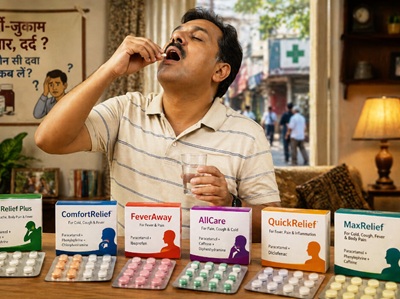
Manoj Pandey has created dozens of informative videos on a wide range of health issues. From time to time, he writes articles on selected health topics for the benefit of our readers. The article below makes a strong case against irrational fixed-dose combinations.
How Drug Combinations force us to consume unwanted medicines
Manoj Pandey
An allopathic medicine is mostly made up of a specific chemical that works on the human body in a specific way. At a deeper level, you will find that to be effective against a disease or symptom, the drug molecule has to modify our body’s biochemical processes.
The molecular pathways of drugs are very complex, but, for the sake of illustration, let us see how ibuprofen, a common medicine for swelling, acts in our body. When swelling occurs after an injury, a type of messenger molecule - prostaglandin - is released in the blood. This chemical goes to the injured area and tells the cells on the walls of tiny blood vessels to move aside. That creates openings in the walls, leading to leaking of fluids to the injured tissue and, in turn, causing the injured area to swell. When we take ibuprofen, it stops the formation of prostaglandin. Since the blood vessels in the injured region now do not get the direction to release fluid from the blood, swelling subsides.
Let me expand this example to illustrate how drug molecules end up producing side-effects, especially when taken wrongly or in excessive doses. In this example, prostaglandin is the key molecule that is stopped by ibuprofen. Prostaglandin, like other biochemicals in the body, assumes different roles in different biological processes and different organs. One of prostaglandin’s jobs is to protect our stomach wall against acid secreted during digestion. Since ibuprofen stops formation of prostaglandin, use of this drug can cause the acid to attack the stomach wall, and this can lead to heartburn, gastritis, ulcers, and bleeding.
What happens when many drugs are taken together?
When you look at the molecular level, multiple drugs taken together can shake the body by accelerating or subduing a large number of internal processes, modifying signals, and so on.
The modern medicine system knows a lot about each drug’s pathways and how a combination of drugs creates a mess - sometimes working counter to each other and sometimes creating new issues for which the body is not prepared. Therefore, doctors are supposed to consider the patient’s health condition, age, sex and other factors even more closely before prescribing more than one medicine, and decide their doses and duration accordingly.
In reality, doctors are not always that careful in practice. Moreover, people take over-the-counter medicines either relying on the pharmacist’s wisdom or their own common sense. That leads to overconsumption of correct medicines and consumption of unsuitable ones.
We shall discuss the issue of wrong medication and self-medication sometime later. Right now, let us come to the wide use of medicines that contain more than one drug. We shall see that when drugs are combined in a single pill, syrup or injection, the risk of excessive and wrong consumption of certain drugs rises manifold.
What are combination medicines, and how do they harm us?
Combination medicines, technically called Fixed-Dose Combination (FDC) products, are medicines that have more than one type of drug included in it.
Multi-vitamins are often prescribed by doctors along with other medicines, and many people gulp them whenever they feel weak. A multi-vitamin capsule has fixed doses of Vitamin A, B1, B2, C, D, etc., and when a person takes that capsule, he gets the benefit of a vitamin that he is deficient in but is prone to developing toxicity for a vitamin that he has already been getting adequately from food.
Multi-vitamins are one of the safest examples of FDCs being consumed in enormous quantities world-wide. The problem becomes more severe when irrational combinations of highly active molecules are sold, prescribed and consumed.
In India, numerous FDCs were being sold till recently by big pharma companies and indiscreetly prescribed by doctors. Let us see some examples.
• Many branded tablets for common cold and flu, which could be bought over the counter, had Cetirizine, Phenylephrine and Paracetamol. In most cases, these ingredients are either not required or required in quantities based on the severity of symptoms.
• A popular combination for pain contained Aceclofenac and Paracetamol. This was being prescribed to patients of all ages, though considered unsafe for children.
• Amoxicillin and Bromhexine were combined into a cough tablet. While Amoxicillin is an antibiotic (which kills only bacteria), the other ingredient soothes the throat. This drug was forcing cough patients to unnecessarily consume an antibiotic.
• Chlorpheniramine and Codeine syrup was also a popular cough combo, until the government acted against codeine-based FDCs because this chemical can cause severe addiction.
• Drugs with Nimesulide and Paracetamol were frequently prescribed for fever and pain, even in children, before the use of Nimesulide in children and in high doses in adults was banned.
On the face of it, FDCs are created so that the impact of different medicines is synergized. Since fever often accompanies cold and flu, it makes sense to combine medicines that would reduce fever and sneezing, no? Why not add something for body pain? Then, because sometimes such ailments are caused by bacteria, why not add an antibiotic so that a bacterial infection is taken care of from the beginning? You will understand that by giving instant relief from fever, sneezing and body pain, such a wonderful combination becomes a darling of doctors as well as common people.
I was suffering from an allergy. That would have gone by itself, and - in most cases - I would have, at best, needed an anti-allergen. By taking that wonder medicine, I unnecessarily took medicines that were not needed. In the long run, I will suffer the consequences, but right now I swear by that wonder medicine!
Take the example of a combination of medicines for reducing body pain and fever. Since these symptoms often come together, I have been taking this medicine whenever I have fever and/or body pain. In the present instance, my body pain went away after two days of medication, but fever kept coming back after some hours. So, I kept taking that medicine. Now, while the fever-reducing ingredient might have some use, I was consuming the pain-reducing drug when it was not required.
Thus, when an FDC is taken, one is forced to either take an ingredient that is not needed or keep taking an ingredient that has done its job and is no longer needed. There are also other ways the combinations are often more harmful than beneficial. For example, in some combinations, one drug that is best taken before meals is combined with the one that should ideally be taken after meals. In the case of patients undergoing treatment for multiple diseases, it is common to see prescriptions that can lead to overdose of some drugs because the same molecule is found in different formulations.
It is documented that the use of irrational antibiotic FDCs is a major cause for the recent rise in drug-resistant infections in India.
Isn’t it ironical that the drug companies, which have enormous resources to examine the likely side-effects and overdoses when two or more molecules are included in an FDC, and doctors have the responsibility to check the final doses and types of molecules that the patient is getting, these are the very actors that produce and prescribe irrational FDCs?
Having said that, let me clarify that there is also a small number of combinations that are made with due medical considerations. Such combinations become necessary when two or more drugs need to be taken in a specific ratio and for a long time, or when it must be ensured that the patient does not, by mistake, miss one of the many essential drugs. HIV/AIDS antiretrovirals, standard multi-drug TB treatments, and a few diabetes and blood pressure drugs can be cited among such rare examples.
Are the authorities not aware of the FDC scourge?
They are, but the production, and sale of undesirable FDCs continues. One reason is that - like many other Indian systems - this system is full of regulatory loopholes. For decades, many FDCs have received manufacturing approvals from State authorities without the mandatory prior approval from the national regulator, the Central Drugs Standard Control Organization (CDSCO). This has virtually bypassed clinical trials meant to verify the suitability of their ingredients, doses, etc. This is happening even now, despite CDSCO issuing advisories to State authorities against permitting such drugs without its approval.
CDSCO has banned 23 such drugs in 2023 and 156 in 2025. Recently, it has written to State authorities to review 90 such drugs in use. This list mainly contains FDCs for cough and cold, micronutrient supplements, skin creams and anti-diabetic formulations.
It is evident that companies persist with issuing new combinations due to lack of ethics and very low regulatory costs.
Consumer beware!
Drug companies would keep making FDCs, doctors will keep prescribing them even when these are not suitable, and pharmacists will keep encouraging their use. The common man/ woman will keep gulping them at liberty due to wrong notions, getting influenced by advertisements and the media, carelessness, and ignorance.
As individuals, we are in no position to take on the drug lobby, but we can at least protect ourselves and our family-members by being aware. This article will ‘earn its honest bread’ if you stop taking FDCs on your own and also start checking whether your doctor has prescribed such combinations. The least you could do is avoid multi-vitamin pills and over-the-counter medicines for common ailments.
**********
Manoj Pandey is a former civil servant with a keen interest in exploring and analyzing issues related to science, technology and health. He has contributed extensively to this web magazine, particularly in the विज्ञान (Vigyan) and स्वास्थ्य (Swasthaya) categories. While he writes articles in English, he also makes Videos in Hindi showcasing his commitment to informing the common-man on these important issues. His videos can be seen on YouTube under the heading 'Hindi Health Videos' .


