
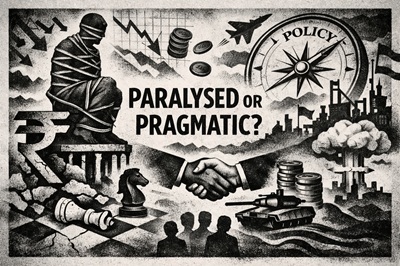
Amandeep Midha has written a critique of India’s fiscal policy and has skilfully entwined it with the country’s foreign policy. He accomplishes this even though the length of the article is such that it almost feels like two essays in one. Yet, it never bores the reader for a moment. The piece also asks an uncomfortable but necessary question: are we paralysed, or merely pretending to be pragmatic? Read on and grapple with the issues raised by him.
The Paralysis Dressed as Pragmatism: India's Strategic Drift in 2026
Amandeep Midha
There is a particular kind of silence that settles over a country when it is no longer sure what it stands for. Not the silence of deliberation, which is productive, nor the silence of strategic patience, which has its own quiet dignity. The silence that has settled over India in the first quarter of 2026 is a different thing altogether; it is the silence of a state that has run out of answers, and has begun to mistake the absence of a decision for the presence of a doctrine.
We are told this is non‑alignment updated for a multipolar age. We are told this is multi‑alignment, or strategic autonomy, or the mature pragmatism of a civilisation‑state that has learned to hedge. These phrases are offered the way a struggling company offers an investor deck: handsomely bound, confidently delivered, designed to obscure that the numbers underneath are moving in the wrong direction. The numbers, in our case, are now impossible to obscure.
The Currency Cannot Be Talked Down
The rupee closed the last financial year at roughly ₹93.88 to the dollar, a depreciation of about nine per cent over FY26 alone. To arrive at even this battered level, the Reserve Bank of India had to sell a net $50.8 billion in the forex markets between April 2025 and January 2026, a scale of intervention that the government’s own written submissions concede. Reserves which peaked above $728 billion in February collapsed by more than $40 billion in the weeks that followed, settling near $688 billion by the end of March. By the measure that matters most, the worst‑performing major Asian currency of the year, the rupee has earned a distinction no finance ministry would willingly claim.
What is striking is not the depreciation itself, which in isolation can be defended as part of a broader emerging‑market adjustment. What is striking is that the depreciation has happened despite the intervention, not in the absence of it. Roughly one in every fourteen dollars of our reserves was spent, in a single year, to slow a slide that arrived anyway. The RBI’s forward book, the instrument through which it sells dollars on future dates to avoid depleting the spot reserves, crossed $77 billion by February and is believed to have grown since. This is not stabilisation. It is the monetary equivalent of paying next month’s rent with next year’s salary, and calling the accounting solvent because the landlord has not yet knocked.
A country that burns 50 billion dollars to hold a level which it loses anyway, is a country that has confused activity for agency. Global headwinds and capital‑flow volatility explain part of the move, but domestic policy choices have amplified the pressure on the rupee and left the RBI with a narrower operating space.
The Fiscal Architecture of Electorally Timed Transfers
Into this external fragility, we have now layered a fiscal architecture whose only honest description is that of an electorally timed transfer machine dressed in the vocabulary of welfare. The Economic Survey 2025‑26 itself, tabled in Parliament on 29 January, estimated that unconditional cash transfers to women alone would consume approximately ₹1.7 lakh crore across state budgets in FY26. The combined gross fiscal deficit of the states has risen from 2.6 per cent of GDP in FY22 to a projected 3.2 per cent in FY25. Outstanding state liabilities are now above 28 per cent of GDP. In FY24, nearly 62 per cent of states’ total revenue receipts were consumed by salaries, pensions, interest payments and subsidies; which is to say, before a single rupee can be spent on the roads, schools, hospitals or ports that would actually lift a productive economy, the structural commitments have already swallowed two‑thirds of what came in.
Let us be precise about what these transfers are, and what they are not. Freebies based on gender or unemployment are not welfare. Welfare, to earn the name, must result in human capital or in institution building, to some measurable extent. These transfers do neither. They build nothing at all.
Consider the test honestly. A scholarship paid against enrolment in a school builds human capital; the child is educated, the teacher is employed, the school is sustained, and a generation later the country has an engineer or a nurse who would not otherwise have existed. A maternal nutrition programme routed through an Anganwadi builds institution; the worker is trained, the supply chain is established, the weighing scale and the register and the cold chain for vaccines all come into being, and the village has a node of state presence it did not have before. A skills voucher tied to vocational certification builds both; the learner acquires a tradeable capability, and the training institute acquires a revenue line that sustains teachers, equipment, and syllabus revision. In each case, when the scheme ends, something remains. A trained person. A functioning Anganwadi. An ITI with a workshop that still works.
Now consider the Ladli Behna, the unemployment allowance, the electricity freebie, the two‑thousand‑rupee monthly transfer announced the fortnight before a state election. When these schemes end, and eventually they must end, because no fiscal arithmetic permits them in perpetuity, what remains? The recipient has the rupees she spent, which are gone. No school was built. No Anganwadi was staffed. No teacher was trained. No supply chain was laid. No institution was created that will outlast the transfer. The money arrived, was consumed, and left nothing behind but the expectation of the next transfer and the political debt the next government will inherit. This is not welfare. It is not even, in any defensible sense, redistribution. It is consumption‑smoothing paid for by borrowing against future capital expenditure, and the future it smooths away is the one in which the state might actually have built something.
Welfare, in any serious definition, is the reduction of deprivation through investment in human capital: nutrition, education, maternal health, vocational training, old‑age and disability protection. It is capital that compounds. The schemes now proliferating across Indian states under the banner of women’s empowerment or youth employment or electricity freebies are not that. They are recurring consumption transfers disbursed on gendered or occupational criteria that map, with unseemly precision, to voting blocs. The Economic Survey itself was forced to acknowledge, in cautious language but unambiguously, that such transfers can depress female labour force participation rather than raise it, and can produce medium‑term growth concerns if they are not paired with investment in employment and skills.
One does not need to oppose the principle of state support to observe the pattern. A transfer that asks nothing in return, is indexed to no outcome, depends on no institution being built, and is announced in the fortnight before a poll, is not a welfare instrument. It is a political instrument that borrows welfare’s clothing because the cloth is respectable. And the bill arrives as it always does: at the RBI’s forex desk, in the bond market’s risk premium, in the rupee’s ability to hold its line.
The Oil We Did Not Secure
If the domestic fiscal picture is one of indulgence dressed as compassion, the external picture is one of retreat dressed as prudence. The sequence of the past twelve months on energy deserves to be set down plainly, because the official version has not.
In August 2025, when European capitals lectured India about Russian crude, the Ministry of External Affairs produced a sharp and justified rejoinder: the EU itself had conducted €67.5 billion in bilateral goods trade with Russia in 2024; its energy trade with Moscow, far from being a vital national compulsion, was a matter of commercial convenience; India’s own imports had in fact been encouraged by Washington in 2022 to stabilise world oil markets. The argument was correct on its own terms. It was also, in retrospect, the last time New Delhi spoke on this file with genuine self‑possession.
By late November 2025, the United States had sanctioned Rosneft and Lukoil, and Indian refiners began scrambling. Russian crude, which had peaked at over 44 per cent of India’s total oil imports in June, fell below 25 per cent in the December‑February window. Reliance suspended purchases in January, then resumed modestly in February under EU pressure. Public sector refiners continued buying through non‑sanctioned intermediaries, a quiet, workable, unannounced compromise. This is not strategy; it is improvisation at scale. A country of India’s stated stature does not negotiate its sovereign energy basket through shell‑intermediary arbitrage while its foreign secretary rebuts European hypocrisy at the microphone.
The Iran question is still on. On 29 September 2025, Washington reimposed sanctions on Chabahar. Rather than engage in the kind of sustained, high‑level, bilateral negotiation that the port’s strategic value to India—a direct maritime gateway to Afghanistan and Central Asia, bypassing Pakistan—would seem to warrant, New Delhi accelerated the final $120 million tranche of its investment, closed out the liability before the sanctions bit, and informed the US Treasury’s OFAC of its intention to “wind down all activities” at the Shahid Beheshti terminal. OFAC duly granted a six‑month wind‑down waiver, effective 29 October 2025 through 26 April 2026. The waiver window, as I write this, has days left. The port that two decades of diplomacy, capital, and political capital were poured into is being handed, in effect, to whoever is willing to stand where India would not.
Two observations follow. First, the argument that India had “no choice” is an argument a middle power makes; it is not one a rising power, and certainly not a self‑described civilisation‑state, can make without the word ringing hollow. Second, the port was not surrendered to a compelling security threat. It was surrendered to the cost of an unresolved trade file. We traded strategic depth for tariff relief, and received neither.
The killing of Ayatollah Ali Khamenei and Its Aftermath
Ayatollah Ali Khamenei was killed on 28 February in coordinated US‑Israeli strikes on Tehran. Iranian embassies across capitals opened condolence books. Ambassadors of friendly states signed them as a matter of diplomatic convention. India’s ambassadors did not. On 3 March, a cable went out from headquarters, signed by the joint secretary in charge of the Pakistan‑Afghanistan‑Iran division, instructing Indian missions to seek clearance before signing. For four days, New Delhi said nothing. During those four days, the Prime Minister held calls with Arab leaders condemning Iranian strikes on their territory. It was only on 5 March, after mounting opposition criticism at home, after a US naval action off Sri Lanka against an Iranian warship, after the window for dignified silence had plainly closed, that Foreign Secretary Vikram Misri was dispatched to the Iranian embassy in New Delhi to sign the register. No formal condolence statement was issued separately, unlike the convention with several other states.
This is not non‑alignment. Non‑alignment required, at a minimum, the capacity to treat each power as the occasion demanded, without reference to the preferences of any other. This is not multi‑alignment either, which at its best requires simultaneous, overlapping, mutually visible engagement. What we witnessed in those four days was hesitation; the hesitation of a chancery that did not know what it was permitted to feel, because it had not decided what it was willing to say.
The Name for What This Is
Non‑alignment was a doctrine. It had a text, a constituency, a ledger of trade‑offs its architects were prepared to defend. Multi‑alignment, as articulated by our own external affairs establishment over the past decade, was meant to be its updated heir; engaging everyone on the specific terms of the specific issue, preserving room for manoeuvre, refusing the zero‑sum framings imposed by Washington, Beijing or Brussels.
What we have now is neither. What we have is a paralysis whose operating signature is this: the outward assertion grows louder while the underlying positions grow narrower. The civilisational‑state language expands while the Chabahar footprint contracts. The Knesset fatherland metaphor is invoked while the Tehran condolence is delayed four days. The RBI sells fifty billion dollars to hold a line it then loses. The state channels about one and three‑quarter lakh crore to voting‑bloc‑oriented transfers it then describes as beneficiaries of empowerment. The rhetoric scales; the capacity does not.
The difference between pragmatism and paralysis is this: pragmatism pays a price to secure a named objective. Paralysis pays a price and hopes no one asks what was bought. A country that is pragmatic can tell you what it traded and what it gained. A country that is paralysed cannot; and so it speaks, instead, of civilisation.
What a Self‑Respecting Correction Would Look Like
The purpose of this reflection is not to lament. It is, if anything, a quiet plea for the reintroduction of a vocabulary of cost. A state that knows what it is doing can say: we are buying X by paying Y, and here is why X is worth Y. Every serious foreign policy in history has been articulable in that form. Ours, at present, is not.
A self‑respecting correction would begin with three acknowledgements, none of them politically comfortable.
The first is that the currency cannot be defended indefinitely by selling reserves against a structural current account deficit. The rupee’s level reflects what we produce, save, and export more than it reflects RBI’s willingness to intervene; fifty billion dollars spent to slow a fall that arrived regardless is a tuition fee, and the lesson was not in favour of intervention. Global monetary conditions and capital‑flow volatility explain part of the move, but domestic policy choices have amplified the pressure on the rupee and left the RBI with a narrower operating space.
The second is that consumption transfers indexed to gender or employment status, unconditional and indefinite, are not welfare, and should not be allowed to consume fiscal space that a growing economy requires for capital formation. The Economic Survey of our own government said as much in measured prose; the political class has thus far declined to read its own document. Welfare, understood properly, is investment in human capital and institutions; the current pattern of electorally timed freebies risks crowding out that kind of spending.
The third is the hardest. Strategic autonomy is not a posture. It is a balance sheet. It has to be paid for in concrete acts: the maintained Chabahar stake, the defended Russian or Iranian oil lane, the timely condolence, the calibrated Knesset phrase; and every time the balance sheet is debited without acquiring anything, we grow poorer in the one currency no RBI can issue: the world’s estimate of what we will, when tested, actually do.
Consider, as the cleanest illustration of what this debit now looks like in practice, the events of the past month. Under the 30‑day US waiver announced in March 2026 permitting the purchase of Iranian and Russian crude already loaded at sea, Indian Oil Corporation bought 2 million barrels of Iranian oil, its first such cargo in seven years, and Reliance followed. According to Reuters sources reported by Business Standard on 17 April, both refiners are settling those purchases in Chinese Yuan, routed through ICICI Bank’s Shanghai office into seller accounts denominated in yuan. Separate reports carried by Bloomberg describe an IRGC toll system at the Strait of Hormuz in which transiting tankers pay roughly a dollar a barrel in yuan or stablecoins for safe passage; the Ministry of External Affairs has denied that Indian tankers specifically paid such a toll, but has not denied, because it cannot, that the underlying energy payments have quietly migrated to the Renminbi.
Sit with that for a moment: now the fifth largest economy (it slipped from a brief four‑quarter‑ago position near the upper tier of the G20), a self‑declared civilisation‑state, is paying for its emergency Iranian crude in the currency of the country whose strategic encirclement of us is the single most‑cited threat in our own defence white papers. And it is doing so because it spent the preceding six months divesting, on Washington’s schedule, the very rupee‑payment infrastructure it had built for precisely this contingency. The UCO Bank rupee‑vostro arrangement for Iran trade, painstakingly assembled over decades, sits largely idle. Chabahar, which would have given us a physical terminal for that trade and the leverage of an operator’s seat at the Shahid Beheshti terminal, is being wound down. The consequence is that when the Strait closed and the waiver opened, India did not negotiate from the position it had built; it negotiated from the position Washington had left it. Yuan through Shanghai, in other words, is not a clever workaround. It is the invoice for a strategic retreat that was sold to the Indian public, only four months ago, as prudence.
This is what the Chabahar bluff cost us in the first quarter of 2026. Not a port; we had already ceased to effectively operate it. The cost was the option value of the port: the ability, in a crisis precisely like this one, to receive Iranian crude at a discount, pay for it in rupees through a banking channel we control, and do so without routing our energy security through a Shanghai correspondent account. That option was voluntarily surrendered. The bill has arrived in yuan. There was a time, in the decades after Bandung, when Indian foreign policy could be criticised for many things, but never for inaudibility. We argued, we hedged, we engaged, we refused; and the refusal, when it came, was understood as a refusal, not as an oversight awaiting a cable from the PAI desk. We had, then, a sense of our own weight, not inflated, not theatrical, but earned in the eyes of others. We are not that country at the moment. But the architecture that made us that country is not gone. The foreign service that negotiated the original Chabahar agreement still exists. The RBI that built the rupee‑vostro mechanism with UCO Bank still exists. The Parliament that can reform the transfer architecture, from unconditional cash to conditional, outcome‑linked support tied to health, education and skills, as the Economic Survey itself has urged, still exists. The refineries that could, with different instructions from the Ministry, negotiate directly in rupees rather than through Shanghai correspondents still exist. What is missing is not capacity. What is missing is the willingness to spend political capital in the direction of long‑term strategic assets rather than short‑term electoral ones.
The correction is available. It does not require a change of government, a change of doctrine, or a change of civilisational self‑description. It requires only the reintroduction of the vocabulary of cost around what we are buying and what we are paying. A country that can do that can, within a single fiscal year, begin to look like itself again. A country that cannot, will continue to pay in yuan, and in rupees, and in reserves, and in credibility, without ever quite naming what it is buying.
The first step is to call the paralysis by its name, rather than to continue issuing it a passport in the name of pragmatism. The second step follows, as it always has in our history, from the first.
***********
This article is based on publicly available data and policy documents as of April 2026. The views expressed are analytical and do not constitute an endorsement of any political position.

Amandeep Midha is a technologist, writer, and global speaker with over two decades of experience in digital platforms building, data streaming, and digital transformation. He has contributed thought leadership to Forbes, World Economic Forum, Horasis, and CSR Times, and actively engages in technology policy-making discussions. Based in Copenhagen, Amandeep blends deep technical expertise with a passion for social impact and storytelling.

We are trying to create a platform where our readers will find a place to have their say on the subjects ranging from socio-political to culture and society. We do have our own views on politics and society but we expect friends from all shades-from moderate left to moderate right-to join the conversation. However, our only expectation would be that our contributors should have an abiding faith in the Constitution and in its basic tenets like freedom of speech, secularism and equality. We hope that this platform will continue to evolve and will help us understand the challenges of our fast changing times better and our role in these times.
About us | Privacy Policy | Legal Disclaimer | Contact us | Advertise with us