

Tish Malhotra has enriched our spiritual discourse by contributing an article that explores the profound philosophical concept of human unity, drawing insights from Shirdi Sai Baba's teachings and the Bhagavad Gita. His piece emphasizes the fundamental spiritual principle of 'oneness' that transcends religious and cultural boundaries, aligning with the core philosophical traditions of Indian spiritual thought. The contribution is particularly significant given the limited spiritual content published in recent months, offering readers a thoughtful exploration of universal human connectivity and philosophical understanding. Malhotra's writing continues to demonstrate his extensive experience as an independent author with nearly four decades of journalistic expertise.
It is India that has propounded the eternal truth that whole world is “Vasudhaiva Kutumbakam”, that is "the world is one family". Nothing else can emphasise universal brotherhood and interconnectedness better than this.
In contemporary Indian religious space, Shirdi Sai Baba emerged as a unifying force. Shri Shirdi Sai Baba through his simple and all-embracing lifestyle and teachings once again asserted this universal truth for the benefit of entire humankind.
The footnote on page 19 of Shri Sai Sat Charita distinctly mentions: “The place (Shirdi), where doors are open for all people, of the four classes, for accomplishing the four Purusharthas, viz. Dharma, Artha, Kama and Moksha, is called Dwarka by the wise philosophers. Baba’s Masjid in Shirdi was not only open to the four classes, but to the oppressed, untouchables, lepers etc., like Bhagoji Shinde and, therefore, it is very appropriately styled as the Dwarka."
The whole purpose of the advent of Baba in Shirdi was to bring about the unity among all religions and sects to ensure wellbeing of all humankind and ensuring universal peace, compassion, tolerance, harmony, brotherhood, amity and empathy. His unique message of oneness of entire humankind aimed at uplifting all those who have been struggling since ages and ages under unbearable burden of poverty; illiteracy; negligence; and caste-based religious, cultural, social and economic discrimination, deprivation, oppression and exploitation.
The most fascinating book on Shirdi Sai Baba, “Spotlight on the Sai Story” by Chakor Ajagonkan (Sterling Publishers) is considered at par with Hemandpant’s Shri Sai Satcharita which is widely venerated amongst Sai's devotees. An in-depth study of this book leads us to comprehend the depth of the teachings of the Sai Baba. Sai's spiritual teachings focus on fundamental human values and can guide us to strive towards a coherent Indian society that can be all inclusive and all embracing.
Accepting and respecting the individuality of all and one, we need to ensure equal opportunities for their social, cultural and economic wellbeing as well as spiritual upliftment. Thus, no one will be deprived of one’s due place in society. After all, if we look around and acknowledge we would see that each one is contributing to society through one’s own work. Each one’s work is important because it helps in the taking forward the wheel of society. God has endowed each one to contribute through one’s distinct capacity and capability. Therefore, all are required in the divine play.
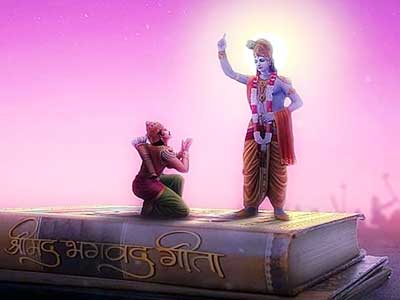
Lord Krishna in the verse 13 of Chapter 4 of the Bhagavadgita underlines that four orders of society are created by Me according to the qualities predominant in each and, He alone apportions corresponding duties to them. Similarly, the verse 41 of Chapter 18 further explains that one may take birth in any family but one’s inherent nature would determine what one’s duty will be, whether to become a scholar, a teacher or be brave as mighty king or a warrior or serve the society as a former or a trader or a member of the working class.
Sri Srila Prabhupada, the founder ISKCON, explained that the Supreme Lord is the creator of everything. Everything is born out of Him, everything is sustained by Him, and everything after annihilation rests in Him. He is, therefore, the creator of the four divisions of the social order, the intelligent class of men, administrative class, mercantile men and serving class. The tendency of a particular man toward work is determined by the modes of nature which one has acquired. The Supreme Lord has distinctly stated that four qualitative divisions are set by Him according to quality and karma, never according to birth. Everyone should think that one has been engaged in a particular type of occupation by Lord Hrishikesha, the Master of senses.
Therefore, Srila Prabhupada has underlined that “what is being labelled as varnasrama is an atheistic concept totally unsupported by the scriptures. Real varnasrama is based not on birth but on people’s qualities and activities. One cannot reach the goal of the scriptures by practicing today’s demonic caste system.”
Thus, as propounded by Srila Prabhupada, in whatever occupation one may be engaged, if one serves the Supreme Lord, one will achieve the highest perfection. No work is abominable, if performed in the service of the Supreme Lord.
Similarly, in order to ensure welfare of all, Lord Sai Krishna on His part has emphasized time and again that while discharging one’s allotted duty, one should follow the religion of humanity, based on the tenets of serving, respecting and loving all. Rising above the narrow idea of egoistic and individual doer ship, one always needs to be guided by the spirit of finding contentment in the selfless action and letting go of desire for rewards.
Always being human in all circumstances towards all is the eternal message of Lord Sai Krishna, rather getting identified by the man-made labels of belonging to this or that religion or sect or community or occupation or ‘ism’.
The true spirit of “Vasudhaiva Kutumbakam” means treating all and one as integral and important members of the One Family. The crux of all the sacred and spiritual teachings is to unite all religions, communities, sects, creeds and castes for the common benefit of entire humankind. Neither one can claim superiority nor can one be condemned to suffer due to inferiority complex, just because of one’s birth in a particular class or community or caste. There should be equal opportunities for all.
One’s actions or what are called karmas alone will determine one’s role in the occupational frameworks of the society, based on the principles of equal respect and importance for each and every occupation, howsoever so-called lower or higher it is. This is the way forward shown by the spirit of being truly religious and spiritual. The main lesson to learn is to love, respect and serve all humanity.
-----------------------------------
The second part of this article can be seen here.
Love, Respect and Serve all : Message of Shirdi Sai - Part 2

*A Delhi-based freelancer.

We are trying to create a platform where our readers will find a place to have their say on the subjects ranging from socio-political to culture and society. We do have our own views on politics and society but we expect friends from all shades-from moderate left to moderate right-to join the conversation. However, our only expectation would be that our contributors should have an abiding faith in the Constitution and in its basic tenets like freedom of speech, secularism and equality. We hope that this platform will continue to evolve and will help us understand the challenges of our fast changing times better and our role in these times.
About us | Privacy Policy | Legal Disclaimer | Contact us | Advertise with us