
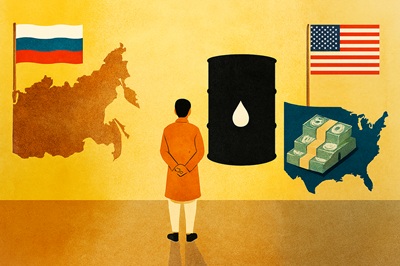
Our discerning readers may recall Amandeep Midha’s earlier piece, “The Hollow Dollar: America’s Modern Suez Moment,” which vividly explored the fiscal vulnerabilities of the United States. In his present article, Midha contends that as America lives on borrowed money and Russia fights on reserves, India must choose its future: the fragility of Washington or the patience of Moscow.
India Between America’s Debt and Russia’s Reserves
Choosing Between Fragility and Endurance
Amandeep Midha
The United States government has shut down once again. On the very first day of October 2025, the world’s most powerful country has run into its old familiar wall: deadlines missed, politics deadlocked, and bills left unpaid until more borrowing can be arranged. Behind the drama lies a stark reality. America now carries a debt burden of over 120 percent of GDP, and every war, bailout, or stimulus is financed not by strength but by creditors’ faith in the dollar. Borrowing has worked uniquely in the U.S. 's favour for decades because it has kept world trade pushed into dollars, allowing the country to live beyond its means with relative impunity. But that advantage is changing fast, and at an alarming speed. Strip away that faith, and the empire rests on shaky ground.
Russia, meanwhile, shows a very different picture. Its public debt sits at just 20 percent of GDP. Sanctions may limit its access to Western markets, but they do not dictate its survival. With oil, gas, wheat, fertilizers, and minerals at hand, Russia can sustain itself, reroute trade, and continue its war footing far longer than many expected.
A debt-heavy state looks powerful in peace, but fragile in war
The average Indian, however, continues to look up to America as the ultimate model of success. This is not unique to the man on the street. Even in the financial elite, awareness of how fragile that model is has often been missing. Between 2009 and 2022, an entire generation of financiers and investment leaders grew up in a world of zero-percent interest rates in the West. Their playbooks were written when money was virtually free. The moment interest rates ticked up in 2022, lending-based models began to collapse. Offshore wind farms, once hailed as the future, now flounder under rising borrowing costs. By contrast, Russia focused its capital not on fragile megaprojects but on icebreakers to build and expand navigability in the Northern Sea Route in a changing climate to advantage. One approach was built on cheap credit, the other on long-term survival.
India stands in between. In 2014, its debt-to-GDP was around 67 percent while ranked as 10th largest economy in the world. Today in 2025, it hovers at 82 to 83 percent while being rated fourth largest economy. That rise puts India closer to America’s fragile camp than to Russia’s low-debt cushion. India also runs a persistent trade deficit, leaving it dependent on inflows of foreign capital. Yet India is not America. Most of its debt is domestic, its growth is still robust, and its internal market is massive. That gives it breathing room, but not unlimited freedom.
While Russia’s natural resources provide it with a cushion of endurance, India’s strength lies in its people. A large, skilled population is the one resource that cannot be sanctioned, embargoed, or blocked. Even if India falters now and then in the manufacturing race, building human capital gives it the long game, a foundation that can sustain resilience across generations.
Borrowing may buy time, but it cannot buy security
This is where the lesson lies. America dazzles but depends on endless borrowing. Russia endures with quiet patience and reserves. India must choose which path to lean toward. If it drifts into the American model of higher borrowing and dependence on external confidence, it risks fragility. If it applies restraint, strengthens reserves, and secures energy and food independence, it can tilt toward resilience. And fiscal prudence must not be sacrificed at the altar of populism. Short-term slogans of free food or free electricity may win elections, but they enlarge the debt burden and erode the discipline needed for long-term strength. A state cannot buy resilience through giveaways; it must build it through balance.
Endurance, not illusion, is what will decide the future.
The world is shifting in ways that punish flash and reward endurance. For India, the first lesson is that debt cannot be the permanent answer to growth. Borrowing may buy time but it cannot buy security. The second lesson is that resilience is built on real assets: food, energy, and reserves that cannot be sanctioned away. The third lesson is that patience is power. Nations that can outlast storms, not just posture in the sun, will set the tone for the decades to come.
The so-called superpower of our time cannot survive without borrowing against tomorrow, while the much-derided Russian economy has the foundations to fight and wait. India, sitting between the two, has the chance to learn before it is too late. India’s greatest resource is its people, and if that capital is nurtured through fiscal discipline while equipping them with education and skills for the long game, the nation can embody endurance, not illusion. The question remains: will India lean toward borrowed brilliance or cultivate quiet endurance?
***********

Amandeep Midha is a technologist, writer, and global speaker with over two decades of experience in digital platforms building, data streaming, and digital transformation. He has contributed thought leadership to Forbes, World Economic Forum, Horasis, and CSR Times, and actively engages in technology policy-making discussions. Based in Copenhagen, Amandeep blends deep technical expertise with a passion for social impact and storytelling.

We are trying to create a platform where our readers will find a place to have their say on the subjects ranging from socio-political to culture and society. We do have our own views on politics and society but we expect friends from all shades-from moderate left to moderate right-to join the conversation. However, our only expectation would be that our contributors should have an abiding faith in the Constitution and in its basic tenets like freedom of speech, secularism and equality. We hope that this platform will continue to evolve and will help us understand the challenges of our fast changing times better and our role in these times.
About us | Privacy Policy | Legal Disclaimer | Contact us | Advertise with us