NFHS-6 has been in the news for the last few weeks after its release in May 2026. It showed significant improvements in India’s maternal and child health, nutrition, and immunisation indicators. It is the largest health survey in India, covering nearly 6.79 lakh households across 715 districts. However, it was also criticised for not including haemoglobin testing and anaemia data, even though anaemia remains one of India’s most pressing public health challenges. The previous survey (NFHS-5) had found anaemia prevalence alarmingly high — 57% of women aged 15–49, 67% of children aged 6–59 months, and 52% of pregnant women were anaemic. Experts worry that removing anaemia data from NFHS creates a blind spot in maternal and child health monitoring. Against this backdrop, Amandeep Midha examines what NFHS-6 reveals about the deeper paradox of India’s urban health trajectory, and why the country must rethink the assumption that urbanisation automatically translates into wellbeing.
Health Before Highways: NFHS-6 Reveals the Real Cost of Urban Rush
Amandeep Midha
The sixth round of India's National Family Health Survey, released last month, reads at first glance like a triumph. Electricity has reached 98.3% of households. Health insurance coverage has jumped from 41% to 60.2%. Institutional deliveries now stand above 90%, and India's total fertility rate has settled at replacement level. These are not small achievements. They represent two decades of sustained public investment finally showing up in the data.
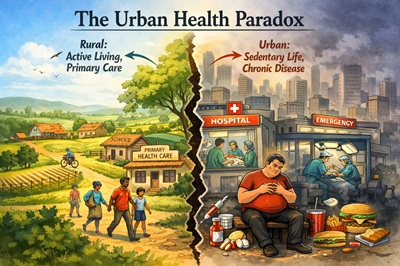
Sit with the survey a little longer, though, and a second, less comfortable story emerges. Urban India, the very geography we associate with better hospitals and better outcomes, is where India's next health crisis is incubating. Obesity among urban women has climbed to 42.8%, nearly double the rural figure of 25.5%. Urban men are not far behind at 36.3%. High blood sugar now affects almost a quarter of urban men and over a fifth of urban women, well ahead of their rural counterparts. Caesarean deliveries in urban India have crossed 40%, four times the WHO's recommended ceiling, a signal less of clinical need and more of a private healthcare economy optimised for throughput rather than wellbeing.
This is the paradox worth naming plainly. India's cities offer more hospital beds per capita, more specialists, more diagnostic capacity. But cities are also where sedentary work, processed food, commute stress, and crowded, poorly planned neighbourhoods are quietly manufacturing the chronic disease burden that better hospitals will spend the next decade treating. A country cannot build its way to family health purely through urban medical infrastructure if the urban condition itself is the pathogen.
The Danish Counter-Experiment
Denmark, a country I have called home for over a decade, offers an instructive, if imperfect, parallel. Since the early 2000s, successive Danish governments have run a deliberate experiment in slowing the pull of Copenhagen. This has been done by relocating thousands of state jobs from the capital to provincial towns, building distributed health centres, so that primary care does not require a two-hour train journey, and investing heavily in regional infrastructure. This also includes one of the world's densest rural cycling networks, precisely so that daily physical activity does not depend on living in a metropolis.
The logic was straightforward. If opportunity, healthcare, and quality public services exist closer to where people already live, families do not need to uproot themselves into denser, more sedentary, more expensive urban life simply to access a decent job or a competent doctor. Fewer forced migrations mean fewer families cut off from the social fabric, land, and daily movement patterns that protect long-term health.
The Danish experiment has not been a clean success, and it would be dishonest to present it as one. Researchers studying the relocation of state jobs to towns in Lolland Municipality have found that decentralisation on paper often remains centralisation in practice, with relocated workplaces still governed by Copenhagen's administrative logic rather than genuinely embedding into local economies. Even Denmark's celebrated bicycle infrastructure is unevenly distributed, concentrated around the largest cities, while rural cycling rates quietly decline and car ownership rises. The lesson is not that decentralisation is easy. It is that even a small, wealthy, administratively disciplined country finds it hard to resist the gravitational pull of its capital. India, with a vastly larger and more diverse geography, should expect the challenge to be harder still. That is a reason to design the policy with more humility than Denmark itself managed, not a reason to avoid trying.
What This Suggests for India
The instinct in Indian policy circles has long been to treat urbanization as a proxy for development, and by extension, for health. NFHS-6 suggests that this instinct deserves scrutiny. If Tier-2 and Tier-3 cities, along with well-connected rural clusters, can provide genuine employment, quality schools, and functioning primary healthcare, families will not feel compelled to migrate. Otherwise, they risk being drawn into the metabolic disease factory that unmanaged megacity growth has become.
A few concrete directions follow naturally from this argument:
Anchor employment where people already live.
India's PLI schemes (Production Linked Incentive schemes), data centre investments, and green energy manufacturing capacity should be actively steered toward district-level industrial clusters, not concentrated further in existing metros. Denmark relocated ministries; India could relocate PSU back-offices, testing labs, and R&D units with equal deliberateness.
Build primary care before building super-hospitals
Urban India's C-section and NCD numbers suggest the private hospital economy is already over-medicalising affluent, urban lifestyles. Investment should shift toward preventive and primary health infrastructure in district towns, the Danish sundhedscentre model, rather than only chasing tertiary capacity in metros.
Treat rural connectivity as health infrastructure, not merely economic infrastructure
Roads, broadband, and last-mile transport that let people work and study without relocating are, in effect, obesity and NCD prevention tools, not just productivity tools.
The Honest Counter-argument
It would be misleading to suggest that this case is settled. Urban economists argue that cities create agglomeration effects. The same density that raises concerns also enables economies of scale in hospital specialization, diagnostic facilities, and medical research—advantages that scattered rural clusters cannot match.
Some public health experts interpret India’s urban NCD numbers as progress rather than failure. Longer lifespans and higher incomes naturally shift the disease burden from infectious illnesses to lifestyle-related ones, a transition seen in every industrializing society, including Denmark.
From this perspective, the goal is not to slow urbanization but to manage its excesses. Better food labelling, walkable urban planning, and workplace wellness norms can regulate risks, while cities continue to deliver their strengths.
Conclusion
Both readings can be true at once. India does not need to choose between urbanization and health. It needs to stop treating urbanization as costless, and start building the Tier-2 and rural opportunity structures that make migration a choice families make for ambition, not one they are forced into for survival.
************

Amandeep Midha is a technologist, writer, and global speaker with over two decades of experience in digital platforms building, data streaming, and digital transformation. He has contributed thought leadership to Forbes, World Economic Forum, Horasis, and CSR Times, and actively engages in technology policy-making discussions. Based in Copenhagen, Amandeep blends deep technical expertise with a passion for social impact and storytelling.

We are trying to create a platform where our readers will find a place to have their say on the subjects ranging from socio-political to culture and society. We do have our own views on politics and society but we expect friends from all shades-from moderate left to moderate right-to join the conversation. However, our only expectation would be that our contributors should have an abiding faith in the Constitution and in its basic tenets like freedom of speech, secularism and equality. We hope that this platform will continue to evolve and will help us understand the challenges of our fast changing times better and our role in these times.
About us | Privacy Policy | Legal Disclaimer | Contact us | Advertise with us