Don't Blame the Clowns. Blame the Circus
Amandeep Midha
Last week, the US Treasury lifted sanctions on Eritrea. On its military. On its ruling party. On its state trading corporation and its senior officials. The diplomatic language was careful, as it always is. The real reason was twenty nautical miles of water.
That is the distance between Eritrea and Yemen at the Bab al-Mandab Strait, the corridor through which ten percent of global trade passes. Yemen's Houthi forces have, against every prediction made by every expert who appears on panels with grave expressions, established effective control of their Red Sea coastline. The western shore, Eritrea's shore, suddenly needed to be purchased. Eritrea's Foreign Minister had already accused the UAE of "port imperialism" across Africa. Washington heard that as an opening bid and responded accordingly.
Eritrea's human rights situation has not changed. The indefinite military conscription that rights organisations call a form of state slavery continues. The political prisoners continue. The one-party state continues. What changed is the calculation. And so the sanctions are gone. The western press will present this as a Trump-era aberration. As the kind of cynical transactionalism that the real estate developer brings to what used to be a principled enterprise. As evidence that adults need to be returned to the room.
This is a very comfortable lie. And it has a very long paper trail.
The Adults Were Always in the Room
In 1998, India and Pakistan tested nuclear weapons. Sanctions were imposed on both within days, with considerable moral energy. By September 2001, they were waived by executive order. Pakistan needed to provide airbases. India needed to provide legitimacy to a coalition running short of willing members. The non-proliferation framework, constructed with such righteous speed three years earlier, was folded away without ceremony. Nobody wrote the press release explaining which principle was abandoned.
In 1982, Donald Rumsfeld travelled to Baghdad as Reagan's special envoy and shook Saddam Hussein's hand while Washington provided satellite intelligence helping Iraq deploy chemical weapons against Iran. Eleven years later, Saddam gassing his own people would be cited as justification for a war. The fact that the gassing had occurred while Washington was still a willing partner received a paragraph in the footnotes and did not delay the invasion by a single day.
In 1953, the CIA removed Iran's democratically elected Prime Minister, returned the Shah to his throne, trained his secret police in methods the CIA's own documents describe with clinical horror, and called the arrangement a pillar of regional stability for twenty-six years. When the Shah fell, Iran was reclassified. The original sin was not mentioned. The moral ledger, it turns out, does not carry forward.
These were not accidents. These were not rogue operations run by mavericks. These were decisions made by credentialled people in well-lit rooms with full institutional knowledge of what they were doing. The adults built this machine. The clowns are merely operating it with less elegant paperwork.
The Wrapper Was Never the Content
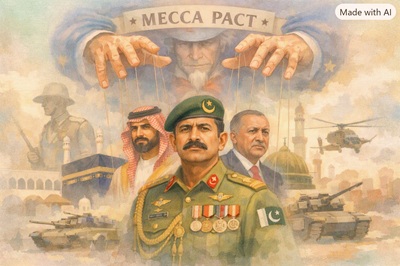
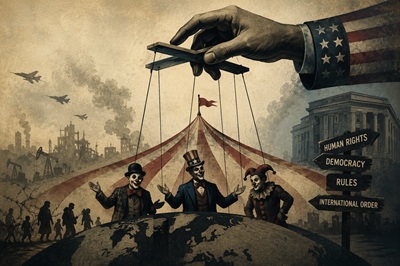
Here is how the machine works, and has always worked. Sanctions are imposed when a country is adversarial or simply not yet useful. They are maintained as leverage. They are removed the moment strategic utility demands removal. The moral vocabulary, human rights, democracy, the rules-based international order, is the wrapper, not the content.
The wrapper matters for domestic politics. A Secretary of State cannot say: we need the coastline. They must say instead: we believe this step will support the aspirations of the Eritrean people. The Eritrean people, not consulted about the sanctions and not consulted about their removal, are invoked as a courtesy and promptly forgotten.
This is why India was right not to join Western sanctions on Russia in 2022, despite considerable pressure. Not because the action in Ukraine was without cost. But because India had watched this pattern long enough to know that the moral framework being invoked would be selectively applied, and that the moment India's own strategic utility shifted, the pressure would evaporate as it always had. Nehru understood this in 1955. Nothing since has suggested he was wrong.
Pete Hegseth is not an argument. He is a symptom. The disease is a foreign policy establishment that built a machine for the exercise of power over eighty years since the second world war and decorated it with language it never intended to universally apply. The current administration simply removed the decoration. The content was always there.
The circus does not close when the clowns leave.

Amandeep Midha is a technologist, writer, and global speaker with over two decades of experience in digital platforms building, data streaming, and digital transformation. He has contributed thought leadership to Forbes, World Economic Forum, Horasis, and CSR Times, and actively engages in technology policy-making discussions. Based in Copenhagen, Amandeep blends deep technical expertise with a passion for social impact and storytelling.

We are trying to create a platform where our readers will find a place to have their say on the subjects ranging from socio-political to culture and society. We do have our own views on politics and society but we expect friends from all shades-from moderate left to moderate right-to join the conversation. However, our only expectation would be that our contributors should have an abiding faith in the Constitution and in its basic tenets like freedom of speech, secularism and equality. We hope that this platform will continue to evolve and will help us understand the challenges of our fast changing times better and our role in these times.
About us | Privacy Policy | Legal Disclaimer | Contact us | Advertise with us