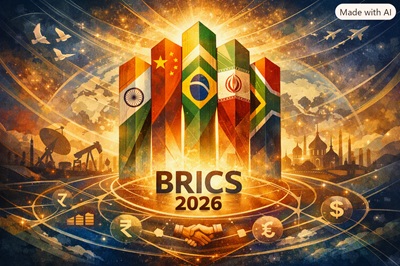
This is a remarkably sharp analysis of BRICS 2026 by Amandeep Midha. He has captured the nuance of the summit that most analysts and media outlets completely missed. The section on the 'currency thesis' and the shift in optics is particularly insightful. You can visit his previous articles also to see his take on these structural shifts.
BRICS 2026: The World That Western Cameras Missed
Amandeep Midha
When Western media cameras panned across the BRICS summit, they found cyclists weaving through Indian traffic and auto-rickshaw drivers hustling their daily routes. They rhymed about India-China divides and Iran-UAE tensions, looking for the fault lines that confirm old narratives. What they missed, quite deliberately, was a civilisational reordering taking place in plain sight. As the old saying goes: never disturb a fool when he is committing his own blunder.
Iran, India, and the Grammar of Strength
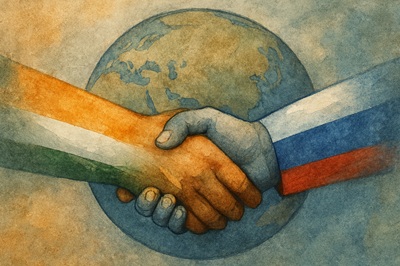
The image that defined this summit, before any joint declaration was signed, was India and Iran seen holding hands. Not metaphorically. Diplomatically, viscerally, and with full choreography. Indian hospitality groups like the Oberois hosted Iran's President with the warmth reserved for a statesman of consequence, framing him not as a pariah but as a world leader worthy of the finest welcome India could offer.
APJ Abdul Kalam's geopolitical theorem made flesh: only strength respects strength. Iran did not arrive at BRICS as a supplicant. It arrived as a power that has absorbed decades of sanctions, survived regime-change attempts, and emerged with its strategic relevance intact. The world noticed. India's embrace was not charity, it was recognition. And that recognition carried a message louder than any press release: the rules of global respect have changed, and they are no longer written in Washington.
Russia's Quiet Diminishment: What Indian Media Won't Tell You
Indian media continues to serve Russia on a platter labelled 'superpower,' but the facts on the ground at this summit told a different story. Russia did not sign any major defence pact with any BRICS member. That absence was not modesty, it was incapacity. Ukraine's sustained strategy of targeting Russian oil refineries has worked with a precision that few analysts in Delhi acknowledge openly. Russia is not bleeding rhetorically; it is bleeding materially, in refining capacity, in export revenue, in the strategic confidence needed to extend defence guarantees beyond its own borders.
More telling: the erstwhile position Russia held as a premium-tier defence supplier, the grade of equipment it once used as geopolitical currency, is being quietly occupied by Turkey. Ankara has leveraged its drone technology, its NATO adjacency, and its Eurasian ambiguity into a defence export footprint that is reshaping how the Global South arms itself. India and others have been blocking Turkey's full participation in certain multilateral formats, alongside Pakistan's aspirations in the same direction. But blocking a tide is not the same as reversing it. Turkey's rise in the defence export hierarchy is one of the underreported structural shifts of this decade.
The Next Chair: Bangladesh, Vietnam, Tunisia and the Queue Behind Them
Every major multilateral institution eventually faces the question of its own expansion logic. BRICS is no different. As the bloc consolidates its expanded membership, the next wave of contenders is already positioning. Bangladesh carries the manufacturing story, garments today but with ambitions toward electronics and pharmaceuticals, sitting at a demographic sweet spot. Vietnam has already demonstrated that it can absorb the China-plus-one manufacturing exodus without losing its own strategic autonomy, a feat that impresses capitals across Asia. Tunisia represents the North African inflection point, educated, Mediterranean-facing, politically bruised but economically hungry.
Each of these nations brings a different growth coefficient and a different set of bilateral leverage points. Their cases will be made not with speeches but with trade volumes, with bilateral currency arrangements, and with the quiet patience of nations that have learned to play the long game. Watch what bilateral trade lines these countries cultivate with existing BRICS members over the next 24 months, that will predict the membership timeline more accurately than any formal application.
The Currency Thesis India Is Actually Promoting
The Western press loves the BRICS currency story, usually told as a China-Russia conspiracy to dethrone the dollar. India's actual position is more sophisticated and more consequential. Delhi is not promoting a new Gaddafi-style gold-backed reserve currency. What India is consistently advocating is bilateral currency trade, the practice of settling transactions in the currencies of the trading partners themselves.
The genius of this approach is structural. When two countries trade in each other's currencies, they become invested in each other's economic stability. Exchange rate volatility becomes a shared problem. Monetary policy recklessness becomes a bilateral concern. It creates a web of interdependence that is far more durable than any single reserve currency architecture. India has been the quiet champion of this model, not because it lacks ambition, but because it understands that the path to de-dollarisation that survives is evolutionary, not revolutionary. Diplomatic teams worked through the night to get these principles encoded into joint declarations. That unglamorous work is where the real summit happened.
Waterways, Warnings, and the Silence Over Tibet-Nepal
Waterways will be the next contested frontier, commercially, strategically, and climatically. Glacial melt, river diversion politics, and maritime chokepoints are converging into a category of conflict that is not yet named but is already underway. One would have expected BRICS, with its geography spanning most of the world's major river systems and coastlines, to address this.
What was conspicuously absent from summit coverage was any reference to the recent tragedy in the Tibet-Nepal region and the complete vacuum of shared early warning infrastructure in that area. After the 2004 Indian Ocean Tsunami, the world came together to build a common signalling network, nations contributed sensors, shared technology investments, and created a framework that has since saved lives. No equivalent conversation is happening in the Himalayan river corridor, where glacial lake outburst floods are an increasing existential threat. That the assembled leaders of nations housing a third of humanity could not produce even a framework declaration on shared early warning systems in this region is a diplomatic gap that deserves more scrutiny than it received.
Palestine, and the Return of India's Moral Compass
India's articulation on Palestine at this summit marked a tonal shift that should not be understated. The support for Palestinian liberation, expressed without euphemism, without the usual diplomatic hedging toward a certain colonial outpost, signals a recalibration. India is not abandoning its strategic partnerships, but it is recovering a moral vocabulary that its Non-Aligned Movement inheritance always carried. When the largest democracy in the world says clearly that it stands with the Palestinian people, it matters, not because it changes facts on the ground immediately, but because it changes the architecture of legitimacy over time.
India Brokered Iran-UAE Peace. The Nobel Will Go Elsewhere
India used this summit to facilitate a peace dialogue session between Iran and the UAE, a diplomatic achievement that in any other era would generate significant global attention. China brokered the Iran-Saudi rapprochement. India has now contributed its own chapter to this quiet regional stabilisation project. But the Nobel Peace Prize continues to be wielded as an instrument of Western foreign policy, reserved for interventionist objectives, regime-change validation, and the manufactured heroism of puppet faces.
The Global South is increasingly building a parallel architecture of peace and cooperation that does not require Western endorsement to be real. Iran and UAE talking. Saudi and Iran normalising. India and China moving carefully toward a border framework. These are the actual headlines. The Nobel committee will look the other way. That is fine. History does not wait for a prize ceremony.
How India Staged This: The G7 Mirror
India's hosting of this summit was a masterclass in geopolitical optics, and optics, in diplomacy, is never merely superficial. Just as China ensured at the SCO that bilateral leader moments were documented and amplified, India ensured that the visual grammar of this summit matched what the world has come to associate with the G7: country leaders photographed in genuine bonhomie, bilateral warmth captured at the margins, the full weight of national delegations on display.
The size of the Chinese delegation, including the number of journalists Beijing brought along, was the most discussed logistical detail inside diplomatic circles. China arrived at this summit as a host-in-waiting, projecting the same organisational ambition that India projected at the G20. That two Asian civilisational powers are now competing on the quality of their multilateral hospitality is itself a story about where global gravity is shifting.
Western media, faced with this visual sophistication, retreated to the safest available frame: cyclists, auto drivers, the chaos of India's streets. They found the India-China divide. They found the UAE-Iran tension. They highlighted what was familiar. What they could not process was a summit that looked, for the first time, indistinguishable from the serious forums they consider their own.
The Refreshing Absence of USA from Indian Prime Time
For the first time in what feels like years, Indian international news did not revolve around the USA, Trump tariffs, or Washington's latest position on anything. The summit displaced that gravitational pull, even if briefly, with something more nourishing: the possibility of cooperation among nations that are building their own story. Cooperation in infrastructure, in currency, in technology transfer, in peace frameworks. The horizons that opened during this summit week were not American horizons, and Indian audiences responded to that with genuine interest. That is worth noting as a social fact, independent of whatever one thinks of the geopolitics.
2027 and the Dragon-Tiger Hypothetical: Lessons from Nordstream First
By the next BRICS summit in 2027, the world will be measurably different. But before Indian manufacturers rush toward the India-China opportunity with characteristic enthusiasm, they owe themselves a sobering lesson from Germany. When the Nordstream pipelines were disrupted, thousands of German businesses across chemicals, glass, ceramics, paper, and heavy industry filed for insolvency, not because their products were inferior or their workers less skilled, but because a single geopolitical event removed an input they had treated as permanent. The average Indian manufacturer in the Make in India story needs to carry this as a first principle: geopolitical literacy is not optional, it is a survival competency. Before deepening dependencies on any corridor, stress-test with one question: what happens to my business model if this input disappears because of a decision made in a capital I have no influence over?
The question of what India sells to China if that market opens deserves an honest answer. Raw minerals, jewellery, and IT services are the reflexive response, but they do not constitute a trade architecture worthy of two civilisational economies at scale. The reinvented Make in India tiger needs to bring pharmaceuticals at the innovation tier, precision agriculture technology, renewable energy components, and processed food products for a Chinese middle class hungry for diversity. Cultural exports, film, music, and spiritual tourism, carry bilateral goodwill dividends that are chronically underrated as economic categories. And the human capital exchange, Indian engineers and designers in Chinese cities and vice versa, would build a people-to-people layer that no border skirmish can easily undo.
There is one more dimension that deserves its own chapter in the 2027 conversation: startups. BRICS now spans enough economic geography that a fintech built in Mumbai, a healthtech from Sao Paulo, an agritech from Johannesburg, or an edtech from the UAE can find its first international market within the bloc itself through preferential access frameworks and innovation partnerships. The infrastructure for this cross-BRICS startup corridor does not yet exist formally, but the appetite is there. If the bloc can negotiate even basic mutual recognition of digital standards, lighter market-entry licensing for BRICS-origin startups, and joint innovation funds targeting climate, health, and food security, it would create the world's most consequential emerging-market startup ecosystem overnight. This is not charity toward smaller member economies. It is the smartest possible use of the bloc's combined consumer base of over three billion people.
The Make in India tiger has to be reinvented to walk beside the Chinese dragon, not in subordination, not in mimicry, but in complementarity. The diplomatic groundwork is being laid quietly, in hotel lobbies, overnight working sessions, and bilateral meetings that no camera bothered to film. The startups of the BRICS world may end up being the most visible proof of that groundwork.
***********

Amandeep Midha is a technologist, writer, and global speaker with over two decades of experience in digital platforms building, data streaming, and digital transformation. He has contributed thought leadership to Forbes, World Economic Forum, Horasis, and CSR Times, and actively engages in technology policy-making discussions. Based in Copenhagen, Amandeep blends deep technical expertise with a passion for social impact and storytelling.

We are trying to create a platform where our readers will find a place to have their say on the subjects ranging from socio-political to culture and society. We do have our own views on politics and society but we expect friends from all shades-from moderate left to moderate right-to join the conversation. However, our only expectation would be that our contributors should have an abiding faith in the Constitution and in its basic tenets like freedom of speech, secularism and equality. We hope that this platform will continue to evolve and will help us understand the challenges of our fast changing times better and our role in these times.
About us | Privacy Policy | Legal Disclaimer | Contact us | Advertise with us