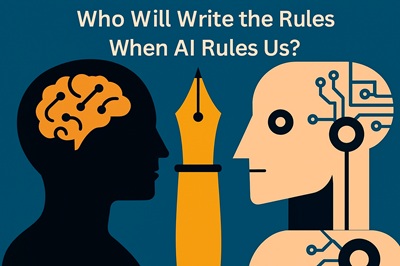
Dr. Shailesh Shukla’s article makes a compelling case that India cannot treat AI in newsrooms as a mere technical upgrade—it is an editorial force that shapes narratives, amplifies or silences voices, and influences public trust. His five-pillar framework is particularly strong because it moves beyond abstract principles into actionable newsroom practices.
How Should India Govern the Use of AI in Newsrooms
Dr. Shailesh Shukla
Artificial intelligence is reshaping Indian newsrooms faster than regulation can keep pace. From automated transcription and translation to AI-drafted summaries and synthetic visuals, the technology promises efficiency but also magnifies risks of misinformation, bias, and eroded public trust. India’s approach must balance innovation with accountability, ensuring AI serves journalism’s core mission—truth-telling in the public interest—without becoming a black box that undermines it.
The starting point is clarity about what is at stake. AI in newsrooms is not merely a productivity tool; it is an editorial actor that influences what gets published, how stories are framed, and which voices are amplified or silenced. When models trained on skewed data summarise court judgments, translate political speeches, or generate explainers on welfare schemes, they can inadvertently distort meaning, reinforce stereotypes, or omit marginalised perspectives. In a country as linguistically and culturally diverse as India, these risks are acute. Governance, therefore, cannot be limited to technical fixes; it must embed ethical guardrails into editorial workflows, institutional policies, and legal frameworks.
India already has pieces of a regulatory puzzle. The Information Technology (Intermediary Guidelines and Digital Media Ethics Code) Amendment Rules, 2026 impose due diligence obligations on intermediaries regarding synthetically generated information, requiring user declarations, technical verification, and labelling of deepfakes and realistic AI-generated audio-visual content. The Digital Personal Data Protection Act, 2023 establishes consent and data-use boundaries that affect how news organisations collect, store, and process personal information for AI systems. The India AI Governance Guidelines (2025) articulate seven sutras—Trust, People First, Innovation over Restraint, Fairness, Accountability, Understandability, and Safety—that provide a normative compass for responsible AI across sectors, including media. Yet these instruments remain fragmented and largely platform-centric, leaving newsroom-specific practices under-regulated.
A coherent governance framework for AI in Indian newsrooms should rest on five pillars. First, mandatory transparency and disclosure. Audiences have a right to know when AI has significantly assisted or generated content. News organisations should adopt a standard disclosure taxonomy—“AI-Assisted,” “AI-Generated,” “Human-Edited”—displayed prominently alongside articles, videos, or graphics. This goes beyond labelling synthetic media under IT Rules; it covers text summaries, translations, data visualisations, and even algorithmic curation of homepages. Transparency builds trust and allows readers to calibrate their skepticism appropriately. The Press Council of India, in consultation with editors’ bodies, should issue binding disclosure norms that apply uniformly across print, digital, and broadcast.
Second, human-in-the-loop editorial oversight. AI must remain a tool, not a decision-maker. Every AI-assisted story should pass through a human editor who verifies claims, checks sources, and evaluates framing for bias or omission. Internal charters should define red lines: no fully automated publication of sensitive stories (crime, health, elections), no unverified AI-generated quotes, and no synthetic visuals without explicit disclaimers and provenance logs. Editorial sign-off thresholds—based on story type, risk level, and AI contribution—should be codified in newsroom policies and audited periodically.
Third, bias auditing and fairness testing. AI models inherit biases from training data and design choices. Indian newsrooms must conduct regular fairness audits on tools used for translation, summarisation, recommendation, and content moderation. This includes testing for linguistic bias across major Indian languages, representation of marginalized communities, and accuracy in domain-specific tasks (legal, medical, financial). Independent bodies—perhaps under the Press Council or a new Media AI Standards Board—should develop benchmark datasets and certification protocols, similar to algorithmic impact assessments proposed in global AI governance debates.
Fourth, data governance and provenance tracking. News organisations should maintain AI provenance logs recording the model used, version number, purpose (drafting, translation, visualisation), data sources, prompts supplied, and human reviewer details. This creates an audit trail for accountability and helps trace errors to their origin. Data retention policies must align with the DPDP Act, ensuring personal information used in training or fine-tuning is minimised, anonymised where possible, and deleted after defined periods. Consent mechanisms should be explicit when user data feeds AI systems.
Fifth, capacity building and ethical training. AI literacy is no longer optional for journalists. The Ministry of Information and Broadcasting’s partnership with Google to skill 15,000 media professionals is a start, but curricula must go beyond tool usage to cover bias detection, data ethics, verification workflows, and legal compliance. Newsrooms should mandate bi-annual ethical AI training for all staff, with special modules for editors and social media teams who handle high-risk content.
Critics may argue that heavy-handed regulation stifles innovation. But the goal is not to restrain AI; it is to channel it responsibly. India’s media landscape is already fragile, with trust deficits and economic pressures. Unchecked AI adoption could deepen cynicism, especially if audiences cannot distinguish between human reporting and machine-generated content. Conversely, a clear, enforceable framework can empower ethical outlets to differentiate themselves, attract discerning readers, and set global benchmarks for responsible AI journalism.
The path forward requires collaboration. Government must provide legal clarity and enforcement teeth; industry bodies must craft practical standards; newsrooms must internalise ethics as competitive advantage; and civil society must hold all actors accountable. India has an opportunity to demonstrate that AI and journalistic integrity are not opposites but complements—if governed with foresight, transparency, and an unwavering commitment to public trust.

Dr. Shailesh Shukla has been actively engaged for two-and-a-half decades in research on Digital Media, AI, Academics, Official Language, Administration and Language Governance & Policy Implementation. After a decade of journalism and teaching in Delhi, serving as the first Rajbhasha Officer of Sikkim University and as Official Language Officer in a Central PSU, he is presently Global Group Editor at Srijan Sansar International Group of Journals and Consulting Editor at The GaurSons Times. He is Principal Consultant at New Media Srijan Sansar Global Foundation and Adamya Global Foundation. He taught at Delhi University and Sikkim Central University. With Ph.D. on 'Hindi Literature in New Media', he has written 40+ chapters including for DU and IGNOU courses, authored/edited 25+ books, and 1000+ writings including 40+ Research Papers, Articles, Poems, Stories, Satires in 200+ media outlets of India and abroad. Recipient of Rajbhasha Gaurav Puraskar 2019-20 by MHA, Govt. of India, Navodit Lekhak Puraskar 2003-04 by Hindi Academy, Govt. of NCT Delhi, ERAI Fellowship by Knowledge Network, Virginia, USA, and many other honours.

We are trying to create a platform where our readers will find a place to have their say on the subjects ranging from socio-political to culture and society. We do have our own views on politics and society but we expect friends from all shades-from moderate left to moderate right-to join the conversation. However, our only expectation would be that our contributors should have an abiding faith in the Constitution and in its basic tenets like freedom of speech, secularism and equality. We hope that this platform will continue to evolve and will help us understand the challenges of our fast changing times better and our role in these times.
About us | Privacy Policy | Legal Disclaimer | Contact us | Advertise with us