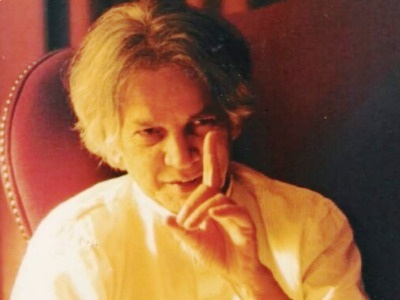
In the first part of his essay, Frank Noronha reflected on his encounters with the unorthodox philosopher—often labeled a spiritual guru (though he would detest the epithet)—U.G. Krishnamurti. In this continuation, he deepens the inquiry, probing further into what U.G. truly gave him, and how those encounters shaped his search for answers.
What U.G. Really Gave Me - Part II
Frank Noronha
What happened to U.G. at forty-nine?
Part I described how U.G. took things away - certainties, spiritual ambitions, accumulated answers. Part II begins where that dismantling leads.
Because something did happen to U.G. Something he never fully explained and never allowed anyone to turn into a template.
He called it the calamity.
Not enlightenment. Not liberation. Not awakening.
A calamity.
That word alone tells you everything about how he related to what most traditions would celebrate as the highest achievement of a human life.
He described it as an atomic explosion. Every psychological structure - beliefs, hopes, fears, spiritual seeking, the entire accumulated burden of culture - was flushed out of his system in one shattering event. Not gradually. Not through practice. Not through grace.
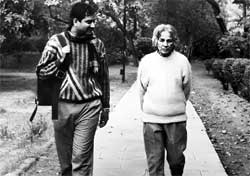
Author with UG in Lodhi Gardens in 1990
In spite of everything he had done. And in spite of everything he had not done.
He called it acausal.
No cause. No method that led to it. No recipe that could reproduce it.
That last point was non-negotiable for him. The moment you identify a cause, thought immediately converts it into a project. Another path to walk. Another technique to perfect. Another spiritual ambition to feed.
U.G. had no interest in feeding spiritual ambitions. He had spent decades watching that particular hunger consume people, including himself.
The natural state
What remained after the calamity he called the natural state.
People assumed this meant bliss. Ecstasy. Divine love. Some elevated condition the rest of us were missing.
He denied it completely.
He said - and this statement puzzled me for years before it began to land - your natural state has no relationship whatsoever with bliss, beatitude or ecstasy. They all lie within the field of experience.
What he meant, as I gradually understood it, was this. Bliss and beatitude are experiences. Experiences require an experiencer. The experiencer is thought. And thought, in its very movement of experiencing bliss, is strengthening the same structure that created the suffering in the first place.
The natural state is simply the organism functioning as it was designed to function before thought declared itself the master. The senses see. The ears hear. The body responds with its own extraordinary intelligence. Thought appears when practically required - to answer a question, read a watch, navigate traffic - and then becomes quiet. It does not linger. It does not build a story. It does not immediately convert the experience into evidence for the continuity of a self.
He called thought an interloper.
In Part I, I described how thought interferes with the senses, naming and labelling and comparing before the pure seeing can even register. The natural state is what remains when that interference is absent. Not a mystical condition. Just life, functioning cleanly.
There is no method
I have already described in Part I how U.G. refused to offer a path. But here I want to go further, because his refusal was not merely tactical. It was structural.
He would sometimes say - if you have even a slightest inkling, if what you are actually aiming at really would happen to you, you would run away from me. You would not touch this with a barged pole as he said.
What we seek, he said, is not the ending of the psychological self. What we actually seek is permanent pleasure, permanent peace, permanent happiness - without the inconvenience of pain or uncertainty. That demand is itself generated by thought. The nervous system cannot sustain any sensation indefinitely. Your body cannot endure any sensation beyond a certain duration. It will cut it off. Yet thought keeps insisting on permanence. And that insistence, not the suffering itself, is what keeps the whole machinery of seeking alive.
He would even say - there is no such thing as enlightenment. To realise that there is no enlightenity at all is enlightenment.
He knew that statement would disturb people. That was exactly the point. Give thought another ideal and it immediately begins planning the route.
Then I discovered A Course in Miracles
Many friends assume U.G. and A Course in Miracles stand at opposite ends of the spiritual spectrum. I no longer see it that way.
Their languages could not be more different. The Course speaks in luminous, poetic, almost Shakespearean cadences. U.G. speaks like a hammer. Raw, blunt, frequently abrasive, completely indifferent to whether you found him comforting or not. He was called the raging sage for good reason.
But beneath those entirely different surfaces, something quietly rhymes.
Both point to the tyranny of the psychological self. Both locate the source of suffering in identification with a thought-constructed entity that claims ownership of every experience. Both suggest that this entity is less solid than it appears.
ACIM says - I am never upset for the reason I think. U.G. says - thought creates the problem and then searches for the solution.
ACIM says — I am not a body. U.G. questions whether the psychological self exists at all, and goes further to suggest that body-consciousness itself is largely a construction of thought.
But here is where I find the most interesting convergence and the most significant difference.
The Course works with what it calls the metaphysics of mind. It says the world we see is a projection of an inner condition. Change the mind and the world changes - not physically, but in how it is perceived and experienced. It offers a correction for the thought system of the ego through what it calls the Holy Spirit - a different quality of perception available in every moment.
U.G. offers no correction. He offers no alternative thought system. He does not invite you to choose differently. He simply invites you to observe the movement of thought as it actually operates — without doing anything with what you see.
ACIM says there is a choice available. U.G. says the entity that would make the choice is itself part of the problem.
That is a real difference. Not a surface one.
And yet I keep returning to this. ACIM's own deepest teaching says that at the level of Knowledge - not perception, Knowledge - there is no choice, no duality, no separate self perceiving anything at all. It says God does not perceive. God simply knows. And in that knowing, there is no subject and object, no experiencer and experienced, simply what is.
That is not so far from what U.G. was pointing at when he said - there is no experiencer. There is only experiencing. And even that statement has no meaning because the moment you make it, the experiencer has returned to make it.
Perhaps they are pointing at the same territory. The Course gives you a map and a path toward it. U.G. refuses the map entirely and questions whether the one who wants to reach the territory actually exists.
Throw me out of your system
One of my last conversations with U.G. remains unforgettable.
I asked him - how can I ever repay you for all that you have meant to me?
He looked at me and said - if you have the guts, throw me out of your system.
Then he continued.
It is easy to throw out your Jesus, your Buddha, your Krishna, your Osho. Now throw me out. You already have enough monkeys on your back. Why do you need one more monkey called U.G.?
And then he said something I have never forgotten.
If you can make a bonfire of all my teachings, all my memories, all my ideas - so that not the slightest trace of me remains in you - that will be the greatest tribute you can pay me.
He did not want followers. He wanted freedom. Freedom even from himself.
That, more than anything, is the man in a sentence.
Where I stand today
Have all these years with U.G. transformed me?
Not in the way people imagine.
I still become anxious. I still get caught in my own stories. I still react when I would rather not. I certainly do not function the way U.G. described himself functioning.
But something has shifted that I cannot quite name.
The urgency to become somebody spiritually has softened. The compulsion to collect experiences, reach states, acquire certainties - that has quieted, not completely, but noticeably.
I still read A Course in Miracles. I still question. I still explore. I still correspond with similar minds, whose posts continue to illuminate things I thought I understood and reveal them as still open.
What U.G. gave me was not a philosophy. Not a practice. Not a promise.
He gave me permission to question everything, including him.
He gave me the courage, still imperfect, still incomplete, to stand on my own feet.
He would often say - throw away your crutches. I guarantee you will walk.
Have I completely done that? No.
But I am standing more on my own today than I ever was before.
Whether that is freedom or simply another idea, I honestly do not know.
And strangely, that not knowing has become the most comfortable place I have ever stood.
Perhaps that is what he really gave me.
Not certainty.
Not conclusions.
Not enlightenment.
Just the courage to look honestly at what is.
And for me, quietly, that has been enough.
************

Frank Noronha IIS ( Indian Information Service) is a retired Principal Director General, Press Information Bureau, Government of India, compiler of two volumes of interviews with philosopher U.G. Krishnamurti, and Managing Trustee of a charitable trust in Bengaluru supporting underprivileged children. Mob: 9910417002

We are trying to create a platform where our readers will find a place to have their say on the subjects ranging from socio-political to culture and society. We do have our own views on politics and society but we expect friends from all shades-from moderate left to moderate right-to join the conversation. However, our only expectation would be that our contributors should have an abiding faith in the Constitution and in its basic tenets like freedom of speech, secularism and equality. We hope that this platform will continue to evolve and will help us understand the challenges of our fast changing times better and our role in these times.
About us | Privacy Policy | Legal Disclaimer | Contact us | Advertise with us