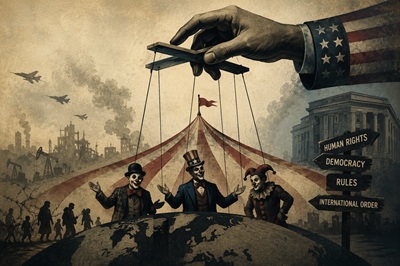
Institution building for nations sometimes takes centuries. Dismantling institutions, however, can be swift, causing lasting damage to the values and systems they embody. Taking the proposed military execution of Nidal Hasan as his point of departure, Amandeep Midha argues that the larger issue is not one convict or one punishment, but what happens when political strength increasingly comes to be measured through spectacle, grievance and institutional defiance. Please read this article, written perhaps with a sense of angst and disappointment.
The Lecture Hall Is Closing: What MAGA-Style Politics Teaches the World, and What It Costs America
Amandeep Midha
Nidal Hasan, a former Army psychiatrist, shot dead thirteen people at Fort Hood in 2009. A military jury sentenced him to death in 2013. His last legal challenge failed in April 2025, and the Defense Department secretary says he is "100% committed" to seeing the sentence carried out. Reports now put the execution in December, by firing squad. I could not independently confirm the date or the method, so treat both as reported. If true, it would be the first American military execution since 1961.
Hasan is a murderer, and this is no plea for him. The question is what a government announces about itself when it turns a punishment into a performance.
The Tribute Vice pays to Virtue
The usual complaint about America is hypocrisy. It preached human rights while running Guantánamo, preached law while waging a war sold on weapons that were never found, and preached dignity while its own Senate documented the torture of prisoners.
All true. But hypocrisy was once the tribute vice paid to virtue. The hypocrite still believed the standard existed. He hid what he did, he apologised, he set up a commission.
That tribute is no longer paid. The ministry of defence now calls itself the Department of War, and the word is meant as a boast. Cruelty is advertised as strength, process as weakness, mercy as decline. A country that once felt obliged to explain itself in moral language has stopped bothering. That is the real loss of the compass, and it dwarfs any single execution.
Nostalgia is Not a Programme
The creed is restoration: bring back the golden age. Every country has one in its memory, and none can return to it. The slogan promises a destination without a route.
I have spent twenty-odd years building data systems for telecom networks, banks, and energy markets. One lesson from that work applies here. Systems fail at the interfaces, in the dull places where rules meet other rules. A country is the same. Its greatness lives in the boring machinery: courts that rule on time, regulators who cannot be phoned, statisticians who publish bad numbers. Dismantle the machinery for applause, and the applause fades long before the machinery can be rebuilt.
And what does the applause buy? A firing squad has never repaired a power grid. A tariff wall has never taught a child to read. A purge of civil servants has never made a single hospital run better. History offers a cheaper test of this creed. Across continents, nations have spent decades, and sometimes blood, contesting a plot of ground for a house of worship: a church, a mosque, a temple. The day the foundation stone is laid is a day of triumph. The day after, the same families queue at the same clinic, the same school still lacks a roof, and the same wage buys a little less. Faith was never failing. Governance was.
"But it is lawful"
The defenders say the sentence came from a jury, survived a decade of appeals, and is the law applied. Granted, entirely. But legality is the floor of a moral order, not the compass. Apartheid was lawful. So was much else that history has since judged. A state that waves its statutes whenever its conscience is questioned has told you the conscience has retired. The issue is not whether one sentence is legal. It is the spirit in which it is carried out: with relish, with an hour and a date announced like a sporting fixture.
"But Voters Chose This"
They did, and many Americans are angry because the old establishment failed them. The anger is real. But a majority can authorise a policy without making it wise. An election confers power, not wisdom, and the test of a mature democracy is what it does with a bad choice afterwards.
I note, too, that most democracies have set this punishment aside. India keeps it, uses it rarely, and has no business gloating. We have our own temptations, and the American mirror is a warning to us, not a comfort.
Strength Performed is not Strength Possessed
Confident states do not need to prove they are tough. They let the appeal run, let the inspector report, let the press print the embarrassing story. Insecure governments mistake delay for betrayal and then wonder why investors, allies and talent price in the risk.
Consider what the performance signals. A government that acts swiftly and without restraint against a hated man shows it can do the same to anyone. The investor in a distant capital hears that second message loudest, because a contract is only as good as the court that enforces it.
Capital is not sentimental. It does not admire swagger; it audits it. It goes where rules outlive rulers, where a change of mood in the palace leaves the terms of the deal untouched. Every tariff announced by tweet and every regulator overruled by phone call adds a small premium to doing business there, and that premium compounds quietly.
Where this Leads
America will not stop talking. It will stop being heard.
Alliances turn transactional. Partners hedge, signing trade and security arrangements that no longer route through Washington.
Standards Migrate. Europe's regulation, India's digital public infrastructure and Asia's trade blocs become the reference points the American model once was.
Soft Power Drains Away. Universities, courts and research agencies were the quiet export. Starve them and the talent follows the prestige out the door.
Meanwhile every strongman from Ankara to Hanoi quotes Washington's conduct back at its diplomats, and the diplomats have no answer. The lecture hall is not being closed by America's enemies. It is being locked from the inside.
The Lesson for the Rest of Us
Institutions are slow, tedious and indispensable. Tearing them down takes a season. Rebuilding them takes generations. A country that copies the style of grievance politics gets the grievance without greatness.
The alternative is unglamorous: independent courts, predictable rules, a free press, a competent administration, and policy that survives the next election. None of it trends.
All of it is what makes a nation prosperous, secure and, in the end, worth listening to.
********

Amandeep Midha is a technologist, writer, and global speaker with over two decades of experience in digital platforms building, data streaming, and digital transformation. He has contributed thought leadership to Forbes, World Economic Forum, Horasis, and CSR Times, and actively engages in technology policy-making discussions. Based in Copenhagen, Amandeep blends deep technical expertise with a passion for social impact and storytelling.

We are trying to create a platform where our readers will find a place to have their say on the subjects ranging from socio-political to culture and society. We do have our own views on politics and society but we expect friends from all shades-from moderate left to moderate right-to join the conversation. However, our only expectation would be that our contributors should have an abiding faith in the Constitution and in its basic tenets like freedom of speech, secularism and equality. We hope that this platform will continue to evolve and will help us understand the challenges of our fast changing times better and our role in these times.
About us | Privacy Policy | Legal Disclaimer | Contact us | Advertise with us