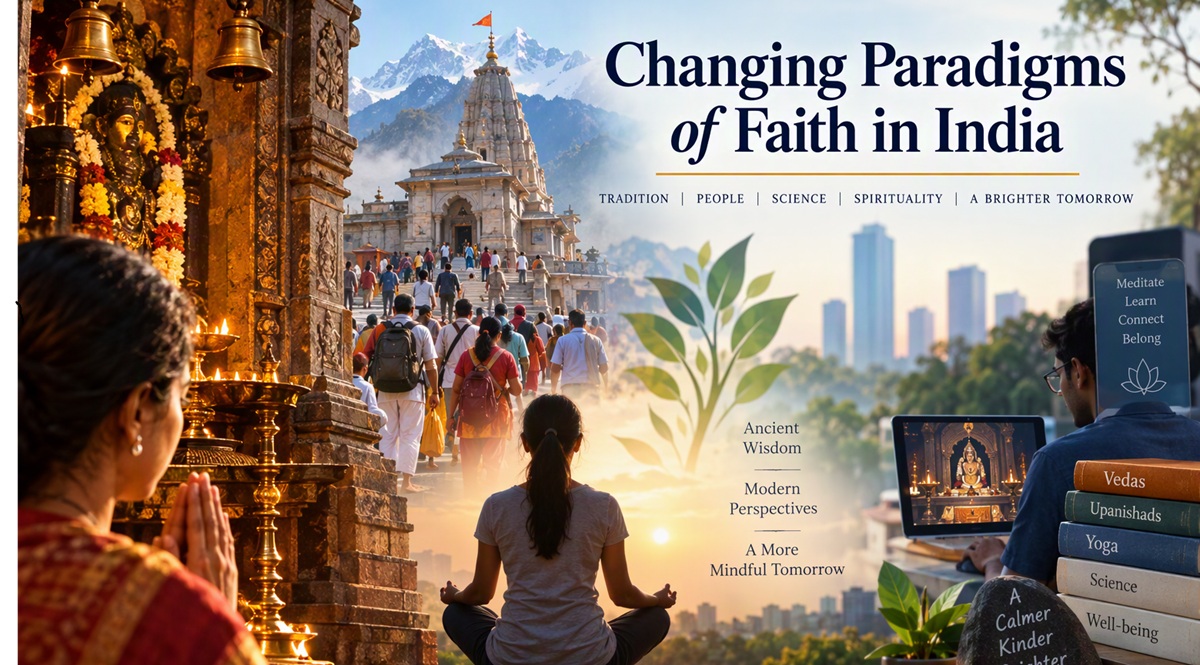
Faith in India is rarely confined to places of worship. It flows through everyday life, family traditions, festivals, pilgrimages, and an enduring search for meaning. In this essay, Dr. Meenakshi Saxena traces the evolving relationship between religiosity and spirituality in contemporary India, examining how ancient practices are being reinterpreted through the lenses of psychology, neuroscience, wellness culture, and digital technology. Readers may note that some observations discussed in the article, particularly those concerning devotees' experiences, divine energies, and lunar influences on human consciousness, remain matters of belief rather than areas of settled scientific consensus. The essay is best read as an exploration of a changing cultural landscape, where tradition, faith, and modern tools of knowledge increasingly meet each other and find the new ways of understanding belief and spiritual experience.
Changing Paradigms of Faith in India: Move Towards Spirituality
Dr. Meenakshi Saxena
Religious and spiritual practices are interwoven into the social fabric of India. Most of these practices are transmitted through oral traditions, folklore, and the acculturation processes of society. Even those with little or no formal education are familiar with various religious observances, fasts, and the rituals associated with them.
People go to temples to worship gods and goddesses. They offer prayers for the well-being of their family, community, and the country. Several rituals are performed to seek blessings, and to express gratitude for what life has given them. Many people have a pooja ghar (place for worship) in their homes. In some newly- built residential apartments, a small space is reserved where the owner could make his own pooja ghar.
Many people, including seniors, muster enough courage to visit even far-off venerated places of worship, such as Vaishno Devi, Char Dhams etc. They bear vagaries of weather, and walk on foot to have ‘darshan’, a look, at the deity.
Large number of people attend ‘satsang’, joint singing of devotional songs, and spiritual congregations to listen to the discourses by gurus and holy men. On special occasions, such as child -birth, marriage, house-warming and several others, they perform ‘Havan’ (Yagna) at home. Celebration and worship of deities at the community level is done with great pomp and show, and enthusiasm, such as Durga Pooja, Ganesh Chaturthi, Ravan Dahan, Holika Dahen, and Janmashtmi.
Regular donations to the poor and to places of worship are considered a sacred duty. ‘Bhandaras’ (community lunches) are occasionally arranged. People bow their head before God before leaving home. They follow age-old traditions about having specific foods on specific occasions, and wearing different colours, offering different flowers to worship each deity, offering of running water to the rising sun, wearing different gemstones to align with the planetary movements, among several others.
Such traditions have been the subject of ridicule. Seeing people stand in long queues to give offerings to God in the temple, and observing other rituals, one wonders as to what one gains by doing so. People also say that if God is everywhere, why go to the temple at all.
There has been a marked paradigm change in understanding such rituals. The scientific basis of many such practices is being explored through studies of the Vedas and Upanishads, as well as developments in physics, chemistry, astronomy, and human physiology.
Going to temples has been an age long tradition. Many devotees report a sense of peace, renewal, and emotional well-being after visiting temples. Temples provide seclusion, serenity, and quiet away from the noise, chaos, and distractions outside. Walking barefoot on the cool clean floor of the temple provides tactile soothing. The idols provide focussed concentration. The constant ringing of bells and chants produces synchronized auditory resonance. The use of camphor, jasmine, sandalwood and guggle in burning sticks calms down the olfactory system. Thus, the visit to temples creates a sensory reset, which produces calm.
Such experiences may contribute to physiological and psychological restoration. Prayers at the temple reduce the hormone corticoids (stress), increase oxytocin (belongingness), and serotonin (promoting concentration). They may lower the activity of the sympathetic nervous system which is the centre for emotional excitation. They deactivate the default mode network (DMN) of the brain, thus helping reduce repetitive patterns of thought associated with stress and anxiety. Surrender before God releases accumulated grief, guilt, stress, and anxiety. Thickening of brain cells after meditation, and discovery of brain areas controlling spiritual experiences are astounding findings of the day.
Besides that, visits to temples increase community feeling and satisfy the motive of affiliation. People feel that they perform their moral duty by taking forward their ancient traditions. Such visits are the means to gain social acceptability.
Ancient temples in India, built with marvellous astronomical precision, architectural sophistication, and engineering acumen, were the centres of immense positive energy, and not merely meant for worship and prayers. They were often regarded as centres of rejuvenation, contemplation, and transcendence. Some devotees even describe them metaphorically as places where one "recharges" one's physical and spiritual energies.
With deep faith in heart, an individual begins to see God as his sole saviour. Parents teach children to take the name of God when in danger, and to leave everything to Him when in a state of utter indecision. For everything ‘good’ happening to them, they attribute it to the grace of God, and for ‘bad’ to their destiny, God’s will, and Karma. They take God as their companion, and protector. In an interesting study of Covid survivors, it was found that from detection to the progression of disease and hospitalization, their faith in God kept increasing. However, when they saw their near and dear ones die, and empty beds of those who did not survive in the hospital, they expressed extreme anger and anguish against God. Yet many retained their faith despite their anguish. It was like a child angry with the mother, yet wanting to be soothed by her.
Move towards Spirituality
Earlier, the concepts of religiosity and spirituality were blurred. The latter was simply taken as penance, celibacy, and enlightenment. Considered as a domain of monks and priests, it was discussed under the paradigms of philosophy and theology.
In the modern times, spirituality has taken on a new meaning. It is connected with self-actualization, healing, and total well-being. Prominent among the spiritual practices are; meditation, mindfulness, all forms of yoga, breathing control and exercises, adhering to moral / ethical values, letting go and forgiveness, and self-introspection. Faith in higher power and the presence of divine in oneself are the key concepts. The aim is the search for meaning, and the connection between self and the divine. Notably, younger people are also being drawn to such practices in large numbers.
Information Technology is playing a significant role in this context. Ancient texts with translations are now accessible through digital formats, such as Gita GPT and conversational AI assisted scriptures. Digital prayer meetings, poojas, and ‘havans’ are performed. Even astrologers who appear daily on television advise people to hear ‘Hanuman Chalisa’ (devotional song in praise of Lord Hanuman) on phone if they are not able to memorize and sing it themselves. Devotees increasingly access virtual darshan through YouTube, Instagram, and other digital platforms.
An unprecedented boom in faith-based tourism, often referred to as ‘spiritual back packing’ is visible. Massive upsurge in pilgrimages to holy places has been recorded. ‘Bhajan clubbing’, i.e., devotional music concerts, sound healing via vibrations by using bowls and gongs, full moon meditation since the mind is highly sensitive due to the presence of moon, ‘yoga-Nidra’ (conscious deep relaxation in the yogic posture of shavasana), study of astrology, and the effect of planetary movements on human physiology and psyche are some of the techniques used to achieve spiritual well-being.
Corporates are taking these wellness programs in a big way for their employees. Meditation rooms, yoga mats, brief in-office yoga sessions, stress-management programmes, ergonomic interventions, and individual mindfulness apps such as Spirituality but Not Religiosity (SBNR) have been provided. However, they have been criticised by the employees themselves. Critics argue that such initiatives sometimes shift attention from structural workplace problems to individual resilience. Unable to manage intense work-life imbalance, the authorities are said to be trying to increase employee compliance in unfair conditions.
Spiritual awakening arises from within. Unlike some rigid religious practices, it cannot be forced on anyone. Nor can anyone be dissuaded from it, once a person starts his journey on the spiritual path.
Changing paradigms of religiosity and spirituality have brought in a subtle revolution in India and abroad. They have opened new vistas of the experience and generation of collective and personal energy, and an excellent blend of ancient wisdom with latest tools of technology. Religion is increasingly being viewed not merely as dogma but as a means of exploring the relationship between the individual, society, and the larger environment. Spirituality is the quest of universal truths, ethics, stirrings of the soul, and ultimate liberation (Moksha). The wisdom of our ancient culture is getting its due veneration in the modern times.
*******

Dr. Meenakshi Saxena retired as Associate Professor in Psychology in indraprastha College for Women, Delhi. She has worked extensively in the fields of Clinical Psychology, Child Development, Delinquency, Women's Studies, Gerontology, and Spirituality.

We are trying to create a platform where our readers will find a place to have their say on the subjects ranging from socio-political to culture and society. We do have our own views on politics and society but we expect friends from all shades-from moderate left to moderate right-to join the conversation. However, our only expectation would be that our contributors should have an abiding faith in the Constitution and in its basic tenets like freedom of speech, secularism and equality. We hope that this platform will continue to evolve and will help us understand the challenges of our fast changing times better and our role in these times.
About us | Privacy Policy | Legal Disclaimer | Contact us | Advertise with us