In his characteristic style, Amandeep Midha revisits Serbian President Aleksandar Vučić’s recent address to the UN General Assembly, where a twenty-five-year-old question was laid bare: the 1999 NATO bombing of Yugoslavia, conducted without a UN Security Council mandate. Midha’s analysis points towards a perpetual inconsistency - what happens when the very powers that invoke the “rules-based order” are asked to account for their own departures from it. This piece is not comfortable reading. It is not meant to be.
The Podium Europe Ignored: Vučić at UNGA and the Ghost of an Unlawful War
Amandeep Midha
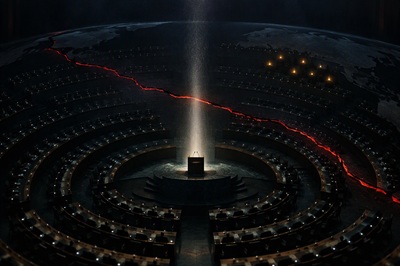
There is a particular kind of theatre that surrounds the United Nations General Assembly each September. Heads of state arrive in New York with prepared scripts and cameras pointed at them. The powerful deliver pronouncements that will dominate the news cycle. The less powerful speak into a hall that is, by tradition, half-empty.
And yet, sometimes the half-empty hall registers something historically significant, something the full-house press briefings quietly prefer to ignore.
This year, Serbian President Aleksandar Vučić took the podium and said, plainly and without diplomatic cushioning, what the rules-based international order has spent twenty-five years hoping the world would forget: NATO bombed a sovereign European nation for 78 days in 1999 without a United Nations Security Council mandate. No resolution authorised it. No legal framework sanctioned it. It happened anyway, and the campaign even struck the Chinese embassy in Belgrade, killing three Chinese journalists covering the bombardment and injuring 27 others. That is not Serbian grievance-politics. That is a fact of international law, and it is one that Beijing has not forgotten.
When the Rules-Based Order Breaks Its Own Rules
The 1999 NATO bombing campaign against the Federal Republic of Yugoslavia remains one of the most legally contested military actions in the post-Cold War era. Russia and China both made clear they would veto any UNSC resolution authorising force. NATO proceeded regardless, framing the intervention as a "humanitarian necessity," a doctrine that has no standing in the UN Charter, which reserves the use of force to self-defence (Article 51) or explicit Security Council authorisation (Chapter VII).
The International Court of Justice never fully adjudicated the legality of the campaign. NATO governments declared the matter settled. The Western press moved on. Serbia did not, and cannot. What Vučić reminded a distracted General Assembly is not merely a Balkan grievance. It is a constitutional challenge to the very architecture of international law that Europe, and particularly Brussels, now invokes as the foundation of its foreign policy identity.
If Kosovo 1999 was legal, then the UNSC mandate is optional when powerful enough coalitions disagree with it. If it was illegal, then NATO, the alliance Europe relies upon for its collective security, has a precedent of unilateral bombing on European soil that has never been formally repudiated. Europe cannot have it both ways. And it is increasingly being asked by the Global South to choose.
The Absent Audience and What It Signals
The irony of Vučić's address is structural. UNGA high-level week has become a forum where the leaders who most shape the next decade, from the emerging multipolarity of Global South economies to the leaders of nations navigating strategic non-alignment, are either absent or marginalised by a media architecture still calibrated to amplify Washington, London, Brussels, and Paris.
Those who are "important in the future," as one analyst put it bluntly, were not watching the speeches being covered on primetime. They were in the corridors. They were in the bilateral meetings that never made the front pages. They were in the phone calls that happen when cameras are pointed elsewhere.
This is precisely why Vučić's statement carries weight beyond Belgrade. It lands in an international environment where the credibility of Western-led institutions is under sustained scrutiny, not from authoritarian spoilers, but from democracies across Africa, Asia, and Latin America who watched the post-2001 sequence of interventions without UNSC mandates and drew their own conclusions.
Iraq. Libya. Kosovo. Each time, the legal architecture was bypassed. Each time, a new doctrine was improvised, humanitarian intervention, responsibility to protect, coalition of the willing, to provide political cover for what the UN Charter did not permit.
The Global South remembers this ledger. So does Belgrade.
Europe's Unfinished Reckoning
For the European Union, which has spent the better part of this decade constructing a strategic autonomy narrative, the ambition to act as a geopolitical power independent of both Washington and Moscow, the Kosovo precedent is an uncomfortable inheritance.
The EU's credibility as a rule-of-law actor is its central asset. It is what distinguishes Brussels' diplomatic posture from great-power realpolitik. And yet, the EU's founding members were either participants in, or silent endorsers of, a bombing campaign that the UN Secretary-General at the time, Kofi Annan, himself described as raising "profound questions about the future of international law."
Vučić is not asking Europe to relitigate the 1990s. He is asking Europe to acknowledge that the standard it applies to others, that military force requires multilateral legal sanction, must apply to itself. Retroactively and prospectively. This is the moment where strategic autonomy either acquires moral coherence or remains a geopolitical marketing slogan.
The Warning Inside the Bombshell
Strip away the political theatre and the pointed rhetoric, and Vučić's UNGA address contains a structural warning that European capitals would be wise to internalise: the era in which the Western alliance could bomb, intervene, and reconstruct the narrative without lasting institutional consequence is ending.
The UNSC, for all its dysfunction, is not a bureaucratic relic. It is the last multilateral forum where the legitimacy of force is formally negotiated. Its circumvention does not go unrecorded by the nations who were not invited to the decision, but who are now being invited to the table in a more plural world order.
Europe, in particular, needs to hear this clearly. Not because Serbia is owed an apology on CNN's schedule. But because the continent that suffered two world wars and built the architecture of international law from the rubble of 1945 has a deeper institutional memory, and a more consequential interest in that architecture's survival, than any temporary strategic alignment with Washington's preference for unilateral action.
NATO's 1999 campaign may have achieved its immediate humanitarian goals in contested ways. But its legal legacy is a loaded weapon that others now point back at the West every time multilateral consent is demanded from Moscow or Beijing.
Vučić fired that weapon at UNGA. Europe would be naive to pretend it didn't hear the sound.
**********

Amandeep Midha is a technologist, writer, and global speaker with over two decades of experience in digital platforms building, data streaming, and digital transformation. He has contributed thought leadership to Forbes, World Economic Forum, Horasis, and CSR Times, and actively engages in technology policy-making discussions. Based in Copenhagen, Amandeep blends deep technical expertise with a passion for social impact and storytelling.

We are trying to create a platform where our readers will find a place to have their say on the subjects ranging from socio-political to culture and society. We do have our own views on politics and society but we expect friends from all shades-from moderate left to moderate right-to join the conversation. However, our only expectation would be that our contributors should have an abiding faith in the Constitution and in its basic tenets like freedom of speech, secularism and equality. We hope that this platform will continue to evolve and will help us understand the challenges of our fast changing times better and our role in these times.
About us | Privacy Policy | Legal Disclaimer | Contact us | Advertise with us