This piece by KG Sharma hardly needs an introduction from us. At first, the thought arose that it should be published on 1 October, celebrated as Senior Citizens’ Day (International Day of Older Persons), but the poignancy of the article made waiting impossible. Read on — you will enjoy it whether you are young, old, or somewhere in between.
The Living Room Sanctuary : The Gratitude We Never Asked For
Krishan Gopal Sharma
Have you ever looked into those eyes — the eyes that seem to wait for you, yet ask for nothing in return? Not money, not gifts, not even explanations. Just you. And when you finally appear, something changes. The eyes brighten, the face softens, and for a few moments the years seem to fall away. There was a time when such moments were ordinary. We did not call them quality time. We did not schedule them, photograph them or announce them. We simply lived them. Perhaps that is why they now feel so precious.
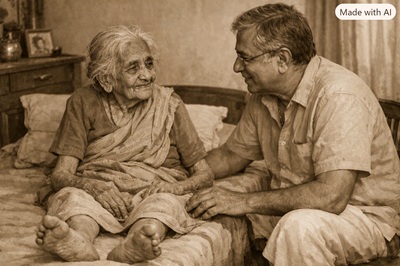
I sat across from my Maa during one of my regular weekly visits. She is ninety-two now. The afternoon was quiet, almost uneventful. We spoke little. There was no great conversation, no profound exchange of wisdom. Then, quite unexpectedly, she looked at me and whispered, “Thank you.” Just that. Thank you for coming. The words caught me completely unprepared.
A mother thanking her own child for giving her a little of his time is one of those moments that makes you uncomfortable with your own memories. How many times had she waited for me without saying so? How many afternoons had passed while I found a hundred things that seemed more urgent? I suddenly wondered whether, somewhere along the way, we had quietly reversed the natural order of things. Children once waited for their parents. Now parents wait for their children — and they wait without complaint.
The House We Carry in Memory
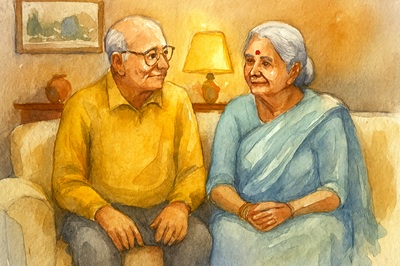
There was a time when the living room was not merely a room. It was the centre of the universe. A chair where father sat with the newspaper. A corner where mother folded clothes. Siblings drifting in and out. Someone arguing about the television programme, someone asking for tea, someone calling from another room. The familiar clatter of utensils from the kitchen. The evening light falling through the window. Nothing remarkable, really. And yet, years later, these are the things that return to us.
Memory has a strange way of preserving what we once considered ordinary. We leave home believing that the world outside is where life is waiting for us. We study, work, travel, build careers, raise families and sometimes cross oceans. We become independent, just as our parents once hoped we would. Only much later do we realise that while we were busy building lives of our own, the house we left behind was quietly becoming older. And so were the people in it.
Perhaps that is the melancholy of growing older ourselves. We begin to understand the value of things only after they have started slipping away.
The New Ritual of Being Together
Technology has made distance remarkably easy to manage. A video call can cross an ocean in seconds. A message can carry affection across time zones. A voice can arrive from thousands of miles away. We say, “I touch your feet,” from behind a screen. The words are sincere. The affection is real. But something is missing.
There is no hand to hold, no shoulder to lean against, no familiar room in which silence itself becomes conversation. No sudden smile when someone walks through the door. Technology has conquered distance, but it has not yet learnt how to replace presence.
And our parents know this. They know that the face on the screen is not the child walking into the room. Yet they accept the screen because it is what the times have given them. They smile, they bless us and they say they are fine. Perhaps we should sometimes listen more carefully to that “I am fine”. It may contain a lifetime of things they have chosen not to tell us.
The Thorn We Never See
There is an old legend about the thorn bird — a creature that seeks out the sharpest thorn and gives its final, most beautiful song upon it. The story is a myth, but the metaphor is unsettling. Parents, too, seem to acquire their own thorns. Not dramatically, and not all at once. It happens quietly.
They stop mentioning their aches because they know we are busy. They stop asking when we will visit because they do not want us to feel guilty. They learn to spend evenings alone. They become accustomed to the empty chair, the silent telephone and the long afternoon.
And perhaps the most painful part is that they do not always resent us for it. They understand. They remember being young themselves. They remember the hurry of life. They remember having parents of their own. So they forgive us before we have even realised that we need forgiveness.
That may be the most difficult thing for a child to accept.
The Guilt We Keep Postponing
There is a peculiar guilt that comes with ageing parents. It does not arrive loudly. It comes in small flashes: a missed visit, a call postponed until tomorrow, a birthday remembered late, a conversation interrupted because something “important” has come up.
And then, one day, a parent says, “Thank you for coming.”
You suddenly realise how little they had actually been asking for.
Perhaps that is what hurts most. We tell ourselves that our parents understand. They do. We tell ourselves that they are happy for us. They are. We tell ourselves that they never complain. They rarely do. But their silence should not be mistaken for the absence of need.
Their generation was taught to give without keeping accounts. We, perhaps, have become too accustomed to receiving without checking the balance.
There is a quiet irony here. We can spend hours answering messages from people we barely know, yet postpone a call to the person who knew us before we knew ourselves. We can travel thousands of miles to see places we have never seen, while putting off a visit to the person who watched us take our first steps.
It is not necessarily that we love our parents less. Perhaps we have simply become too good at postponing the things that matter most.
When the Living Room Comes Alive Again
Something happened during one of my recent visits that I will remember for a long time. I put my phone on silent. Not merely muted. Silent. For once, the outside world could wait.
Later, I sent a simple message to our family group, sharing a glimpse of the afternoon. One by one, my brothers and sisters began responding from wherever life had taken them. Messages appeared, conversations began, and there was laughter and the usual little family exchanges that had nothing particularly important to say.
And Maa changed.
For a while, the aches seemed to disappear. The frailty seemed to retreat. She became animated, interested, almost young again. She was not simply watching her children on a screen. She was watching her family come together.
For those few moments, the living room became what it had once been — the centre of our little universe.
And I understood something. Perhaps we cannot turn back the clock. But sometimes, for an hour, we can make it feel as though we have.
The Sanctuary We Must Not Take for Granted
We often speak of what our parents gave us — education, security, values, sacrifice, a place to return to. Perhaps there is one gift we rarely acknowledge. They gave us a place where we did not have to prove anything.
We could arrive tired, unsuccessful, confused, angry or broken. They would still open the door.
That kind of unconditional acceptance is becoming increasingly rare in a world where almost everything seems to have a price, a condition or an exchange attached to it. And yet, we sometimes offer our parents the leftovers of our time.
The irony is difficult to escape. We make time for meetings that could have been emails. We scroll through hundreds of messages without noticing the one person waiting for our call. We find time for holidays, celebrations and social obligations, while telling ourselves that we will visit home next week.
Perhaps this is not neglect. Perhaps it is simply the blindness of a generation perpetually rushing towards tomorrow.
But blindness does not make the consequences disappear.
Our parents are ageing while we are busy becoming.
And there is no rewind button for that.
A Small Return
The answer need not be grand. Visit. Sit beside them. Put the phone away. Ask the same story again, even if you have heard it twenty times. Look at old photographs. Let them complain about their knees, the weather, the television or the neighbour. Listen when they repeat themselves. Let the silence remain a little longer than usual.
And if brothers and sisters are scattered across cities or continents, bring them together sometimes — even if the meeting has to pass through a screen.
Because something extraordinary happens when parents see their children together. For a little while, age loses its authority. The years loosen their grip. And the person sitting quietly in the living room is no longer merely an elderly mother or father. They become the person they once were — the centre of a noisy household, surrounded by children who needed them for everything.
Perhaps that is the smallest gift we can return.
Not money. Not duty. Not even gratitude.
Just our presence.
Before the waiting room becomes an empty room. Before the voice that says “Thank you for coming” becomes a voice we would give anything to hear once more.
Somewhere in every home, there is a living room that still remembers us as children.
Perhaps we owe it to ourselves — and to those who waited for us there — to go back sometimes.
Not because they asked.
But because they no longer have the luxury of waiting forever.
*************

The writer is a retired officer of the Indian Information Service and a freelance writer. Also worked as an international media consultant with UNICEF Nigeria and contributes regularly to various publications. kgsharma1@gmail.com
(Views are personal.)

We are trying to create a platform where our readers will find a place to have their say on the subjects ranging from socio-political to culture and society. We do have our own views on politics and society but we expect friends from all shades-from moderate left to moderate right-to join the conversation. However, our only expectation would be that our contributors should have an abiding faith in the Constitution and in its basic tenets like freedom of speech, secularism and equality. We hope that this platform will continue to evolve and will help us understand the challenges of our fast changing times better and our role in these times.
About us | Privacy Policy | Legal Disclaimer | Contact us | Advertise with us