The piece below by K.G. Sharma cannot easily be termed a story. Or is it a story? No, I don't think so, because calling it a story would be a cliché. Nor is it a lecture. It does not preach what to do or what not to do. Neither does it seek to compare two lives in any conventional sense. Instead, it places before us two divergent realities that appear to have little in common except for the presence of two elderly men at the centre of them. Some readers may view it as an oversimplification of life's complexities, and they may not be entirely wrong. But then, not everything can be nuanced. Sometimes, the stark and unvarnished facts are best presented with disarming simplicity. Perhaps this is one such piece.
The Ledger and the Loaf
Krishan Gopal Sharma
The rain in New Delhi always felt like a transaction—a grey currency falling from a sky that had forgotten how to breathe.
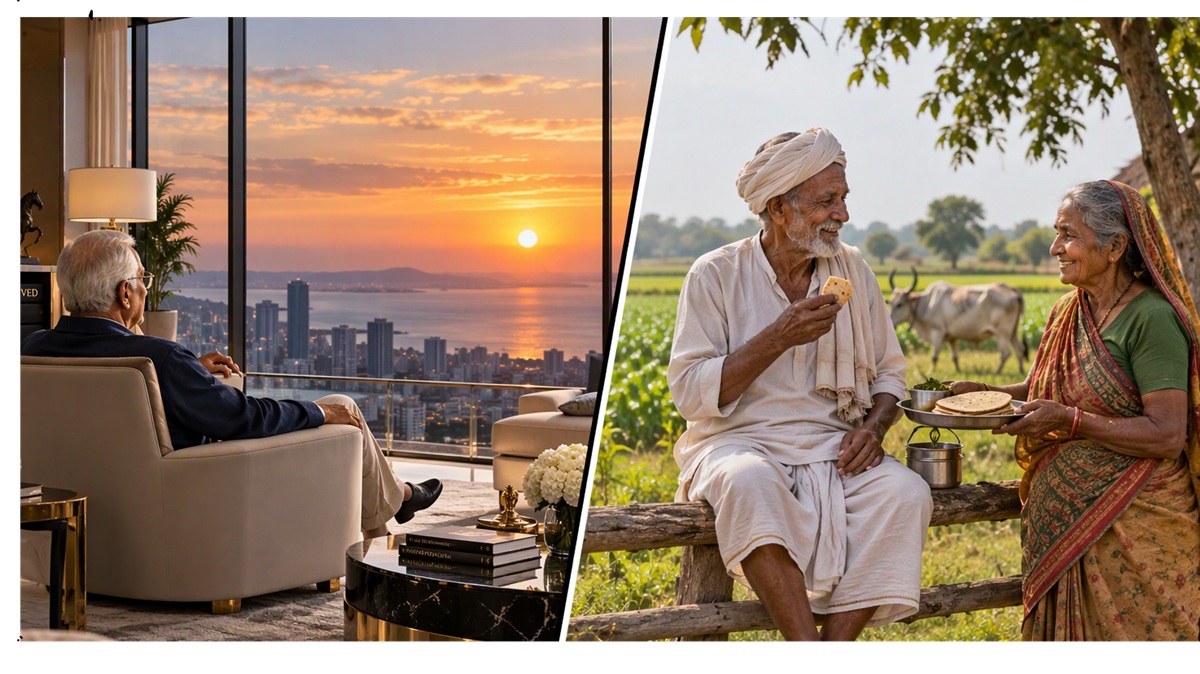
From the top floor of the glass penthouse in Lutyens' Delhi, the city below resembled an intricate, hyper-efficient circuit board: a restless grid where human existence was governed by a profound and painful duality. Down there, miniature autorickshaws and luxury cars hurried along wet tarmac, chasing schedules, numbers, and the vague promise of a comfortable future. It was a world driven by a relentless race to acquire—more assets, higher titles, greater influence. Yet inside this pinnacle of abundance, the air was conditioned to a sterile, perpetual cool, free from the heavy scent of wet earth, free from dust, and entirely free from life.
Jayawardhan sat behind a desk crafted from a single slab of imported Italian marble. He was seventy-eight, though his skin possessed the tight, waxy sheen of expensive clinical interventions that tried—and failed—to mimic youth. Beside his gold-plated fountain pen lay his midday meal: three pale, unsalted rice cakes, a small bowl of steamed, unseasoned broccoli, and an elaborate transparent plastic tray containing nine different pills. Red, yellow, blue. His daily routine was a masterpiece of biological engineering, a fixed, machine-like sequence designed to prolong his presence on earth without actually inviting him to live in it.
He reached for a capsule, his fingers slightly unsteady. As he swallowed it with a sip of alkaline water, he realised he could not remember the last time he had tasted something that made him close his eyes in genuine relish. His taste buds had not merely aged; they had been retired by a lifetime of low-sodium boundaries and defensive nutrition. He owned a portfolio of properties spanning three continents, yet his immediate universe had shrunk to the chemical margins required to keep his heart pumping. He could sit in only one luxury chair at a time, yet his mind remained too restless to enjoy it, fuelled by a perpetual undercurrent of anxiety—the fear of losing relevance, the exhaustion of the hedonic treadmill, and the poverty of time and presence.
The door opened with a soft, electronic chime. His son, Rohan, stepped into the room. Forty-five, immaculate in a bespoke charcoal suit, carrying a leather folio. He walked with the brisk, urgent stride of a man who measured his self-worth in acquisitions.
"Afternoon, Father," Rohan said, his voice smooth, professional, carefully calibrated. He stepped forward and leaned down, offering a brief, one-armed embrace.
Jayawardhan froze slightly during the contact. As Rohan's hand brushed his shoulder, a familiar toxic chill settled in his chest. He found himself subtly shifting his weight, his mind instantly racing down a path of cold arithmetic. Why is he here on a Tuesday? Is he checking my frailty? Has he spoken to the firm's lawyers about the trust restructuring? Was that hug a gesture of comfort, or was he weighing the remaining strength in my bones?
"The quarterly reports for the infrastructure fund are ready for your signature," Rohan murmured, already untying the leather strap of his folio, completely missing the hollow look in his father's eyes.
Jayawardhan felt a sudden, crushing sense of guilt. He had built Rohan in his own image. He had taught the boy that relationships were legal frameworks, that loyalty was something you guaranteed with a contract, and that emotion was a vulnerability to be hedged against. Now, in the twilight of his life, the inheritance of his ambition had come full circle. He had manufactured a family of opportunists, devoid of any raw emotional connection. He had spent his life building walls of security, yet the finest things in life—peace, contentment, connection—could not be hoarded or locked in a vault. What was old age worth if you could not even embrace your own flesh and blood without a ledger of hidden meanings being read into the silence?
Jayawardhan signed the papers without reading them. His eyes wandered past Rohan's shoulder, past the glass windows, traversing a few hundred miles across the shifting North Indian landscape, settling on a memory of a place he had only ever seen through a luxury safari vehicle window decades ago—the scorched, beautiful expanse of the Rajasthani desert.
In that dry, uncompromising earth, under a sun that burned away all illusions, lived another eighty-year-old man. A peasant.
The farmer's face was an open book, a living map of the cosmos where every deep wrinkle held the geography of a thousand sandstorms, shared laughter, and honest toil. He possessed no pension, let alone an infrastructure fund, yet he stood erect, his spine hardened by decades of bowing only to the soil and the sky. Across the material divide, scarcity had stripped away luxury, but hunger of the stomach was merely a physical crisis; hunger of the soul—the insatiable urge for more—was a spiritual one the old peasant had long laid to rest. He had mastered the rare ability to step off the track and simply enjoy what he had, recognising that true abundance is measured by how much you can afford to leave behind.
As the afternoon heat softened into amber light, the old peasant stood by the edge of his small patch of parched land. He wasn't tracking a stock index; he was watching the horizon. And then, he saw her. His wife, seventy-plus, walking along the dusty ridge, balancing a simple metal container on her head.
There was no transaction between them. No lawyers had drafted their devotion; no pre-nuptial agreements protected their assets. Their bond was the quiet legacy of shared hardship—of winters spent shivering under thin blankets and summers spent praying for a drop of rain. When she reached him, there were no calculated words. He simply sat on the warm earth, his joints aching with an honest tiredness that money could never buy. He inhabited the single moment he was given.
She unwrapped his food: a thick, coarse roti made of millet, a single cracked raw onion, a splash of thin buttermilk, a pinch of coarse salt, and a fiery paste of red chillies.
The peasant did not have a tray of nine coloured pills. He had a deep, primal hunger born of real living. He broke the heavy bread with his rough, calloused hands—hands that had never held a fountain pen but knew the weight of life. He dipped the roti into the chilli, took a bite, and felt the sharp, honest explosion of flavour hit his tongue. The buttermilk cooled the heat; the onion gave a sharp, grounding crunch. It was a sensory celebration, a pure, unadulterated joy that cost less than a single pill in Jayawardhan's tray, yet possessed a richness that millions could never purchase.
Before his next bite, the old farmer closed his eyes, pressed his palms together, and bowed his head slightly towards the vast sky. It wasn't a complex theological negotiation. It was a simple, profound surrender—a whisper of shukrana, of gratitude, for just another day of mercy, for the strength to work, and for the food before him. He carried no ego of intellect, no burden of status. It was just life, lived completely to the full in its absolute simplicity.
But the desert keeps its own accounts. Their eldest son had gone to the city years ago—Jaipur, then Pune—and the calls had grown rarer, then stopped altogether. The peasant did not speak of it. When his wife lit the evening lamp, he would sometimes look at the empty chair by the door and then look away. He had learned to hold grief the way he held water in his palms: briefly, and without complaint. The gratitude was not innocence. It was a choice he made each morning, and some mornings it was harder than others.
His mother, long gone, had a saying she repeated when the harvest failed or a child fell ill: "The hand that gives is always lighter than the hand that grips." He had never owned much, but he had always been able to open his hand.
And miles away, when the peasant's grown children came home from the nearest town—the younger ones, at least—their hands stained with the dust of their own labour, they looked at their father's cracked heels and their mother's sun-faded veil. They remembered the meals their parents had skipped so they could buy a schoolbook. When they wrapped their arms around the old man, there was no shadow in the room. No one was reading meanings into the embrace. The hug was heavy with years of mutual survival and fierce, unshakeable love. It was mathematically pure.
Back in the Delhi penthouse, Rohan gathered his signed documents, offered another rehearsed smile, and walked out. But at the door, he paused. For a moment—brief, almost imperceptible—his shoulders dropped, and he looked back at his father with an expression that belonged to a much younger man. Then the mask returned. The electronic door clicked shut with a final, mechanical snap.
Jayawardhan sat entirely alone in his perfect, climate-controlled spring. His rice cakes remained untouched. He looked down at his waxy, expensive hands and realised the terrible truth we see every single day but fail to relate to our own lives.
Like the mighty demon-king Ravana in his golden palace of Lanka, Jayawardhan had spent his entire existence accumulating wealth, building defences, and mastering his empire, only to become a prisoner of his own stakes—forever terrified of the leak from within, forever doubting the loyalty of those closest to him because everything around him was transactional. He had chosen the golden cage.
Meanwhile, the old peasant lived like Lord Rama in his forest exile—owning absolutely nothing, wearing the simplest clothes, yet entirely fearless. The peasant had nothing to lose, which meant he had everything to give. His family and his world were held together not by leverage, but by the unbreakable glue of devotion.
Jayawardhan reached out, picked up a cold piece of broccoli, and chewed it slowly. It tasted of nothing at all.
***********

The writer is a retired officer of the Indian Information Service and a freelance writer. Also worked as an international media consultant with UNICEF Nigeria and contributes regularly to various publications. kgsharma1@gmail.com

We are trying to create a platform where our readers will find a place to have their say on the subjects ranging from socio-political to culture and society. We do have our own views on politics and society but we expect friends from all shades-from moderate left to moderate right-to join the conversation. However, our only expectation would be that our contributors should have an abiding faith in the Constitution and in its basic tenets like freedom of speech, secularism and equality. We hope that this platform will continue to evolve and will help us understand the challenges of our fast changing times better and our role in these times.
About us | Privacy Policy | Legal Disclaimer | Contact us | Advertise with us