
KG Sharma writes on a wide range of subjects for our web magazine. When he is not addressing topical issues, he turns to the world of emotions, offering either a touching story or a satire rich in subtlety. Read the following piece and see how he brings alive the memory of forgotten times.
The Table That Remembered – Lessons from a Slower World
Krishan Gopal Sharma
The old teakwood clock in the corner of the veranda had been ticking for as long as Ajay could remember.
Its heavy pendulum moved with an unhurried rhythm. Tick. Tock. Tick. Tock.
It had seen the house change, watched children grow up and leave, walls being painted and old photographs slowly gathering dust. It had watched the world outside become faster and noisier.
Sometimes Ajay wondered whether the clock was measuring time at all. Perhaps it was measuring what time had taken away.
One Tuesday morning, Ajay was looking at the clock when his phone announced that another subscription had been automatically renewed. A digital invoice appeared almost immediately.
Everything had happened without a person entering the transaction. It was quick, efficient and perfectly smooth.
Ajay put the phone down.
His eyes fell on the old teakwood writing table near the window.
He ran his fingers gently across its surface.
The wood was still warm to the touch.
And suddenly, after all these years, he remembered Vishwakarmaji.
A Promise Was Enough
It was the late 1970s.
The old bazaar had narrower lanes then. Shops seemed to spill into the streets. There were bicycle bells, handcarts, the smell of spices and the occasional clang of a blacksmith's hammer.
At the far end of one such lane stood Vishwakarmaji's carpentry workshop.
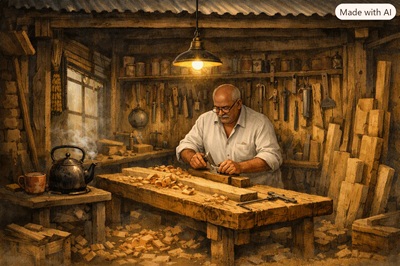
It was not much to look at. A wooden board served as its sign. Sawdust covered the floor. A few hand tools hung from the walls. There was usually a kettle of tea somewhere nearby, and the air smelled of freshly cut wood, mustard oil and resin.
To Ajay, then a schoolboy, it was a place of quiet fascination.
Vishwakarmaji was a large, gentle man with calloused hands and silver-rimmed spectacles. He spoke little. When someone spoke to him, he listened.
One day, Ajay's father took him there. The family needed a dining table.
There were no contracts to sign, no complicated quotations and no advance payment schedule.
His father explained what he wanted.
Vishwakarmaji listened, took a few measurements and made some calculations on a scrap of paper.
Then he looked at Ajay's father.
"It will be ready on Dhanteras," he said.
"And the price?"
"Five hundred rupees."
That was all.
Ajay's father nodded.
The matter was settled.
There was something almost remarkable about the simplicity of it. A man's word was enough.
The Work Had Its Own Dignity
For the next few weeks, Ajay passed the workshop almost every day on his way home from school.
Vishwakarmaji was always there.
Rain or shine.
Sometimes the shop was full of customers. Sometimes he worked alone beneath a single yellow bulb.
Ajay would stand at the entrance and watch him.
The old man never seemed to hurry.
If a piece of wood resisted the plane, he did not force it. He changed the angle. If the grain ran differently from what he had expected, he adjusted his work.
He seemed to believe that wood, like people, had to be understood before it could be shaped.
Once, Ajay asked him why he spent so much time on a part of the table that nobody would ever see.
Vishwakarmaji smiled.
"Because I will see it."
Ajay never forgot those words.
Perhaps that was professionalism before the word acquired its modern meaning.
It was not a designation, a dress code or a collection of impressive words.
It was simply the quiet belief that whatever one put one's hands to deserved to be done properly.
Dhanteras
On the morning of Dhanteras, Ajay went with his father to collect the table.
It stood in the middle of the workshop.
For a moment, neither of them spoke.
The teak had been polished until its grain seemed to have a light of its own. The joints were almost invisible. There was not a nail where one was not needed.
Ajay's father walked around it slowly.
"It is beautiful," he said.
Vishwakarmaji simply nodded.
"It should last your lifetime," he said.
Then, after a pause, he added, "Perhaps your son's too."
Ajay's father smiled.
When he opened his cloth wallet, he found that he had ₹550 with him.
He counted out five hundred rupees and placed the extra fifty on the table.
"For the good work," he said.
Vishwakarmaji gently pushed the extra note back.
"The price was five hundred."
"It's only fifty rupees."
The old man smiled.
"Then it should be easy to keep."
Ajay's father laughed.
But Vishwakarmaji did not take the extra money.
"The price we agreed upon was five hundred," he repeated. "If I take more now, the agreement changes."
There was no sermon in his voice. No attempt to teach anyone a lesson.
Just certainty.
His word had been given.
That was enough.
What Remains
Decades passed.
The bazaar changed.
The workshop disappeared.
The old shops gave way to showrooms. Handwritten bills became printed invoices and then digital receipts. Cash became cards, cards became apps, and conversations became notifications.
Ajay's father was gone now.
So was Vishwakarmaji.
The house had changed too.
But the table remained.
It had survived children doing their homework, family meals, examination results, birthday cakes, arguments, reconciliations and long evenings when someone sat alone beside the window.
There were a few scratches now. A faint mark where a hot cup had once been left too long. A tiny ink stain that no polish had ever quite removed.
Ajay had never tried to repair those marks.
They were part of its history.
He looked at the table again.
His smartphone buzzed.
Another notification.
yet another renewal.
Another transaction completed without a handshake, a conversation or even a human voice.
Ajay smiled.
There was nothing wrong with any of it.
The world had changed because it had to.
The young were not responsible for what had disappeared. They had inherited a faster world and learnt to live in it with remarkable ease. They would build things their parents and grandparents could not even have imagined.
But perhaps progress did not have to mean forgetting.
Perhaps somewhere between the speed of tomorrow and the patience of yesterday, there were still a few things worth carrying forward.
A promise.
A little honesty.
The dignity of doing a job properly.
The courage to say, this is what I agreed to do, and this is what I will do.
Ajay placed his palm on the old teakwood table.
For a fleeting moment, he imagined the smell of sawdust.
He could almost hear the hand plane moving across the wood.
And somewhere in that memory, a large man with silver-rimmed spectacles looked up from his work and smiled.
The clock in the veranda continued to tick.
Tick.
Tock.
The table did not move.
It did not need to.
It had already outlived the man who made it.
Perhaps that was Vishwakarmaji's final lesson.
Some things are not meant to keep up with time.
They are meant to remind us what is worth taking with us.
Author's Note
This is not a lament for a vanished India, nor an argument against progress. Every generation inherits a different world and learns to make its way through it.
But some values do not belong to any particular generation.
Honesty does not become obsolete. Neither does commitment, nor the quiet pride of doing something well simply because one's name is attached to it.
We may change our tools, our speed and even the language of work.
Perhaps we should not change the things that give our work — and our lives — their meaning.
Sometimes, an old wooden table is enough to remind us.
***************

Author: kgsharma1@gmail.com; The writer is a retired officer of the Indian Information Service and a freelance writer. Also worked as an international media consultant with UNICEF Nigeria and contributes regularly to various publications.
(Views are personal.)

We are trying to create a platform where our readers will find a place to have their say on the subjects ranging from socio-political to culture and society. We do have our own views on politics and society but we expect friends from all shades-from moderate left to moderate right-to join the conversation. However, our only expectation would be that our contributors should have an abiding faith in the Constitution and in its basic tenets like freedom of speech, secularism and equality. We hope that this platform will continue to evolve and will help us understand the challenges of our fast changing times better and our role in these times.
About us | Privacy Policy | Legal Disclaimer | Contact us | Advertise with us


