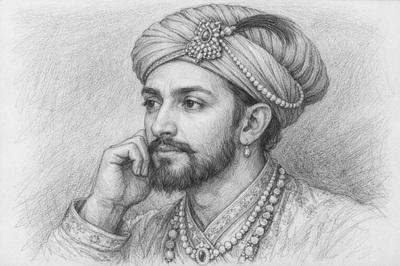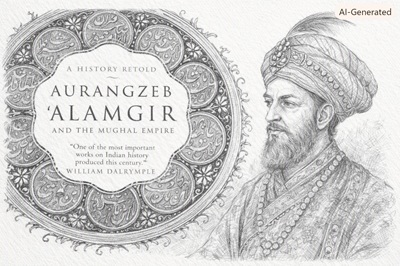
Aurangzeb remains one of the most polarizing figures in Indian history — vilified as a zealot by colonial historians and nationalist narratives, yet reconsidered by modern scholarship. In Aurangzeb ‘Alamgir and the Mughal Empire, Munis D. Faruqui draws on decades of archival research painstakingly presents a ruler of striking complexity. Sudhirendar Sharma’s review highlights how Faruqui’s use of Persian court bulletins and imperial documents unsettles long‑held assumptions and invites readers to rethink the subject.
Archival Scholarship at its Best: Aurangzeb Reconsidered
Sudhirendar Sharma
Sir Jadunath Sarkar published his magisterial History of Aurangzib in five volumes in 1924 and provided the dominant framework for understanding Aurangzeb ‘Alamgir. The sixth Mughal emperor who ruled for nearly half a century from 1658 till his death in 1707, was perceived a religious bigot who was responsible for the collapse of the Mughal Empire. Such narrative persisted with the bigot image till imperial historian Audrey Trushke dispelled it in Aurangzeb: The Man and the Myth in 2017, and found the emperor more pious than his imperial predecessors.
Given the surge of Hindu nationalism any historic re-reading in favour of the bigot emperor is strongly contested or rejected, as Aurangzeb has been foregrounded as an archetypal evil Muslim. Aurangzeb and the Mughal Empire are treated so dangerous and vile that efforts to erase it from the public consciousness have escalated. The city named after him (the city of Aurangabad is now Sambhajinagar) has been rechristened, however, suggestions that his tomb be destroyed and his body disinterred continues to evoke sectarian interests. To get a sense of the man behind the emperor, historian Munis D. Faruqui cuts across many distortions to get a balanced account in his recently published Aurangzeb ‘Alamgir and the Mughal Empire.
The book has been in the making for last thirty years, and for good reasons. It is deeply researched work that questions the early assessments of the emperor by historians. Sarkar’s views were broadly shaped by the the Hindu-Muslim tensions of the 1920s and the distaste for Muslim nationalist politics. It extended legitimacy to Aurnagzeb as a religious zealot who undid much of what the third emperor Akbar had achieved. But a revelatory assessment has found in him an emperor in contrast, referred as a zinda pir who was accepted all across. However, many continue to accept the storyline peddled by colonial-era thinkers and historians while there is an untold side to him as an emperor who strove to be just.
Curiously, both sides rely on the same evidence to reach very different conclusions. Was he a great ruler who has been unfairly vilified? Should history not matter about what it has been? Faruqui steps in to rescue Aurangzeb from both praise and condemnation, restoring him to the complexity of his life and times. Drawing on multi-volume Akhbarat, the handwritten Persian news bulletins and newsletters, Faruqui brings the granular details of the tensions at the court and rumblings inside the harems. It helps to get a nuanced understanding of how the empire worked, what influence the harem and the eunuchate had, and how the legacy of the empire was conceived, and considered for posterity.
The answer, as it emerges, is genuinely complicated. The Akhbarat is the most elaborate bureaucratic information systems available to reveal the priorties and anxieties of the imperial state. Having referred particularly to the Akhbarat-i Darbar-i Mu’alla (News of the Exalted Imperial Court) and the Dastawizat (Documents from the Mughal Era), the book has expressed despair at weaponizing of a historical figure. Such materials have either been neglected or only selectively utilised by previous writers/historians. As a result, the fixation with religiosity has helped lose sight of the far more significant insights about Aurangzeb.
Aurangzeb ‘Alamgir and the Mughal Empire insists that such fixation on religiosity and neglect of the Hindus obscured important dimensions of imperial governance. It further offers a persuasive new insights on the life and career of Aurangzeb, one of the most influential and debated kings. Such polarized views suited the colonialists, which encouraged them to portray themselves as enlightened rulers. On the contrary, the empire was managed for almost fifty years by negotiating internal rebellions and external invasions.
Rather than settling the debate over the emperor, the narrative invites a rethinking on the Mughal regime of the time. How a talented administrator and a remarkable general came to be known as a bigot? The book challenges existing writing on Aurangzeb and offers a fresh way of understanding him. It extends a much longer conversation about power, institutions, legitimacy and imperial decline within the Mughal world. Aurangzeb ‘Alamgir and the Mughal Empire reconsiders the much-studied details of Aurangzeb’s life and reign, in the hope of reviving scholarly attention to his complicated legacy. Credible archival research has painted a fresh portrait that has the potential to change how we see the most infamous of the Mughals.
Aurangzeb Alamgir
by Munis D. Faruqui
Juggernaut, New Delhi
Extent: 384, Price: Rs. 999.
******************

Sudhirendar Sharma is an independent writer, researcher and academic.

We are trying to create a platform where our readers will find a place to have their say on the subjects ranging from socio-political to culture and society. We do have our own views on politics and society but we expect friends from all shades-from moderate left to moderate right-to join the conversation. However, our only expectation would be that our contributors should have an abiding faith in the Constitution and in its basic tenets like freedom of speech, secularism and equality. We hope that this platform will continue to evolve and will help us understand the challenges of our fast changing times better and our role in these times.
About us | Privacy Policy | Legal Disclaimer | Contact us | Advertise with us