
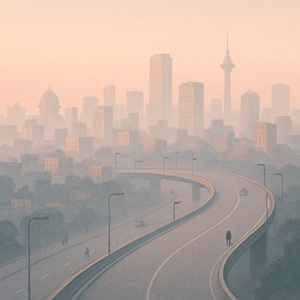
In this essay, KG Sharma seems to hold back from strong labels, yet his concerns are clear. With measured tone and tight focus, he underlines the key questions India will face in the coming year — on growth, institutions, social cohesion and climate stress.
A Quiet 2025, Harder Questions in 2026
Krishan Gopal Sharma
“Sthirata bhi ek pariksha hoti hai” — stability, too, is a test.
India’s passage through 2025 can be summed up not by what happened, but by what did not. No economic rupture, no diplomatic shock, no sweeping political upheaval. The year unfolded with almost deliberate restraint, as if the system had decided that calm itself was the objective. In a global environment marked by wars, fractured alliances and economic unease, this quiet was neither accidental nor insignificant. Yet history cautions that prolonged calm, if left unexamined, often stores questions rather than resolves them.
As the country steps into 2026, those questions are beginning to surface. The transition is less about changing direction and more about deciding whether momentum can be converted into meaning.
2025: A Year of Managed Stability
Politically, 2025 was defined by continuity. With electoral uncertainty behind it, governance operated from a position of confidence and predictability. Administrative systems appeared well‑drilled, infrastructure projects advanced steadily, and flagship initiatives moved deeper into implementation rather than remaining in perpetual launch mode. For a state long criticised for policy drift, this consistency mattered.
But continuity also produced side effects. Public debate flattened, even as institutions formally remained intact. Parliament functioned, but often without sustained deliberation. Oversight existed, yet assertiveness appeared uneven. This was not democratic breakdown, but democratic fatigue — a quieter condition, and therefore easier to ignore.
Socially, the most striking feature of 2025 was the normalisation of polarisation. Divisive rhetoric did not necessarily escalate; it simply became routine. What once shocked now blended into background noise. This dulling of public sensitivity is often more corrosive than open conflict, because it lowers the urgency for course correction.
Economic Resilience, Uneven Reality
Economically, India weathered 2025 with resilience. Growth rates held up well relative to global peers, public capital expenditure remained a key driver, and the services sector continued to provide external cushioning. Crucially, there was no balance‑of‑payments scare, no banking crisis, no runaway inflation. The absence of economic drama was itself noteworthy.
Yet beneath the aggregates lay divergence. Job creation did not keep pace with aspiration, particularly among educated youth. Informal workers remained exposed to food and fuel volatility. Rural recovery was uneven, and inequality showed little sign of narrowing. The year revealed not economic failure, but economic asymmetry — two Indias moving forward at different speeds, increasingly aware of each other.
Legislation: Reform, Speed and Symbolism
One area where 2025 did register visible activity was legislative business. Several laws aimed at administrative rationalisation, infrastructure facilitation and sectoral reform were pushed through with speed and confidence. Supporters saw this as evidence of decisiveness — a government unwilling to be paralysed by process when execution was the priority.
Yet this same speed unsettled critics. Bills were often passed with limited debate, compressed scrutiny and minimal accommodation of opposition concerns. The emphasis appeared to be on velocity rather than consensus. Alongside substantive law‑making came a continued focus on symbolic legislating — renaming schemes, institutions and historical references to align with a reimagined national narrative. For supporters, this represented long‑overdue cultural correction; for detractors, it signalled misplaced priorities amid unresolved economic and social challenges.
The result was a mixed legislative legacy: efficiency without reassurance, reform without full persuasion. Parliament legislated, but did not always deliberate — a distinction that may loom larger in retrospect.
Diplomacy Without Fireworks
If 2025 had a clear positive, it lay in foreign policy. India’s diplomacy appeared more assured, less performative. Engagements with major powers, the Global South and plurilateral forums reflected a country comfortable with its relevance. Strategic autonomy was practised pragmatically rather than proclaimed theatrically.
However, presence outpaced pay‑off. Regional leadership in South Asia remained constrained. Trade negotiations moved slowly. India’s global visibility increased, but its capacity to shape outcomes lagged its participation. The year resembled a holding pattern — important, but incomplete.
Why Quiet Can Be Deceptive
What made 2025 distinctive was not success or failure, but the absence of forcing events. No crisis compelled reform. No upheaval demanded introspection. Stability prevailed — and stability, if not periodically questioned, can harden into complacency.
This is what makes 2026 consequential. Deferred choices rarely disappear; they accumulate.
2026: From Momentum to Meaning
Expectations from 2026 are sharper precisely because excuses are fewer. With political capital intact and global goodwill largely favourable, the coming year will test whether India can deepen its growth story rather than merely extend it.
Economically, the central question will be inclusion. Manufacturing‑led employment, private investment and skill absorption must move beyond pilot successes and headline announcements. Youth employment, long discussed in abstract terms, risks becoming a tangible political pressure point. Growth that does not visibly broaden opportunity may sustain elite confidence, but it will struggle to retain social trust.
Governance and Institutional Confidence
Politically, 2026 will not be judged by decisiveness alone. The real test will be institutional confidence — the capacity of power to tolerate scrutiny without perceiving it as a threat. Strong governments often equate criticism with weakness; mature ones recognise dissent as a pressure valve.
Whether space for federal negotiation, independent regulation and civil debate expands or contracts will shape governance legitimacy far more than any single reform.
Social Cohesion and Diminishing Returns
By 2026, social polarisation may face diminishing returns. Fatigue with perpetual mobilisation is increasingly visible, particularly among urban youth focused on livelihoods rather than loyalties. Identity narratives may still energise core constituencies, but their ability to unify broader society appears to be waning.
Social cohesion, often framed as moral aspiration, is in fact a practical requirement for sustained growth and administrative stability.
The Unscripted Test: Climate and Urban Stress
Unlike politics or economics, climate stress refuses choreography. Heatwaves, water scarcity, floods and urban infrastructure strain could define 2026 in ways no policy speech anticipates. These challenges will test governance in real time, demanding adaptation rather than ambition.
A Quiet Reckoning
India enters 2026 with real strengths — scale, confidence, global relevance and improved state capacity. But strength without recalibration risks rigidity. Stability without inclusion risks erosion. Momentum without meaning eventually exhausts itself.
2025 demonstrated that India can hold steady. 2026 will reveal whether it can adjust.
As Arnold Toynbee warned, “Civilisations die not by murder, but by suicide.” India is nowhere near such a fate. Yet the warning endures: systems that mistake calm for completion often miss the moment when renewal is most possible.
India does not need spectacle in 2026. It needs honesty — about growth, governance and cohesion — and the courage to refine what works while confronting what does not. At this point, the future will be shaped less by noise, and more by choices quietly made.
**********

The author is a freelance journalist and retired officer from the Indian Information Service.
Views are personal.

We are trying to create a platform where our readers will find a place to have their say on the subjects ranging from socio-political to culture and society. We do have our own views on politics and society but we expect friends from all shades-from moderate left to moderate right-to join the conversation. However, our only expectation would be that our contributors should have an abiding faith in the Constitution and in its basic tenets like freedom of speech, secularism and equality. We hope that this platform will continue to evolve and will help us understand the challenges of our fast changing times better and our role in these times.
About us | Privacy Policy | Legal Disclaimer | Contact us | Advertise with us